
Bible study of Matthew 11-20 verse by verse
A verse-by-verse Bible study of Matthew 11–20 presents a crucial turning point, where Jesus denounces the Galilean cities of Chorazin, Bethsaida, and Capernaum for witnessing miracles yet failing to repent. He warns that pagan cities such as Tyre, Sidon, and Sodom would have repented, highlighting the great responsibility that comes with greater revelation. The passage concludes with an invitation to rest for the weary. Matthew 11 covers following Jesus. Matthew 12 addresses working on the Sabbath and judgment upon the man. Matthew 13 includes the parable of the sower, the parable of the mustard seed, the parable of the leaven (yeast), more parables by Jesus, explanations of the parables, and additional parables given to the disciples. Matthew 14 recounts the murder of John the Baptist. Matthew 15 describes Jesus’ interactions with the Pharisees and scribes. Matthew 16 presents Jesus’ teachings. Matthew 17 explores the meaning of the Messiah. Matthew 18 discusses the Kingdom of Heaven. Matthew 19:1–12 addresses marriage and divorce. Matthew 19:13–15 covers the laying on of hands. Matthew 19:16–30 focuses on following Jesus. Matthew 20 tells the parable of the laborers in the vineyard and their wages.
1-1011121314151617 181920 21-2627-28
Source: Het evangelie naar Mattheüs ISBN 9026607660; New Testament Commentary ISBN 0851511929
Matthew 11 - Following Jesus
Verse 1: Jesus has given His teachings and instructions to the disciples. Now comes the command to proclaim this throughout all Judea and to practice it.
In verses 2-3, John the Baptist is in prison (Matthew 14:3-5) because he told Herod it was wrong to have his brother's wife. John allowed his disciples to ask, "Are you the one who is to come, or should we look for another?" This doubt arises because John had preached about the Messiah Jesus as a judge (Matthew 3:7) who called for repentance over sin, not as a healer of the sick.
Verses 4-6: Jesus' answer comes from Isaiah 35:5-6: "Then the eyes of the blind shall be opened, and the ears of the deaf unstopped; then shall the lame man leap like a hart, and the tongue of the dumb sing for joy." Here, Jesus reminds John that these prophecies regarding the Messiah are being fulfilled by Him, meaning He is the Messiah. In fact, Jesus does even more than the prophecies state, as He also raises the dead.
Verses 7-8: While John's disciples return to the prison with Jesus' answer, Jesus turns to the crowds. Many were beginning to doubt John, thinking he was only a reed, a weak person now imprisoned. However, this was not the case. John had strongly called for repentance from sin, had called the Pharisees and Sadducees a brood of vipers, and had reprimanded Herod for taking his brother's wife.
Verses 9-10: Why did you go out to see John from all Judea? Yes, he preached the Kingdom of God and called for repentance from sin. Yes, he is the fulfillment of Malachi 3:1, the messenger sent to prepare the way before the Messiah.
Verse 11: John fulfilled his mission as prophet and messenger of the coming Messiah. See John 1:29: "Behold, the Lamb of God, who takes away the sin of the world!" He is the greatest of the prophets as the prophet and herald of the Messiah.
Verse 12 John has spoken of Jesus as the Messiah and the coming of the Kingdom of Heaven (God's Kingdom). This Kingdom is only for those (men of violence) who are willing to recognize their sinfulness, repent of their worldly lives, and change from serving Satan and the world to serving God. This requires violence—a conscious choice and resistance against worldly pleasures, riches, Satan, and demons—and a complete surrender to the Holy Spirit to do God's will. On the other hand, the Sanhedrin (chief priests, Pharisees, and Sadducees) seek to stop the Kingdom of God by force.
Verse 13 The prophets and the law spoke about sinful humanity, the need to acknowledge guilt, repent, and turn away from a life serving idols.
Verses 14-15 John is the prophet Elijah, who, according to Jesus, would come on the Day of the LORD (Malachi 4:5). Although the Day of the LORD is still in the future, John is a precursor. With Revelation 11:3, the two witnesses (Moses and Elijah) will fulfill Malachi 4: 5.
Verses 16-19: The children played in the marketplace and called to their playmates to join them. The children played the flute and danced, but the invited group did not want to dance. At a funeral, lamentations were sung, but another group did not want to mourn. Or perhaps it was the children who played at funerals. One group refused to be led and disrupted the games. It is clear that "this generation" refers to the Jews who lived at the time of John the Baptist and Jesus. God sent His last prophets before the end times. This generation only dictated and criticized. John the Baptist was a game breaker because he fasted, lived soberly, and called for repentance, while the Jewish community wanted to celebrate. Jesus was a game breaker because He associated with tax collectors and sinners, while the Jews and the Sanhedrin demanded strict separation. They did not want to engage with John and claimed he had an evil spirit. As for Jesus, who healed diseases and cast out demons, they accused Him of being a friend of tax collectors and sinners. Both were rejected by the Jewish people and the Sanhedrin. This generation continued to prefer remaining on the sidelines, with no participation in repentance or recognition of sin, and therefore no eternal life in Heaven. The wisdom of God is shown through John the Baptist and Jesus, and justice is demonstrated by the works of John and Jesus. Both have revealed God's plan for the world and the redemption of sin. However, these self-pleasing people have not wanted it and have rejected salvation.
Verses 20–24: Jesus begins by mentioning the cities where He performed most of His healings and miracles. Chorazin (Katzrin), possibly a city now in ruins, is located three kilometers northeast of Capernaum.
Capernaum
Bethsaida
Capernaum
Bethsaida
Located north at the mouth of the Jordan River in the Sea of Galilee, Tyre and Sidon were famous for their trade, shipping, and wealth, but also for their injustice in commerce. However, if the miracles of Jesus had occurred there, they would have quickly repented. God's judgment of Tyre and Sidon is described in Isaiah 23 and Ezekiel 26–28.
Capernaum, the city where Jesus "lived," was where He preached in the synagogue and performed many miracles. This city expected to be exalted to Heaven, but the Jews living there rejected Jesus. Therefore, their judgment will be worse than that of pagan Sodom, which had already been destroyed by God in the time of Abraham. God will judge on the Day of Judgment based on their knowledge. Sodom did not have the miracles and preaching of Jesus, but the Jews in Capernaum did, so their judgment will be much heavier.
Lesson: The people of antiquity who never heard of Jesus will be judged according to their conscience. Those who have knowledge, or could have gained knowledge by reading the Bible or examining what the Gospel means through television or the internet, will be judged more strictly by God on the Day of Judgment. People today have no excuse for lacking conscience, as the internet, television, and churches are proclaiming the good news, the Gospel, and the Kingdom of God.
Verses 24-25: After the previous verses in which Jesus pronounced His judgments on the uncooperative cities and delivered the verdict on the unbelievers, Jesus now praises His Father. "These things" refer to the liberation from sins and eternal life in Heaven.
The wise and understanding are the scholars, those who have studied, the specialists in the Torah, and the prophets—people who must know. However, their study with their own explanations leads them to disbelief and error.
The babes are the weak and poor who need healing, to repent, and to seek forgiveness for their sins. They are those who dare to acknowledge being sinners and need Jesus Christ as their Savior, recognizing that they cannot redeem themselves from God's judgment.
With a "Yes, Father," Jesus closes this prayer, for it pleases the Father that weak little children, who do not boast of their knowledge but recognize they are sinners and their need for Jesus.
Verse 27: The Father and Jesus are united in the Trinity. The Father stands above all, and He has given Jesus, through His crucifixion and salvation, all judgment and power. Through the teachings of Jesus and His way of life, God the Father becomes visible to sinful people on earth. It is the Son who determines to whom this becomes visible (at that time, only to the Jews in Judea and a single Samaritan). He is the one who chose the twelve disciples after praying with His Father.
Verses 28-30: Not the wise and understanding, but the poor and weak who are weary and burdened are those whom Jesus invites to come to Him. They are tired of the oppressive burden of the 613 rules of Jewish law—the yoke of the Torah—which brings no joy or liberation. The Torah is to be followed closely according to the wise, the scribes, and the Pharisees.
A yoke was placed on the shoulders and neck, and then the load was attached at both ends with ropes or chains, which pressed heavily on the shoulders and neck and sometimes caused intense pain. The yoke was also used for animals, such as plowing oxen.
Take the yoke of Jesus—that is, bind yourself to Jesus—the yoke of recognizing you are a sinner and understanding the true meaning of the Torah: first, love God, and second, love your neighbor as yourself, and do the will of God. Place your life under the guidance of the Holy Spirit.
Then comes rest and the peace that comes from the power of the Holy Spirit. WHO gives the power to do the will of God, to love your neighbor as yourself, and to fulfill the commandments of God. The yoke remains; however, it is accomplished by the action of the Holy Spirit in the believer. Learn from Me—my way of life, my instructions, my parables, my word, and the Bible.
Why? Because Jesus is gentle and lowly in heart. He has a humble attitude as a servant to God the Father. Jesus was meek, felt compassion for those struggling to keep the law, and showed mercy to the sick and demon-possessed. He groaned under the burden of sins.
Rest for your soul. After surrendering to Jesus (recognizing His finished work and accepting Him as your Savior) and to the Holy Spirit (who works out God's will in you), rest for your soul follows—the reconciliation with God the Father.
The yoke of Jesus is easy and light. God's will is best for you. Even under difficult circumstances, persecution, or in prison and torture because of your faith in Jesus Christ, Jesus is with you and will give you His strength.
 Back to top
Matthew 12 - Working on the Sabbath
Verses 1-2 The significance of the Sabbath for Jews at the time of Jesus, as well as today, cannot be overstated. Consider the elevators in hotels in Israel that operate automatically on the Sabbath and the fact that Jews do not light fires on the Sabbath. Exodus 35:1-3 is very clear: "These are the things which the LORD has commanded you to do. Six days shall work be done, but on the seventh day you shall have a holy sabbath of solemn rest to the LORD." Whoever does any work on it shall be put to death; "You shall kindle no fire in all your habitations on the Sabbath day." The death penalty for this was stoning. The Pharisees were watching and observing Jesus and his disciples to catch them violating the law. They watched the disciples to see if they broke the law and if Jesus allowed it without punishing them (to let them be stoned).
Verses 3-4: Jesus responds by referencing King David's violation of the law. The Pharisees are questioned about their knowledge of the law. King David was not permitted to break the law simply because he was a famous and beloved king; he was an ordinary man, and even the King of Israel was strictly forbidden to eat the bread of the Presence. The bread of the Presence was reserved only for the priests. In 1 Samuel 21:1-6, David and his men are fleeing from King Saul. They are hungry, but the priest has no bread except the bread of the Presence. The priest requires that the men be holy, meaning they have not had relations with women. This bread of the Presence is removed and replaced with fresh bread. Nevertheless, David and his men did not die after eating the forbidden bread.
Verse 5: Jesus continued his answer by referencing Numbers 28:9-10, which states that on the Sabbath, the priests offer a burnt sacrifice. In Leviticus 24:5-8, each Sabbath the priest is to bake twelve cakes and place pure frankincense on each row. Thus, the priests work on the Sabbath and kindle a fire. In John 7:22-23, circumcision also takes place on the Sabbath, yet the law is not broken by the priests.
Tois sabbatois (plural) and not to sabbaton (singular) points to every and not to a single Sabbath.
Verses 6 and 8: When King David allowed his men to eat the bread of the Presence, how much more should the Son of David, the promised Messiah, allow his disciples to pick and eat on the Sabbath? Jesus is greater than King David. Jesus is the High Priest. If a priest may violate the Sabbath, then the High Priest, Jesus, may serve on the Sabbath. The High Priest is the Lord of the Sabbath.
In verse 7, Jesus refers to Hosea 6:6: "For I desire steadfast love and not sacrifice, the knowledge of God rather than burnt offerings." God is more pleased when people love their neighbors as themselves, rather than simply bringing offerings for their sins. God takes greater delight in the knowledge of Him and the true meaning of the Torah than in burnt offerings and mere compliance with the law as interpreted by the elders. The law should be fulfilled from the heart, with love for God and for others. God does not want the suffering of the hungry; He wishes to feed people with the Bible and, indeed, with food as well.
Verse 9 Jesus continues His way and goes to the synagogue of these Pharisees.
Verse 10 of Luke 6:6 mentions that it is the right hand, the hand one uses to work. This person could not work and was condemned to begging. The Pharisees were eager to bring Jesus before the Sanhedrin (the Jewish court) to accuse Him of violating the Sabbath commandment. Hence their question: Is it lawful to heal on the Sabbath? According to their interpretation, it was lawful to save a man if there was immediate danger to life, but not in other cases.
Verses 11-12: Jesus sees the hardness of their hearts and responds with a counterquestion: Does a man not rescue a sheep if it falls into a well? In other words, is a human not worth more than an animal? Or are you hypocrites who consider property (an animal) more valuable than a human being?
With this response, their question is answered: a man is worth more than an animal, so it is permitted to do good on the Sabbath and to heal.
Verse 13: Now, something strange happens. Jesus does not say that the hand should be cured, only to stretch out the arm. Stretching out can be considered a regular act without further consequences. The man is obedient; he stretches out his arm. By his obedience, the hand is healed.
Jesus shows that He is Lord over the Sabbath, but there is more—He also shows that He is Lord over Satan and demons. The fall and Satan have brought sin into the world. The withered right hand, which made this person unable to work and caused him to suffer hunger, was the result of the power of Satan and demons. Jesus demonstrates His power over Satan and demons by healing. The man is obedient to Jesus, no longer to Satan. He is saved by his obedience and faith in Jesus, rather than by putting his confidence in the false Pharisees with their human teachings.
Verse 14 The Pharisees cling to their teachings, but they do not have the courage to bring Jesus before the Sanhedrin now because of the crowds, who rejoice in Jesus' beneficence. They desire the death of Jesus, who undermines their teachings and explanations.
Verse 15: Jesus, with His divine knowledge, is able to read minds and sees the evil intentions of the Pharisees. He leaves the synagogue, and many people follow Him. It is a strange situation: the Pharisees accuse Jesus of violating the law, while many people follow Him, and Jesus heals them all. This means that many people had no problem with Jesus healing on the Sabbath.
Verse 16: Jesus does not wish to be known as a physician. His message is one of recognizing oneself as a sinner and the need for reconciliation with God the Father.
In verses 17-18, Matthew quotes the words of the prophet Isaiah 42:1-4. Jesus is the Messiah—not the physician and liberator from the Roman yoke, but the one who frees humanity from God's punishment for sin. Jesus, referred to as "my servant," is both the servant of humanity and of God, bearing the heavy responsibility of taking on God's punishment for sin and dying on the cross. At Jesus' baptism (Matthew 3:16-17), a voice from heaven declared, "This is my beloved Son, with whom I am well pleased," and the Holy Spirit descended on Jesus in the form of a dove. In this way, Isaiah's prophecy was fulfilled.
Verse 19 shows that Jesus does not argue with the Pharisees and scribes, nor does He cry out loudly. This should serve as a lesson to believers and pastors who shout from the rooftops, in the streets, or in church, and who cry aloud in prayers. Jesus spoke in a normal tone, so He was well understood. When the message is shouted or accompanied by loud music and becomes unclear, the message is lost and Satan prevails.
Verses 20-21: Jesus came for the weak, those who were struggling, the sick, those of little faith, the tax collectors, and sinners. With love, He proclaimed the message of sin and salvation from God. After His death and resurrection, the Gospel was also brought to the Gentiles. The hope of salvation from sin and reconciliation with God was now offered not only to the Jews but also to the Gentiles. It was not just remission for the Jews but salvation for the whole world—for anyone who desires to believe in Jesus Christ as Savior and Lord.
Judgment upon the man - Matthew 12
Verse 22 Many are cured, and a demoniac was brought to Jesus, who therefore was blind and dumb. We know that through the fall, Satan has ruined the world. Demons cause diseases, such as paralysis, blindness, and not being able to speak. We must not reverse and thus say that all diseases, blindness, and paralysis are a result of possession by demons. All this is also a consequence and result of the fall and sin of man. This can be through personal sin but also through sin in the family. But also because of objects at home, which are dedicated to demons (unconscious bought on holiday, pictures of saints, Buddha images, etc.).
Jesus is Lord and has power over Satan and demons. Here He shows His power; the demonic power is extruded, resulting in a perfect liberation of the demoniac so that he spoke and saw.
Verse 23 The people see with their own eyes what is happening. They are outside themselves by surprise. How is this possible? Which power works here? Is this the promised Messiah, the son of David? But in the first place, the Jew saw the material matters, the son of David as the savior of the Roman yoke. While Jesus points to sin. Sin and giving oneself to demonic forces bring disease and misery. Jesus is coming as the Messiah, who brings redemption from Satan, demons, and diseases. Unfortunately, the people do not see this. Their expectations are different. Possibly, hence their outrage and their doubt about, "Is this the son of David?"
Verse 24 Since the death penalty was for sorcery and witchcraft, the tactic of the Pharisees is clear. The fame of Jesus with the people should be broken by accusing Him that He is the Prince of spirits, that is, He practiced sorcery. On this accusation, Jesus can be condemned to death.
Verses 25-26 Jesus answers with, "If I cast out devils, then this means that Beelzebub fights himself through Jesus." That is to say, the demons themselves are fighting against their own superior: Satan. How can Satan maintain it? Then the kingdom of Satan goes to fall through his own demons.
Verse 27 The disciples of the Pharisees also expelled demons. The question given by Jesus: By whom do they do this? Is it not by the power of God? Therefore, these students will judge the Pharisees.
Verse 28 The fact that I cast out demons by the power of God means that the Kingdom of God is coming. It is about you: whether you believe it or not, the Kingdom of God is proclaimed and is near. It is up to you. It is happening to you! Believe it or reject it. An extrusion by Beelzebub and not attributing it to the Holy Spirit is a deadly sin against the Holy Spirit (verse 31, Acts 5:1-11).
Verses 29-31 If a thief comes to rob a house and he finds the owner at home, then he must be strong enough to first tie the owner and then carry away the household from the house. Jesus must first bind Satan and the demons before He can liberate sinful men (the Holy Spirit can convince sinful man of sin). In the future, Satan and the demons are forever bound and thrown into the Lake of Fire. Then finally Jesus is Lord. Then and now the Gospel is proclaimed. The man can voluntarily choose either for Jesus and be free from the power of Satan and demons. Or against Jesus (like the Pharisees) and voluntarily surrender yourself to the power of Satan and demons and remain in the world, with as a result the judgment of God on your sin.
Verses 31-32 In spite of what the Pharisees are seeing, they harden their hearts and describe the forces of Jesus through the Holy Spirit towards Satan. There is absolutely no question of repentance. David repented of his sin of adultery and murder. Peter repented over his denial of Jesus three times. Every sinner, no matter how big his/her sin (murder, theft, adultery, fornication, abortion, curse of God or Jesus, or whatever), who repents and confesses the sin, will receive forgiveness. However, the man, who persists in his/her sin and/or curses the Holy Spirit, receives no forgiveness. Nor in this century, the century in which Jesus lived. Nor in the coming one, the century in which we live (the century after which Jesus lived).
Also think deeply about Ephesians 4:30, the grieving of the Holy Spirit (resisting recognition of sin that the Holy Spirit reveals), followed by persisting in sin in 1 Thess. 5:19, the quenching of the Holy Spirit. Hebrews 3:7; Psalms 95:7: Today, when you hear his voice, do not harden your hearts!
Verses 33-35 Fruit and tree cannot be separated from each other. It is the tree that produces fruits. The fruits need the JUICE of the tree in order to be able to grow. What comes out of the mouth is what is in your heart. The mouth reveals what lives in the inner man. By the actions of a man, a believer, one recognizes his/her walk with Jesus Christ. Or Jesus Christ is his/her Lord, and the lifestyle reveals if the Holy Spirit controls the life of the believer, taking care of the Kingdom of God (the good tree). Shows the believer no change in his/her lifestyle, shows a materialistic life, a life in the world, a life of earthly enjoyment, then it is a bad tree. A bad tree, a believer, does not take care of his fellow man, does not read and study the Bible, does not pray, and does not love his neighbor as himself, and his evil treasure displays in evil things and selfishness.
Verses 36-37 Each person is fully responsible for what he/she is, thinks, speaks, and does. Although a man is a sinner, God has given him/her a voluntary will with which he/she can make choices and take a positive decision for Jesus Christ as Savior and Lord and voluntarily be guided by the Holy Spirit. By the power of the Holy Spirit, it is possible not to admit to sin and to resist the temptations of the world and of Satan and demons.
Of each word an infidel or a believer or spiritual leader or politician speaks, he/she will be accountable to God. Has he/she been a witness of the words of God, or has he/she given a false explanation or disrespected God's laws and commandments? On the day of judgment for the infidels, see Revelation 20:11-15. But also the believer is not free of judgment; the believer will appear before the judgment seat of Christ (2 Corinthians 5:10) and will be assessed on his/her work and words (1 Cor. 3:12-15).
Verse 38 The scribes were the Torah experts, the rabbis, who were valid as professionals in the question of Scripture. According to P. Bonnard, they said, "If THOU do not want us to speak bad about you—and your words (Mat. 12:25-37) show that you will think that we do—let us see a sign that proves your Messiahship."
The sign (Sèmeion) is more than the general wonder (dunamis); it must be a divine legitimacy.
Verses 49-40 Jesus rejects this resolutely. An adulterous generation: Israel was seen as the Bride of God. Because of the killing of the prophets and the disbelief in John the Baptist and Jesus, Jesus calls it adultery. An infidelity to the marido, to God.
Jona remained for three days and three nights in the belly of a great fish (Jonah 1:17). This statement was very well understood by the Pharisees and scribes and used in Mat. 27:63. The heart of the earth was considered as staying for the dead until the resurrection of the dead, Hades.
Verses 41-42 The men of Nineveh, pagans, have converted from their evil deeds upon the sermon of Jonah; without that, this would have been accompanied by forces and miracles. For you is standing more than Jonah, the Messiah, who, with deeds, miracles, and healings, calls to repent. And that not to the Gentiles, but to his own Jewish people, with knowledge of the Scripture. Therefore the men of Nineveh will judge you.
Also the queen of the South (Sheba, 1 Kings 10:1-10), a pagan queen, praised the God of Israel. She made a trip (of approximately 1800 km?) to Solomon. Jesus Himself came to His people. Left heaven and came to earth. Therefore, she will also judge the unbelieving Jewish people.
Verses 43-45 Jesus is going to give an example. A man with an unclean spirit (a demon) is rather expelled (by the sons of the Pharisees, Mat. 12:27), and the demon has gone to the barren places (the desert was seen as the abode of demons). But there a demon is powerless and cannot do anything. So he returns to his expelled place, man. This liberated man, however, has not taken any measures and does not believe in God; that is why his/her home is empty. The evil spirit takes another seven (a number of fullness) evil spirits with it, worse than himself, and again takes possession of the freed man. The lesson for man, who receives liberation during sermons of exorcism. The evil spirit(s) is (are) expelled, but if one does not accept Jesus Christ as a personal Savior, the house is empty. Through faith in the Lord Jesus Christ, the believer receives the Holy Spirit, and the house is inhabited by the Spirit of God, so that the demon (and no other demons) cannot make any new indwelling, because the house is already inhabited by the Holy Spirit. However, please note, the believer should continue in Jesus Christ in order that the Holy Spirit is not grieved and extinguished. Because otherwise it will be worse with that man than in the beginning. The believer should do the will of God and not return to a life in the world (Matthew 13 and 25).
Verse 46 The names of the brothers of Jesus, that is, begotten of the father Joseph by mother Maria, are given in Matthew 13:55 (verse 56 mentions that there are also sisters).
Verse 47 Probably Jesus was in a house surrounded by the people, and the house was completely full, and therefore it was impossible for his mother and brothers to enter the house. The reason why they wish to speak, the Bible does not mention.
Verses 48-49 Jesus does not deny His mother, brothers, and sisters in the flesh. Jesus refers to His spiritual brothers and sisters, those who believe in Him as the Savior of sin AND do the will of God.
Verse 50 Please pay close attention: who are the brothers, sisters, and mother (women are not excluded; it includes the female sex: the sister and mother)? They are them, who do the will of God:
- Recognition of sin and guilt
- , recognitionof Jesus as personal Savior from sin and Lord
- Then let go of the worldly life (Gal. 5:19-21) and go on living a holy life under the control of the Holy Spirit.
- Do the will of God; see e.g., Mat. 25, 28:19; Gal. 5:22; Ef. 5:1-4, 22-26, Ef. 6:1-6, and many more other texts.
The Pharisees and scribes are blamed for saying they live according to the will of God; from their practices, it shows clearly that it is only words and they do not practice. How pious someone can sermonize, but if one looks at his daily life (sometimes full of self-interest and adultery), then a nonbeliever can have difficulty believing. Jesus' words are full of seriousness; someone who does not seriously repent, has not changed his/her life, and does not surrender himself to the Holy Spirit and live according to God's will is lost and comes under God's wrath.
Matthew 13 - Parable of the Sower
Verses 1-2: Whether Jesus left his home in Capernaum (Mat. 4:13) is not mentioned; in each case he went out of the house and sat beside the sea (the Sea of Galilee?). There he speaks to the crowds. The sea has a good effect on speaking and acts as an amplifier. No sound installation is required with the microphone and amplifier, because the sea gives this effect. In this way, Jesus could speak in a normal tone to many people.
Verses 3-9 Speaking in parables was a normal use by the rabbis. Comparing a story and education with an example from everyday life. The crowds were familiar with the use of sowing. Sowing in Israel happened in another way than with us. Here was sown before plowing. On the road was also sown, despite that the road was hardened, because this was later ploughed. On the stony places, because the stones were covered by a layer of earth, and the stones were discovered when ploughed. Between the thorns, because later on this too was ploughed.
In the parable, it concerns the futility (3/4 or 75%) and the harvest (1/4 or 25%). Percentages are just an example. Despite that many seeds are interspersed, much is lost. However, the rest of the 25% gives a great result, a hundredfold, some sixty, and some thirty. A relief for the workers of God not to lose the courage. Many may reject the Gospel, yet there is a harvest (25%), which bears MUCH fruit!
He who has ears, let him hear. The parable is obvious from everyday life; however, the spiritual significance has yet to be explained, which follows in the verses 18-23.
Verses 10-11 From Mark 4:10, it shows that also the disciples of Jesus did not understand the parable. They are amazed at the fact that Jesus speaks in parables. Jesus replied that there is only a chosen part of humans who can understand the meaning of the Kingdom of God. Man has his own responsibility. The Pharisees and scribes were among the group that could not understand the meaning; to them it was not given. Why? They had their own rules and their own interests. However, we cannot say that all of the Pharisees and scribes were lost; a few of them came to faith.
Verse 12 Man has his own responsibility. When one has come to faith in Jesus Christ, then rests upon man the task to grow. A baby (fed with milk) remains no baby; it grows to child (fed with solid food), to adolescent, to adult. So the believer should grow out of milk to solid food (Hebrews 5:12-14), from baby to adult (1 Cor. 14:20, Hebrews 5:14). Therefore, it is the responsibility of the believer to grow in knowledge of the Bible (reading the Bible daily, daily prayer, and Bible study), to grow in the knowledge of God's will, and to do this, his/her life should be more and more under the control of the Holy Spirit daily.
Verse 13 An introduction to verse 14 of the fulfillment of the prophecy of Isaiah. The Jewish people want to see the Messiah as the liberator from the Roman yoke. They were blind for a Messiah as the savior of their debt, their sins. Today man wishes a Jesus. Who brings wealth, healing, and a savior from disease and misery? And man does not wish to hear anything about guilt and sin, nothing to hear about God's laws. Today man wishes to remain living in the sinful world, with nothing to hear about a life under the control of the Holy Spirit. Nothing to hear about no sex before marriage, nothing about biblical teaching and rules.
Verses 14-15 Their hearts have grown dull, their ears have become heavy of hearing, and their eyes have closed. The Jew was aimed at accomplishing the laws, the Torah. They wanted liberation in their own strength, bringing sacrifices. Meeting the explanation according to the scribes, its own salvation is nothing by faith. Today man seeks salvation by worship of images (Buddha), saints (in the Roman Catholic Church), yoga, meditation, and acupuncture. Today man wishes to know nothing about being a sinner, that one cannot redeem himself from diseases and misery, and that one must believe in Jesus Christ as the only way to God and Jesus Christ as the Savior of the punishment for sin.
Verses 16-17 However, to those who want to come to knowledge of sin, the true meaning of the parables is given. Those who seek Jesus with an open heart are given the Kingdom of God. The prophets and righteous men (like Abraham) from the Old Testament have longed to understand the true meaning of the Messiah, the meaning of dying on the wood (= cross), and resurrection from the dead. The disciples, ye see and hear, are now receiving the education of Jesus. Jesus explains the meaning of the words spoken by the prophets. Jesus points out the sin and the need for His death on the cross. Jesus explains the meaning of the parables. They are privileged. The present believer has the privilege of having the Bible and the many Bible commentaries, which also are accessible for free on the internet. Although the believer must critically read the explanations on the internet that are in conformity with the Bible and should not be taken over without examination. There are many false prophets this century; be warned! Man is responsible for his/her faith and growth!
Verse 18 Jesus continues to explain the parable of the sower, but only to the disciples. Lesson: The man must be active to find Jesus, and then the Holy Spirit will make it clear what the Bible says and what the will of God is. The man who does not seek God does not understand, and that is his/her responsibility.
Verse 19 What falls on and along the road has no ground. It is stepped on. The one who accepts Jesus with Gloria to God, shouting Hallelujah, soon loses his faith because it has no ground. This believer has responded to a call without knowledge of the why. There is no true sense of sin. The church did not accompany them, and the church members were guilty of giving no guidance to the newborn again there. The new believer lapses into a void; there is no growth, and as a result, they are still lost for eternity.
Verses 20-21 What is sown on stony places cannot take root. When the sun rises, it withers, because without (deep) roots, it cannot take up juice (water). The one who has come to faith begins with Bible reading, but his/her busy life robs him/her of the time to read the Bible and visit church and Bible studies. Care for daily life support; let the faithful one work hard. Diseases come on his road, tribulations and misery by Islam, and the believer comes to fall and is deprived of eternal life in Heaven.
Verse 22 What falls between the thorns? The seed cannot grow because it is stifled by the thorns (weeds). Satan and demons (thorns, weeds) come and bring all kinds of temptations on the path of the believer. Wealth and prosperity and wild parties, so that the believer seeks his pleasure in the world and has no eye for the Kingdom of God. The believer stops reading the Bible, stops the brotherly love, stops giving the tithe, and looks for his/her own wealth. The wealth and pleasure on earth that only last a dozen years. And loses the eternal (millions of years) of wealth and pleasure in Heaven. They prefer the short fun and wealth on earth and have totally no eye for eternal life after death. They became fools. He/she does not bear fruit anymore and is lost forever. Denying the faith.
Verse 23 The good seed bears fruit. The believer who reads the Bible daily, follows Bible studies, brings neighborly love into practice, gives the tithe and offering with a happy and voluntary heart, and proclaims or supports the Gospel. Maintaining God's commandments and living a life full of the Holy Spirit. Who bears an example? Despite that many seeds are interspersed, much is lost. However, the rest of the 25% gives a great result, a hundredfold, some sixty, and some thirty fruits. By him/her unbelievers come to faith in Jesus Christ as their personal savior from sin. In their life, daily is visible the Kingdom of God, whereby they bear fruit.
Parable of the Sower, verses 24-25
Jesus continues with another parable about sowing. The Kingdom of God is like a man (owner) who employs sowers (slaves). This man (Jesus) orders the sowers (the believers in the Lord Jesus Christ) to sow seed (the Gospel) in the field (the world). While the owner and the sowers slept, the enemy came. How cunning and cowardly is the enemy; he waits for people to sleep. The enemy, Satan, waits until the believers are no longer on their guard and then opens the attack. Christians are tolerant and do not proclaim the truth, the Bible, or the Gospel with power. The enemy throws weeds (the original word indicates a heavily poisonous weed). How powerful is not the poison that Satan sprinkles: falsities, attacks on hetero marriage, allowing sex with children, attacks on the truths in the Bible, undoing laws and commandments, incitement to violence (violent internet games and Xbox), inciting disobedience to parents and church leaders, etc. The enemy goes away, but Satan uses the man who lives in the world as his servant. Satan is invisible to man, but his work is clearly visible.
Verse 26 The seed is coming up, and the culms of the corn become visible, but also the weeds. The seed of the Gospel proclamation becomes visible (people come to faith, some grow in faith), but also visible is the work of Satan.
Verse 27 The slaves come in amazement to the owner; had they not received good seed? It must have been a considerable amount of weeds, because normally there is always a small amount of weeds present. How typical is this not for the world, the number of weeds that is the vast number of non-believers who follow Satan and oppose the commandments of the Bible? The weeds came out: today we see the powerful poison of Satan, and more and more visible is the resistance to biblical values and norms. Freedom from sex, away with man and woman—everyone can freely choose whether he wants to be male or female or animal. Canada is a clean example of the rejection of biblical norms, and by law anyone who turns against homosexuals is put in prison. The compulsory free norms at the schools mean that parents who oppose visibility are put out of parental power, and their children are deprived.
Verse 28 He replied that it was done by a hostile man. He certainly answers, "Jesus knows the source," so the believer must also know the source of the evil one, Satan. The evil that we see today in the world (the rejection of biblical norms, drugs, the many murders, the violence, tattoos, and piercings) originates from Satan.
Verse 29 When removing the weeds, the corn can also be lost. The roots of the weeds and corn have grown together. If the weeds are pulled out, the corn is pulled, and both are lost.
Verse 30 When harvesting, the weeds and corn are harvested. Both are collected, and at the gathering place, the weeds are separated from the corn. The weeds are burned. During the final judgment (Revelation 14:14-20, 20:11-15), the angels are sent over the earth, and the weeds and the seed are gathered together and find judgment. The weeds, those who are not in the book of life, are burned; that is, they go to the lake of fire. The choirs, those whose names are in the book of life, come into the shed, the New Earth.
The harvest time is near. This century and the future century, that is, two centuries, that is, 2000 years (Matthew 12:32). We live in 2018 (the year of this comment); now it is still possible to come to faith in Jesus Christ; in a few seconds, tomorrow it may be too late. It is up to you to belong to the weeds or the seed!
Parable of the mustard seed


 , verses31-32 Mustard seed is growing luxuriantly in Israel today. It is a tiny seed (about 740 seeds in 1 gram) that grows to 3 - 4.5 meters in height. In the autumn, the many species of birds seek their shelter from the storm and shadow against the bright sun. It is small at the beginning but grows to great heights and ultimately offers great protection. How appropriate for God's Kingdom. It began small with the finished work of Jesus Christ on the cross, the dead seed. But millions of believers have come to faith in Jesus Christ, and He has grown and has eternal life for protection.
Parable of the leaven:n
Verse 33 A piece of leaven, yeast, versus a large quantity of three sizes of flour, almost 40 liters (Gen. 18:6). The small amount of yeast passes through the whole meal after being left standing overnight. The power of the Gospel is great. It began with the finished work of Jesus Christ (the yeast) and the proclamation of the gospel by the 12 apostles, with the result that it is spread over the whole earth (three measures of flour) and billions of people have brought faith in Jesus Christ.
But the yeast is also the work of the Lord Jesus Christ in the life of the believer. God's Word, God's commandments, and the Holy Spirit must penetrate deep into the life of the believer, in all areas of life, in the deeds of the believer. The deeds and works of Jesus Christ should become visible in the daily life of the believer.
More parables by Jesus ins
verses 34-35 Jesus speaks through parables to the multitudes and gives the interpretation thereof only to His disciples. Verse 35 comes from the mouth of Asaph, Psalm 78:2. Psalm 78:1-4 calls on the people of Israel to listen with the ear to the words of my mouth and doctrine (here: the mouth and teachings of Jesus), and to hear the glorious deeds of the Lord and to see the wonders.
What has been hidden since the foundation of the world? The mystery of the Church: Eternal life is not just for the Jewish people, but for the whole world. Not only for the Jew, but for everyone who wants to believe in Jesus Christ as the savior of sin. The children of Abraham are not only the natural (Jewish) children but all children through FAITH. To be the acknowledgment of being a sinner, not being able to redeem oneself, and the necessity of FAITH in Jesus Christ.
Explanation of the parables by Jesus
, verse 36The disciples did not understand the meaning of the weeds in the field and asked for an explanation. When a believer does not understand something, there is nothing wrong with asking for an explanation of a Bible text. The Holy Spirit is given to explain the Bible, but the believer must take the time and ask for an explanation in prayer.
Verses 37-40 The owner of the field: Jesus Christ is the owner of the world. He is the King of God's Kingdom (Revelation 20:1-6) and the King in the New Heaven and New Earth (Revelation 21:1-7).
The good seed are the children of God's Kingdom: all believers in Jesus Christ, who have put their lives under the control of the Holy Spirit.
The weeds are the children of Satan who rejected Jesus Christ as Savior. The enemy is the enemy of Jesus Christ, all demons, and Satan.
The end of the world, see Revelation 14, 16-18, 19:17-21, 20:11-15. The reapers are the angels in Revelation 14:15-16 and Matt. 24:31.
Verses 41-42 refer to Revelation 20: 13-15.
Verse 43 The righteous are the believers in Jesus Christ, who have put their lives under the control of the Holy Spirit. They will shine in the kingdom of their Father, for they are the priests in the kingdom (1 Peter 2:5, 9; Revelation 1:6).
More parables by Jesus to the disciples:s
Now there is a continuation of parables only to the disciples.
Verses 43-44 Because of burglars and wars, it was a custom to bury precious possessions and not to keep them in the house. If the person died, the wife and children often did not know where the treasure was buried. Here is a man who finds a treasure hidden in a field by chance. If he was a slave, a tenant, or a poor day laborer, that is not mentioned, but he was not the owner. In order to get hold of the found treasure, he first had to become the rightful owner of the field. That is why he sells everything he has to buy the field and get the rightful possession of the treasure. And so it is with the life of a person who, by chance, discovers Jesus Christ as the Saviour of sin. In order to come into possession of the remission of sin and eternal life in Heaven, the person first has to sell everything. His sinful life, giving up life in the world to obtain the treasure, eternal life in Heaven. How many are prepared for this? Many discover the treasure, the redemption through Jesus Christ, but do not sell all they possess and continue to live in the world; they belong to the foolish virgins (Matthew 25:1-13) and do not obtain the treasure and lose eternal life.
Verses 45-46 Here is a wealthy person, a merchant. He could have been a merchant in all kinds of goods, but with a special interest in pearls. Pearls were valid and counted as valuable possessions. Pearls came from the Persian Gulf or from the Indian Ocean and were extremely expensive, far exceeding the average person's ability. He also sold everything he owned (including all the other pearls he already owned) to get hold of that one pearl.
Can we compare this with a person who is interested in religions? Consciously looking for redemption from sin? Someone who visits the church? But once Jesus Christ discovers he is the Savior of sin, he gives up everything, follows worldly life and sinful life, and puts his life under the control of the Holy Spirit to the wise virgins (Matthew 25:1-13) to obtain the precious pearl, eternal life in Heaven.
Verses 47-48 Here too the main theme is the same: only on the day of the judgment a separation is made between unbelievers and believers. Until then, both live together in the sinful world. And the unbeliever has the chance to come to faith and to come into possession of the true treasure. Until the day of the judgment (our death), we live in the field or in one network.
The fishermen leave the trawl in the sea and pull it on. The gospel is lowered and drawn into the sea (proclaimed throughout the world). When the net is full of fish (the gospel is proclaimed all over the earth), the net is drawn to the shore, where the separation takes place between the good fish and the useless fish and other objects. The saleable fish was put in barrels. The day of judgment is reached when the completeness of believers is reached. Then the separation takes place between the believers (the good fishes) and the unbelievers (the faulty ones: in the world believers and unbelievers lived).
Verses 49-50; see commentary on verse 40. It is not the people, believers, who judge whether someone goes to Heaven. It is the angels who, by order of Jesus Christ, make the separation between good and bad, whether or not eternal life in Heaven. It is up to the believer to preach the gospel, not the judgment.
Verse 51 Jesus asks His disciples whether they have understood ALL of this and gives them the opportunity to ask questions. All this can refer to the special to the disciples (verses 44-50) or all similarities (verses 1-50), but that is of no importance. The question is, HAVE THEY UNDERSTOOD EVERYTHING? The answer of the disciples is simple: YES. How is it with the believer? Does he or she understand EVERYTHING that Jesus Christ and the Bible teach? Or do you have to go back to Jesus and say, "Please explain it to me because I do not understand"?
Verse 52: A scribe is a person with thorough knowledge and training in the Old Testament, the law, and the Torah. A scribe was able to govern his household (1 Timothy 3:1-7) and teach Scripture. A disciple of the Kingdom of Heaven is a disciple of Jesus, who has obtained new knowledge and an explanation of the Old Testament. Not by law and Torah does one obtain eternal life in Heaven, but through acknowledgment of sin and FAITH in Jesus Christ. The old things are the education of the law; the new things are the preservation by faith. The old cannot do without the new one. There is no new if there is not an old first. First the law had to come to the realization of sin, and after knowledge of the Old Testament, only the New One can follow: salvation through the death and resurrection of Jesus Christ through faith.
Verses 53-54 Jesus leaves Capernaum and goes to His father's city, Nazareth. Here Jesus continues His teaching in the synagogue. Those present in the synagogue are amazed at His teachings, knowledge, and powers.
Verses 55-56 In His hometown of Nazareth, Jesus grew up (Luke 4:16, where He was brought up), where He lived for about 27 years (first rejoiced in Egypt), and people know Him as a carpenter (Mark 6:3) and the son of the carpenter Joseph. A carpenter was usually a person who learned the trade from his father and had little education. The people are amazed at the great Scripture of Jesus, His explanation, and the miracles that He does.
Brother James: The Letter of James. Brother Judas: The Letter of Judas.
The brothers and sisters of Mother Mary and the husband of Mary: Joseph. Jesus was begotten by the Holy Spirit by His mother, Mary, and not by her husband, Joseph.
Verses 57-58 The prophets of the Old Testament were rejected, not believed, and killed. The father city and the prophet's own house: the Jews and Israelites. Jesus did not do many miracles in His own city because He did not want to because of their stubborn disbelief.
Matthew 14 - The murder of John the Baptist
Verses 1, 3-5 From Matthew 2:13 is known the enmity of Herod the Great; now it's his son Herod Antipas. Born about 22 BC, at the death of his father in 4 BC, he had not retrieved the title of king over Galilee from Emperor Augustus but only the title of tetrarch. With this he was a little one of Rome, depending on the monarch. In 26 Pontius Pilate came to power and remained until 36. Herod Antipas was married to the wife of his half-brother Herod II. A commitment in such a degree of consanguinity was, according to Jewish standards, forbidden (Lev. 18:16). John the Baptist had reproached this fact to Herod; for that reason, he had put him into prison. Out of fear for the Jewish people, he did not dare to bring John to death.
In verse 2, Herod said to his servants that Jesus is John the Baptist resurrected from the dead. Verses 3 to 12 indicate the reason.
Verse 6 On the birthday of Herod, the daughter Salome dances. This is already an error of Herod, for this party was exclusively intended for men (see Esther 1:9-12).
Verse 7 The second mistake of Herod is a promise under oath, which she would ask.
Verse 8 His wife, Herodias, had all too well understood the words of John the Baptist. She had no fear of the Jewish people and now saw her chance to kill John the Baptist. She and her husband had no scruples.
Verse 9 The King, although not named as such by Rome, was seen as king by the Jewish people and is now asked something that he desired in his heart but was afraid of because of the people. However, now he has no choice; he has given his oath in the presence of high officials, whatever the girl (maybe 18 years old) would ask.
Verses 10-11: John was beheaded. The head was shown to the attendees of the birthday party of Herod, and then the girl showed it to her mother. What a horror, a birthday party was no happy event anymore for the high attendees. What the response of the high attendees was, the Bible does not state. Maybe they are disgusted and run away.
Verse 12 How the disciples of John the Baptist came to know of his death and into the possession of his body, the Bible does not mention. We do know that John's disciples were free to visit him in prison. They buried him and told it to Jesus.
Verses 13-14: Jesus, with his human character, is shocked about the cruel murder of John the Baptist. He wishes to be alone and pulls back from the crowds and goes with his disciples by ship to a lonely small town, Betsaida (Luke 9:10). Possibly Jesus needed time to rest in order to grieve about the murder of John.
However, the crowds heard this and went on foot through the rugged environment and reached Betsaida earlier than Jesus. Jesus came from the ship and saw these large crowds. Jesus was moved with compassion and continued with curing their sick. He put His own distress aside and continued to provide for the needs of these people. How is this with the believer and the church? When one is in grief and need, we put that aside? And we are going to meet the need of the man. Does that appeal to us?
Verse 15 The disciples are aware that they are unable to feed these large crowds (five thousand men, verse 21) financially (two hundred denarii is not enough, John 6:7); they have the possibility. Probably the time had already passed to buy food in the villages. This lonely place was remote, and these large crowds had therefore to be sent away to the various villages to provide food. A single village could possibly not provide food for five thousand men with women and children.
Verse 16 Now Jesus put to the test the faith of his disciples. He commands them: YOU give them to eat. The command is: you, my disciples, you guys, give them to eat. The task of every believer is to give the food of the Gospel, the true and real living bread that gives eternal life.
Verse 17 John 6:9 The investigation learns that there is a boy who has five barley loaves and two fishes. With barley loaves, we need to think in the form of pancakes. Insufficient to feed all people.
In verses 18-19, Jesus ordered, "Bring to Me these five barley loaves and two fishes." And let the people sit down on the grass in groups of fifty and one hundred (Mark 6:39-40).
According to Jewish customs, Jesus thanked and blessed. But added: He looked up to the sky (the sky where His Father lives). A Jewish househusband thanked before and after the meal with the words "Praised are Thu, YAHWEH our God, King of the world," after which the bread was broken into pieces.
It is Jesus who breaks and multiplies the bread and the fish (the source, the finished work on the cross). It is the disciples who hand out, and it is the believers who hand out the Gospel and proclaim it to all the people in the world (the crowds).
Verse 20 It is not a lousy meal; EVERYONE gets ENOUGH for their needs. The finished work of Jesus Christ on the cross is sufficient and gives eternal life; it is enough for always and forever; it gives abundance. The disciples, in accordance with Jewish custom, collected the surplus, as it was forbidden to throw away food, and it reached up to twelve baskets full of surplus.
Verse 21 According to Jewish custom, only the men counted. Since one was sitting in groups of fifty and a hundred, counting was easy. But the bread and the fish were not only for the men but ALSO for the women and children. The Gospel is not just to be heard by men; women and children are ALSO embedded in order to hear the Gospel and to participate in the Kingdom of God.
Verse 22: Jesus has shown by feeding the complete crowds that He is the true Prophet, the Messiah. Moses "gave" the manna to the people, Exodus 16:11-16. Elijah and the widow were provided with food and drink (1 Kings 17:2-1). 6. Elisha gives food to the hundred men, II Kings 4:42-44. However, the time of His reign, being the Messiah, has not yet come; therefore, Jesus sends the crowds away before the crowds make Him king by force (John 6:15).
In verse 23, Jesus has provided for the crowds; now it is His time to process the murder of John and be alone. Jesus needed His interrelation with His Father through prayer. Similarly, the believer: the power of Jesus, praying in silence and solitude. A personal conversation with Jesus, the power source for every believer who seeks Him.

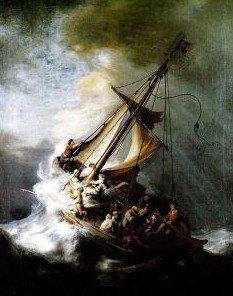 Verse 24 The wind was blowing in the opposite direction so that the disciples were making no progress. The disciples were en route by sea to Capernaum and about 25 to 30 furlongs (approximately 3 miles) away.
Verse 25 In the fourth watch, which is between 3 and 6 hours in the night, Jesus has finished His prayer. He was no doubt praying for the disciples, knowing that they are in need and under the storm. He comes to physically help the disciples. He is lord and master over the weather elements, sea, and storm. He walked on the sea, the divine nature of Jesus; He is the Son of God.
Verse 26 Possibly the disciples have recognized Jesus, but a man cannot walk on the sea, let alone on storming waves. After the miraculous feeding, they have not yet come to see that Jesus is the Son of God. Full of bewilderment, they shout out, "It is a ghost." Fear gave birth to them as it stormed, and now they see a ghost, a demon who wants to do harm.
Verse 27 Immediately Jesus comforted them with the words, "Take heart, it is I; have no fear."
Verse 28 Peter, as well as the others, is afraid but asks, "If it is your command and if it is you, then let me walk on the water." The lesson for the believer: First, be sure that it is Jesus who speaks to you. Secondly, wait until Jesus instructs/orders you. Not going in on your own strength, but waiting for Jesus' command.
Verses 29-30 Peter waits until Jesus says, "Come!" In faith Peter gets out of the boat on the stormy waves of the sea. Probably with his eyes looking at Jesus. But then Peter hears the sound of the storm and the raging waves and sees the impossibility of his walk on the sea. He loses his gaze on Jesus, and fear envelops him, and consequently, he fears and sinks. And he cries out to Jesus, Lord, save me.
The believer can go in command of Jesus, and everything is going well as long as the believer continues to rely on Jesus and not look at the conditions and the attacks of Satan and demons (the raging storm; "Your adversary the devil prowls around like a roaring lion, seeking someone to devour," 1 Peter 5:8).
Verse 31, "O man of little faith," does not mean "small of faith" but rather "at the moment when it comes to heart, not able to rely completely on Jesus." Doubt splits Peter's faith and makes him a "man of little faith. "Is a man responsible for this kind of doubt? Dr. Nielsen believes that this is not the case. According to him, man is guilty who doubts the power of Jesus, which, here in Peter's case, in his opinion, he did not.
Jesus asks for the cause of the doubt of Peter. The reason is given in verse 30: he saw on the wind. In short: he saw the difficult conditions.
Verse 32 Jesus reached out His hand, and Peter was saved, and together they climbed on board the ship. At the same time, the wind and the storm cease. Jesus has power over elements of nature; Jesus has power over Satan and demons.
Verse 33 Everyone in the ship comes to the understanding: Jesus needs to be the Son of God.
Verse 34 The storm is over, and the ship with the disciples sails under calm conditions and continues to Gennesaret.
Verses 35-36 The people on the land must have noticed the sudden silence of the storm and sea. Jesus is recognized when He steps out of the boat. Undoubtedly the disciples told what happened, and people recognized the power of Jesus. With the result that one brings the sick and asks in faith that they only might touch the fringe of his garment so that they are healed by faith.
Matthew 15 — Jesus and the Pharisees and scribes
Verse 1: Pharisees and scribes from Jerusalem. Why? That we do not know, it is possible to reinforce the local Pharisees and scribes. Or was it to take note of the teachings of Jesus?
Verse 2 The tradition of the ancients had taken a major role in Jewish life. It was seen as an equal obligation, equal to the Torah, the laws of God. Even so far, the tradition of the ancients was more major than the commandments of God.
It is true that God demands holiness. Some examples are the baths of the priest before he carried out certain services (Ex. 30:17-21, Lev. 15:5-27). But God's commandments of washing are not for everyone and before every meal. That was a pure interpretation by the ancients. Through the Babylonian exile, the Jewish people become aware of the need to maintain God's commandments. The priests Ezra and Nehemiah taught the people in Israel after they returned. Then started the explanation by the ancients, which, through oral tradition (rehearsed by the student of the teacher/scholar), was continued by the Pharisees and scribes until, in 200 AD, these explanations by the ancients were put in writing in the Mishna by Rabbi Jehuda. The explanations in the Mishna were arranged in 6 commandments: Seeds, parties, women, damage (or wounds), holy things, and washing. Each commandment had chapters and paragraphs. In cleaning was a commandment concerning washing of hands. Pouring twice, each time approximately 0.14 liters of clean pure water that had not been used anywhere else. One had to use a can or jar; the hollow hand was forbidden. The first time, the water removes the uncleanness of the hand and is then itself unclean. The second time, it cleans the hand. The fingers should be kept up so that the hand up to the wrist was cleaned.
Verse 3 The Pharisees and scribes referred to the ritual washing of the hands, not to the ordinary washing of hands before meals. If the disciples had dirty hands, we do not know. The accusation is not performing the ritual, the human tradition. At that time, one was still not familiar with bacteria that can cause infections.
Jesus comes with a counterquestion. With this, it becomes clear that the Pharisees and scribes put their oral tradition above the written Torah.
Verse 4 In the example, Jesus points to the fifth commandment of the 10 commandments (Ex. 20:12), "Honor thy father and thy mother," and (Ex. 21:17), "He who curses father or mother, he will die."
Honoring father and mother is more than obedience. It is the inner attitude of the child against the parents. And excludes all selfish obedience or obedience under compulsion. Love means honor, respect, and awe for father and mother.
Verses 5-6 In the days of Jesus, there was no social security. Mothers and fathers at age were dependent on their children for their maintenance and care in case of illness. The tradition of the ancients, however, allowed that a child declare his property as a sacrifice and thereby be exempted from the care of his parents. Hereby God's commandments were inactivated, and the tradition of the eldest was put above the laws of God. And God's commandment to love your neighbor as yourself, out of action.
Verses 7-9 Jesus calls the Pharisees and scribes hypocrites because their practices were going against God's commandments. It was outer appearance and piety; however, their hearts were far from God. The core of Jesus' criticism is to do what allows the tradition of the ancients and thus exempts God's commandments. Jesus refers to Isaiah 29:13. Because these people (here the Pharisees and scribes) draw near with their mouths and honor me with their lips, while their hearts are far from me, and their fear of me is a commandment of men learned by rote. Lip service is worthless and dangerous. It gives the appearance of piety, but the heart can be far away from God.
How often people are not deceived by the outward piety of Christians: shouting Hallelujah, speaking in tongues, exorcism of demons, long and noisy (many decibels, so hard that the environment even complains, and the church members are deaf) worship services to praise and worship God. Also think of the deception of rock gospel. Under the guise of the youth liking rock music, this is a means to appeal to the youth and proclaim to them the Gospel. However, if one listens carefully to the loud music (and sometimes thereby gives inaudible) and song text, then one hears the source. The rock gospel musicians using drugs, practicing free sex, etc., give enough indication of the wrong source. That has little to do with the Gospel.
Verses 10-11 Jesus calls the people. Possibly, the people were at a distance out of respect for the Pharisees and scribes who were close to Jesus. Jesus continues with the contrast between clean and unclean by the Pharisees and scribes. Not the uncleanness of the world makes man unclean; on the contrary, what comes from the heart—the wrong intents and what is spoken by mouth (curses, lies, and words that hurt)—in short, what comes from the heart. Clean and unclean are not outward concepts but the inner attitude of man towards God and fellow man. The love for God and neighbor.
Verse 12 The disciples are shocked. Jesus points openly out to the Pharisees and scribes in the near presence of the people. Jesus openly points to the false interpretation of the ancients and thus undermines their authority. No wonder these scholars take offense to the teachings of Jesus.
Verse 13 The Jewish people were seen as a plant (Isaiah 5:1, vineyard; Jeremiah 45:4). Whatever the Lord planted. They saw themselves as a people of God forever, regardless of their way of life.
Verse 14 Jesus compares the Pharisees and scribes with the blind. They are blind to the interpretations and teachings of Jesus. If two blind lead each other, they do not see the well in front of them and both fall in. The people reject the teachings of Jesus and are guided by the Jewish teachers and their explanations; they are blind and do not inherit the Kingdom of God.
Similarly, presently those who are guided by church leaders with liberal interpretations and declare that parts of the Bible are not valid for this time, or say, "But that is not the meaning in the Bible," leaders who give false biblical interpretations, whose hearts are not God-centered, will fall into the pit, the lake of fire.
Verses 15-16 Also the disciples live in incomprehension. Peter, as spokesperson for the disciples, asks for explanations. Jesus is amazed at the lack of understanding of his disciples. That the Pharisees and scribes are blinded by their own learning is not surprising, but the disciples were already for a long time with Jesus and aware of his explanation and education; they had to know better.
Verse 17 Everything that enters into the mouth enters into the abdomen (digestive system). There it is digested and rendered harmless. And the digested food is excreted through the anus (so it passes on).
Verses 18-19 What is spoken by the mouth (which lives deep inside the heart)—that is what lives in man. It can be words of (neighborly) love and compassion, mercy, true praise and worship of God, intercession, etc. But also unclean angry words—a summary of the sixth, seventh, and eighth commandments follows: lies and defamation.
Verse 20 Not eating with unwashed hands, the ritual washing, or the regular wash, which makes man unclean. Many bacteria are rendered harmless by digestion. They are not unclean. However, what comes from the angry heart is pronounced through the mouth (and also through deeds), which makes the man unclean.
Verses 21-22 Jesus leaves the Jewish area and pulls back to the Canaanite area. Here is a stark contrast: the Jews who do not believe, in contrast to the pagan Canaanite woman who believes. Her faith is evident from the words "Lord" and "Son of David"; it recognizes and believes that Jesus is the promised Messiah.
She is desperate because her daughter is possessed by demons and appeals to the compassion of Jesus. She knows that Jesus can heal and is determined to obtain this by Jesus; she does not give up.
Verse 23 Jesus acts as if He did not hear her and tests her determination. The disciples are seeing a non-Jewish woman, and they are annoyed by her determination and cries. With the result that they, the disciples of Jesus, wish Him to send her away. Please pay attention; here it appears that the disciples recognize Jesus as Lord and Master, because they ask Jesus to send her away; the disciples do not send her away. Maybe the woman did not listen to the disciples, and the disciples were forced to ask it to Jesus. The disciples show no compassion for this woman and her daughter. How is the believer when he is called upon?
Verse 24 Jesus gives no attention to the ruthless call of the disciples to send the woman away. He appeals to the woman and mother. Indeed, Jesus had come to earth for the lost Jewish people, the House of Israel; that was His first mission. Only later, after His death, would the Gospel come to the Gentiles.
Verse 25 The woman falls onto her knees out of respect for Jesus (how is our prayer attitude?) and asks, "Lord, help me!" NOT help my daughter, but help me. The mother unites herself as one with her sick daughter.
Verse 26 Jesus replies that He is sent to the House of Israel (the children's bread) and has not come to the Gentiles (the dogs). The dogs in the sense of a pet and not in the sense of the lacerating street dogs. Jesus heals not immediately but lets the woman wait, testing her faith and determination. We see this back to Abraham and Sarah, who had to wait for many years for their promised son. Zechariah and his wife prayed for years and only in old age received their son, John the Baptist. Lazarus, who first had to die of his disease in order to be resurrected from the dead. Everything happens as God wants, and only at His time. Also think of the slavery of the Israelites and their stay of 430 years in Egypt, and only their exodus occurred after the ten plagues.
Verse 27 The pet was eating the crumbs off the table and had no equal right like the children of the house.
The woman remains humble, despite that she was compared with a pet. She accepts the equation. However, she does not lead away from her request. After all, the pets also eat what falls from the table. So they share in the food. Therefore, it is why I might share in the grace that is destined for the Jewish people. On those grounds, you may, Lord Jesus, help me. She gives arguments to Jesus on the basis on which He might help her.
In prayer, does the believer only ask, or does the believer also state the grounds upon which Jesus has to help, biblical texts, and clear grounds?
Verse 28 The result of the persistent faith is rewarded by Jesus. The pagan woman shows determined faith, opposite to the disbelief in Israel. Jesus praises her faith and awards her request; her daughter is cured immediately. What a lesson for the disciples, who showed their disbelief often enough; think of the storm on the lake after the miraculous feeding.
For verses 29-39, see the comment on Matthew 14:13-21.
At the first miraculous feeding, there were twelve baskets over of chunks. These twelve could be an allusion to the twelve tribes of Israel. After the pagan woman (unclean: pagan and woman) comes the second miraculous feeding with seven months remaining of chunks. Seven, the number of fullness: the Gospel is not only for the people of Israel (the pure), but there is also sufficient for the (unclean) Gentiles. There needs to be no hunger for Israelites and gentiles. Eternal life is available for everyone who wants to believe.
Matthew 16 — Jesus' teachings
Verse 1 The Pharisees and Sadducees were two Jewish groups that were each other's opponents due to their different interpretations of the Torah. But now they are united to overturn their common enemy, Jesus, in front of the people by requesting a sign from heaven. The healings and the miraculous nourishment they wrote of were as earthy as those of Beelzebub (of the devil). They demanded a sign like Moses, who "left raining manna from the sky" (Ex. 16:4); like Joshua, who prayed that the sun and the moon halt (Joshua 10:12-14); like 1 Samuel 7:10, where the thunder fought against the Philistines upon the request of Samuel; and like 1 Kings 18:30-40, where the fire came from the sky. They were not present when Jesus silenced the storm (Mt 14:32)? And they arrived only later from Jerusalem (Mt 15:1).
Verses 2-3 How blind were these scholars? The signs of the color of the sky could explain whether it would be good or bad weather. But the signs of miraculous nourishment and healings of all kinds of disease, they wrote to the devil. Persistently they rejected Jesus as the Son of David, the Messiah. How is it presently with people? The first signs of the first The coming of Christ is obvious; the Rapture in the air is very, very near. Still believers turn their back on Jesus, falling from faith and returning to their (luxury) lives in the world. They are the foolish virgins from Mt. 25:1-13 and those who are left behind on earth (Mt. 24:40-42) and going through the Great Tribulation.
Verse 4 These scholars will receive no other sign similar to Jonah, who spent three days and nights in the big fish before the fish gave him back life and spit him out. How well have the scholars remembered this and used this argument in Mt. 27:63-64 in their request to Pilate to post a guard at the tomb of Jesus? They received this mark; Jesus rose from the tomb after three days. However, they refused to believe and persisted obstinately in their unbelief. Like now, the signs from Mt. 24:4-27 are present and clearly visible and observable via television and the internet. It is quite clear that the first coming of Christ is soon. Many still refuse to believe. Few sermoners preach about the coming of Christ. But RecordTV television in Brazil clearly shows, during months in the series Apocalypse (Revelation), the things that are going to happen according to the Bible book Revelation and the coming of Christ. Man wants to know and is able to take knowledge about what is going to happen. No human being has an excuse to not accept Jesus as Savior or to be without knowledge.
Verse 5: Jesus and the disciples leave the current location and go to the other side of the lake. The disciples forget to carry bread.
Verse 6 The leaven of the Pharisees and Sadducees is the doctrine of these scholars. The leaven we learned in Mat. 13:33, the little yeast, leavened through the entire meal (bread). With their false explanation of the Torah, they poisoned the entire Jewish people.
Verse 7 How worldly is the thinking of the disciples? They think of bread, not of the teaching of the Pharisees and Sadducees.
In verses 8-10, Jesus points out to them their little faith. If Jesus really talked about the forgotten bread, then why worry? Had Jesus not shown twice before that five loaves of bread were enough for thousands and even had a surplus? So a single loaf of bread, which is what they had, was sufficient for their twelve!
Verse 11 How incomprehensible is your foolishness that you do not understand that I am referring to the teaching of the Pharisees and Sadducees? And you do not understand that I am not talking about the physical bread.
Verse 12 Finally the eyes of the disciples open. And what about believers? They read the Bible, whether or not daily, but their eyes remain closed and remain blind. They do not understand the biblical teaching and education. God is love, and thus they explain there cannot be a Lake of Fire. However, they forget that God does NOT condone sin and punishes (any and every) sin. God's love is revealed by Jesus, who took upon Himself the sin of man and the penalty for sin on the cross for ANY who believes. (John 3:16 For anyone who DOES NOT BELIEVE, the punishment upon Sin remains on him or her!
> Verse 13 The area of Caesarea Philippi is a pagan area at the northern border of Israel. Possibly Jesus wished to be only with the disciples, because the Jewish people, according to verse 20, should not yet know that He is the Christ. Caesarea Philippi differentiates to do with Caesarea, Mt. 16:13, an important seaport south of Mount Carmel. Caesarea Philippi is located on one of the sources of the Jordan River, on Mount Hermon, 2814 meters, and in the winter, covered with snow. A secluded place par excellence to pray and be alone.
Jesus clearly asks, "Who do the people say that I am?"
Verse 14 The answer is that the people say that Jesus is John the Baptist or Elijah or Jeremiah or one of the prophets. The people have still not come to view that Jesus is the promised Messiah; they see Jesus only as a prophet. They are still blind.
Verse 15 Now Jesus changes. His question: Who do you, my disciples, think that I am? You have already been with me for a long time; have you guys come to view who I am?
Verse 16: Peter, personally or as spokesperson for the disciples, replies, "You are the Christ (=Messiah). " Peter and the disciples are no longer blind; their eyes are opened, and they recognize Jesus as the promised Messiah.
Verse 17 No man can come to faith; it is the Holy Spirit who convinces of sin, and man should react to it and make a choice. It is God, the Father. Who is in heaven? Who opened Peter's eyes and let him recognize that Jesus is the promised Messiah?
Verse 18 This verse we can divide into three parts:
I tell you, you are Peter.
On this petra (rock) I will build my church.
The powers of death shall not prevail against it.
I tell you, you are Peter. Peter with all his pride, impulsivity, and weaknesses. Peter is the representation of the Greek word petros (stone). A rock is hard and steadfast; the house that is built on the rock (Mt 7:24-27) has the foundation of Jesus Christ (1 Cor. 3:11-15).
On this petra (rock) I will build my church. It is Peter who confesses that Jesus is the Messiah (Christ). It is man (person) who confesses that Jesus is the savior from sin. With the acknowledgment of Peter, as spokesperson, the 12 Apostles profess that Jesus is the Messiah. On these 12 Apostles, the Church of Christ (all people who profess that Jesus is the Christ) is built. Judas, the disciple who betrayed Jesus, will be replaced by the Apostle Paul. We can say that Peter was sermonizing the Gospel to the Jews, while Paul was employed mainly by the Gentiles. Both Peter and Paul have founded the church in Rome, and according to tradition, both Peter and Paul are buried in Rome.
An appropriation of the Roman Catholic Church that they are only entitled to as the Church of Christ because they have Peter as Petra cannot be justified by this Bible text. The Church Ecclesia is not one particular church but the new people of God that, after the death and resurrection of Jesus Christ, are formed and brought together into the Church of Jesus Christ (both pagans and Jews and not just Catholics). The origins go back to Abraham, the father of faith. In the oldest church, there is no primacy of Peter; next to him is his spiritual twin brother, Paul.
The powers of death shall not prevail against it. At the gates of the entrance of Hades, which, to the views of that time, was in the interior of the earth. This Sheol, Hades, was the place where one stayed after death until the resurrection of the dead ones.
My understanding is that indeed Hades, but then in the meaning of hell, is located in the interior of the earth, where the infidels are located and stay until the last judgment (Revelation 20:11-15).
Shall not prevail against it; that is to say, for the believers in Jesus Christ, Hades, or hell, has no more power. The believer in Jesus Christ goes after his or her death to paradise and not to Hades, hell. Just at the first coming of Christ (1 Thes. 4:13-18), both the dead ones who stay in paradise and the then-living believers on earth will go with Christ to Heaven.
Verse 19 I will give you the keys of the Kingdom of Heaven. After the resurrection and ascension of Jesus Christ, Jesus transfers the proclamation of the Gospel to the 12 Apostles (the 11 Apostles and Paul in the place of Judas, the traitor). The power of Jesus (keys), His healings, and revival from the dead is transferred to the 12. They get the power to lead, to sermonize the Gospel, and to exclude people from the Kingdom of Heaven (Acts 5:1-11, 1 Cor. 5:5-13, 1 Tim. 1:20 to Satan).
And what you bind on earth will be bound in heaven, and what you dissolve on earth will be loosed in heaven. Flavius Josephus relates that the Pharisees had seen a chance by Queen Alexandra (78-69 BC) to obtain favor and gain all the power. They prosecuted and reneged on exiles who they wanted, so they bound and dissolved people of the ban. "Bind" gets the meaning of "permit," as in "permissible." Dissolve the meaning of something forbidden. The 12 Apostles are given the power to declare something binding or dissolving; this dominant position is unique and NOT transferable! With no word spoken about a transfer in verses 17 and 19 (no papal power). Exercising this given power by the Apostles in Acts 15:25-29. Paul gives in 1 Cor. 7. Many rules about marriage in 1 Tim. 3. The requirements are who may be sermoners, elders, and deacons and who may not.
Verse 20 Jesus prohibits the disciples from disclosing "He is the Christ (Messiah)." Why? Because the Kingdom of Heaven (the Millennial Age?) has not come yet. The government of Jesus Christ is not yet applicable. The Jews may not use violence to make Jesus KING. First, Jesus has to die at the cross for the sins of man and to overcome death by the resurrection from the dead. First the Gospel has to be sermoned to the Gentiles.
Verse 21 Now that the disciples know that Jesus is the promised Messiah, Jesus must change their ideas and expectations of the Messiah. The Jews expected that the Messiah would deliver them from the Roman occupation, and they had no eye for and awareness of their sin. Jesus came to earth, born as a baby, with the goal to take upon Him God's punishment for the sin of man. Jesus had to suffer much from the Jewish scholars and die (under immense temptations; after all, Adam had failed and had not passed the temptation not to eat from the forbidden fruit) at the cross. And then to overcome death and rise on the third day from the dead. Despite the raising of Lazarus from the dead, the disciples understood but little of the words of Jesus.
According to the rabbis, the resurrection of the dead on the third day occurred after the end of the world, taking place on the basis of Hosea 6:2, "After two days he will revive us; on the third day he will raise us up, that we may live before him." My interpretation of Hosea 6:2 is different. One day by God is like 1000 years. The Jewish people are "rejected by God" for two days (=2 x 1000=2000 years); during that time the Church is formed. The following is 1 day=1000 years, the millennial Kingdom of Christ. And the final judgment of all people, Revelation 20:11-15.
Verses 22-23 Peter, who has just confessed that Jesus is the Christ, takes Jesus apart (aside) and begins to rebuke Him. Peter falls victim to Satan. Jesus conceives the attack of Satan and punishes Satan. Satan is an offense because he wishes that Jesus did not die at the cross and take away the punishment of sin and did not overcome death.
Undoubtedly, this burst out of Peter is well meant, but it is a human reaction. He cannot reconcile that God the Father would allow His son to suffer terribly. And he wishes that God the Father would prevent this.
What about the believer, first full of the Holy Spirit proclaiming and doing great things, and then falling into the pitfall of Satan? Depression, adultery, grave sin? Be on your guard; after having performed good things for God, Satan comes with the attack upon the believer.
Verses 24-26 Peter's refusal to accept the suffering (of Jesus) is denying to follow God's way. God's plan is totally different than weak human thinking. Peter stumbles and is more prepared for the things of men than that of God. The words of these verses are not only meant for Peter but for all faithful Christians. Self-denial is a requirement to follow Jesus. Whoever is not willing to nail his earthly nature at the cross and wishes to continue to live in the world commits no self-denial. One can win many souls for Jesus Christ; however, if this is accompanied by that one continuing to live in the world, then he or she suffers damage to the soul. Only those who render their lives completely under the control of the Holy Spirit and deny themselves to their sinful nature are worthy of Jesus Christ. Jesus resisted Satan and the many temptations to have an easy way to go and resisted not waiting upon God's time.
Presently, many are killed because they refuse to deny their faith in Jesus Christ. Think of the Muslim countries where Christians are killed. Later on in the Great Tribulation, the terrible torture and putting to death of people who refuse the mark 666. One accepting the mark 666 loses eternal life in Heaven. One refuses the mark 666, despite the torture, and one is killed; one gains life, namely eternal life in Heaven.
Verse 27 "For the Son of Man will come with his angels" is a reference to the second coming of Christ; see Matthew 24:29-31. The present in which man lives now is extremely important; that is decisive. What one does here and now reaches to the time that Jesus comes as judge and will judge. For the believer, see 1 Cor. 3:11-15. For the unbeliever, see Revelation 20:11-15.
Verse 28 There are some standing here who will not taste death before they see the Son of Man coming in his kingdom. By SOME, we can think of Peter, James, and John (Mt 17:1), who were taken by Jesus after six days up to the high mountain. There appeared Moses and Elijah, and they saw Jesus transfigured, "and his face shone like the sun, and his clothes became white as light" (Mt 17:2-5). They have seen Jesus' royal dignity before they died.
Matthew 17 — The meaning of the Messiah
Verse 1 Six days after the confession by Peter that Jesus is the Christ (Messiah), Jesus went up a high mountain with three of the twelve disciples. Which mountain is not listed? It may have been the mountain Tamor or Hermon. Why only three of the twelve? That also we do not know. But Mat. 16:28 says that some of you, who are here, will see the Son of Man in his royal dignity.
Verse 2 The body of Jesus changes in his royal dignity. Also changes the appearance of Jesus like it was changed after His resurrection from the dead (Mark 16:12). Believers will also receive a new body at the first coming of Christ (1 Cor. 15:50-53).
His face is like the sun (Revelation 1:14: his head and his hair were white as white wool, as snow, and his eyes like a flame of fire), and his clothing is white as light. Jesus is the light (John 8:12). A primary function of light is to drive out darkness. So also is the meaning of that Jesus is the light of the world. He is the light of the world that dispels the darkness. He is greater and stronger than the light of the Sun. Isaiah prophesied the great light. Jesus makes it true that He removes the total darkness. Darkness represents the bad, the demons, and Satan. Light and darkness are incompatible: light and darkness can never be present at the same time; it is either light or darkness. Jesus came to destroy sin and Satan.
The Sun is the source of a huge energy with a very high temperature that burns everything. So too is Jesus, who destroys all sins, and at the final time, totally destroys all who refused to believe in Him.
White is the color of purity, without sin, resurrection, and new life.
Verse 3 Moses and Elijah are mentioned in Malachi 4:4-5 at the dawn of the Day of the Lord. Revelation 11:1-12 speaks of the two witnesses, probably Moses and Elijah, who will testify during 1260 days at the end of the Great Tribulation. Moses as the one who caused the ten plagues in Egypt. Elijah, who performed supernatural (from the sky) miracles. Neither of the two has seen death. Moses was not found, and Elijah ascended into heaven. Both will have their death and resurrection at the end of the Great Tribulation.
Verse 4 Peter, as usual, full of zeal and well-meaning, responds with, "It is well that we are here." Let us build three tents. It suits him better than the agony that Jesus predicted earlier.
Verse 5 A cloud covered them. Grammatically it is not clear if this relates only to Moses and Elijah or to all six. A cloud means the presence of God; think of the cloud above the Tabernacle. The words in Matt. 3:17 (baptism of Jesus) are repeated. This is my son, with the addition: listen to Him. God the Father confirmed here to listen to the education of His son Jesus and about what he speaks concerning His agony and His resurrection.
Verse 6 The three disciples throw themselves to the ground. What they do is what the Old Testament people were doing when they heard the voice of God. Think of the Israelites after the exodus from Egypt at Mount Sinai; fear overtook them.
Verse 7 Jesus touches the disciples and removes their fear. They felt down, not out of respect but out of fear. Jesus gives His confidence and removes their anxiety.
Verse 8: Everything returns to normal, the end of its transformation; they see Jesus again with his earthly appearance.
Verse 9 Commended (eneteilato) is a verb that means an exact assignment, a clear command. It is quite clear that this event was not to be told to the other disciples, first the suffering and punishment of sin. Only after the resurrection of Jesus could this go public.
Verse 10 From their reaction, it becomes clear that these three disciples still do not understand the work of the Messiah. Their expectation is that the Messiah will come and reign as King. Still no notion of a Messiah who frees from the punishment of God for the sin of man.
Verse 11 According to the Jewish faith, Elijah appears first before the coming of the Messiah. Elijah restores the unity of Jews (two tribes) and Israelites (ten tribes).
Verse 12 Elijah had already come in the form of John the Baptist, who goes in advance of Jesus. Elijah comes in Revelation 11:3 at the end of the Great Tribulation. Then Jesus comes to end definitively the wars in Israel (Revelation 1:7, pierced in John 19:34-37, Zechariah 12:8-11) with His angels (Revelation 19:11-21). This battle will take place at Armageddon (Revelation 16:16). And it shall also end the Great Tribulation.
John the Baptist was killed by Herod. John the Baptist was rejected by the Jewish spiritual leaders. Similarly, Jesus will be rejected and killed by the Jewish spiritual leaders.
Verse 13 Finally the disciples understood that John the Baptist is the promised Elijah who precedes the Messiah.
Verses 14-16 Coming down from the high mountain, a father of an epileptic son waits for Jesus. Or should we think of demonic possession (verse 18), because this son fell often into the water and fire? His father is at his wits' end because the disciples of Jesus are not able to liberate and heal. After all, Jesus had given them this power in Mat. 10:1.
Verse 17 Jesus replied indignantly, "O faithless and perverse generation! How long am I to bear with you? How long will I endure? Jesus does not refer only to these nine left disciples but to the Jewish people. An unbelieving generation that does not wish to recognize Jesus as the Messiah (but as a prophet). And a perverse generation because of the many sins, diseases, and demonic possessions among the Jewish people. However, Jesus shows his compassion and commands to bring the son to Him.
Verse 18 Here it becomes clear that it is not epilepsy but demonic possession. Jesus casts out the evil spirit (demon). In our present time, we need to discern what is a real disease and what is caused by demons. Thus, by observing the facts and through prayer, we ask God to reveal the source.
Jesus does NOT start a dialogue with the demon. Jesus COMMANDS. Jesus is sovereign; all demons and Satan must (have no choice but to) obey Jesus. He is the Son of God. And immediately the son is healed. INSTANTLY, without falling onto the ground or convulsions, he was cured! Let this be a lesson to current believers and sermoners: today there are many places with ritual exorcism of demons, first a dialogue with demon(s), laying on of hands, convulsions, and falling down onto the ground. This is NOT biblical; this is NOT what Jesus shows here!
Verses 19-20 The disciples are stupefied and ask Jesus why they were unable. Jesus gives a short answer: because of your little faith. Little faith means having scarce faith at the critical moment in order for that faith to work.
A mustard seed (see commentary on Matthew 13 verses 31-32) is very small. But through the power of God, it is able to move a mountain. Nothing is impossible for God. Whether we really should think of moving a mountain is the question. But God uses large miracles to convince people of sins. Nothing is impossible for the believer, who lives in perfect harmony with God and knows God's will and wishes to do so to the honor and glory of God.
The faith of Abraham needed years to grow, time and time again. It can be very dangerous for a young believer to cast out demons. A demon can take possession of the young, inexperienced believer. This is a faith acquired through life experiences (the disciples had previously healed the sick and cast out demons), tested and refined by adversity, distress, and suffering, that in this conviction is able "to move mountains."
Verse 21 This verse appears in a number of manuscripts. RSV gives no text. KJV: "Howbeit this kind goeth not out but by prayer and fasting." At that time, prayer and fasting counted as a known effective way against demons, in which Psalms 91 and 3 were recited. Presently, (a group of) believers use a (long) time of prayer and fasting before (trying) to cast out a demon(s). Apparently Jesus rejects this in this verse. Rebecca Brown, however, recommends prayer and fasting in her books. Personally, I have little experience in casting out demons. But according to my understanding, an order in the name of Jesus is sufficient to cast out a demon or demons. Every demon SHOULD BE obedient to Jesus. NO discussion with a demon! A COMMAND IN the NAME of JESUS, and the demon(s) has to leave the person. With this order, with no doubt, the demon(s) leave(s) the person. With this act, the person can be anointed with myrrh oil. But be CAREFUL; the person's house should not remain empty (Luke 11:24-26). The freed person should immediately accept Jesus Christ as Savior and Lord so that the Holy Spirit dwells in and takes possession immediately. In addition, the new believer continues to live under the guidance of the Holy Spirit and does not grieve the Holy Spirit (Eph. 4:30) or extinguish it (1 Thes. 5:19). Here is the task of the church: to teach the new believer in biblical teaching and to help in spiritual growth. Also, removing occult objects (statues of Buddha, taken souvenirs (unconsciously idols), etc.) out of the house is also a requirement.
Although no education of Jesus, an anointing of the person and his home (think of the anointing of the priests in the Old Testament) with myrrh oil, and under pronouncing the blood of Jesus is my personal experience, it is a good continuation of extruding demons.
Verses 22-23 Jesus repeats the education explained in 16:21: the road and the task of the Messiah. Then He will transfer voluntarily; He who has power over disease and demons will put this power in the hands of man (the believer). The disciples are very sad. Grief brings confusion and disorientation and obscures things and can lead to despair. The remaining in and seeing the will of God and not looking at the circumstances is a requirement.
Verse 24 While one arrives in Capernaum, the collectors arrive to collect the half-shekel tax. The half-shekel tax (a half a shekel according to Ex. 30:13) was a tax for every Israelite of 20 years (and older) that served as payment for the temple servants. Inland on the 15th day of the month, and on the 25th day of the month of Adar, the half-shekel tax was collected. Possibly the collectors went from house to house and came to the house of Jesus. Based on Lev. 6:16, the priests were exempted; the rabbis themselves had appropriated this exemption. With the title of Teacher, possibly Jesus was seen as Rabbi, and thus it was indicated if he wanted to make use of the exemption as Rabbi.
Peter's answer is clear: YES. Thereby denying that Jesus was to be indexed as a rabbi and take advantage of the exemption. Jesus remains in full compliance with the law (Torah), which was applicable to each Jew.
Verse 25 When he came home, or Jesus came to His house. Or Jesus entered His house to get the money. Jesus is in front of Petrus, asking, "Is paying tax correctly?" The payment of tax concerned corn, oil, cattle, food, clothing, and toll. At the time of Jesus, the Roman tax was heavy; tax was also to be paid over water, salt, meat, and other daily needs. In the occupied territories, the tax was highest, but the people in Rome were not spared; however, it was less.
Verse 26: From strangers (from others), that is, the nations that are occupied by the Romans.
So the sons are free, pointing to the exemption of the priests. The shift was to the cult and not a shift by the Roman occupiers.
Verse 27: HOWEVER, NOT TO GIVE OFFENSE TO THEM. Jesus does not want to use his being-rabbi and grant thereby the exemption to the students of the rabbi. Strictly speaking, the exemption was only for priests and not for the rabbis and their students. Jesus keeps strictly to the law. Jesus does not wish to raise the impression that He does not follow the Torah. Not paying the tax, he could be considered a troublemaker.
Peter receives the order to go to the lake, eject a fishing hook (not a net), and take the first fish. Then he will find a silver coin (shekel=estátar). The value of an estátar amounted to four drachma and was the exact value of the half-shekel tax for two people, Jesus and Peter. It is God himself who provides in the exact need of what a believer needs.
Matthew 18 — The Kingdom of Heaven
Verse 1 The question can be distracted by
- Peter, on whom the Church will be built; on
- Peter, James, and John on the mountain
- ; the matterof the half-shekel tax; and Jesus andPeter
The question is human, but against the background of Judaism, it has a deeper meaning. The largest one was due the most reverence. Also in the future Kingdom of Heaven, there will be a difference between small and large (think of the place at the wedding). In Judaism, they are counted as the largest: the martyrs and the righteous, those with great knowledge of the Torah and thereby doing good works, those who taught children faithfully and truthfully the Scriptures, and those who had moved many to righteousness.
Verse 2 A child was not as innocent but was seen as weak, not counted in society, open to all possibilities, and poor in spirit. Here is a child, no baby, no adolescent.
Verse 3 With solemn words, Jesus replies. "Unless you turn" (straphète) means reversing, letting go of adult self-assurance to an uncomplicated and childlike openness. A recognition of sin, willing to be the least.
Become like little children. In Judaism, it was impossible to call God "Father." Hence, the Jews resent Jesus calling God His father (blasphemy). Daring to say "Father" to God was a sign of repentance and being like a child. Recognition of being underage, weak, and poor in spirit compared to an omnipotent God. Recognizing that the child is superior to the father is much more than he.
Verse 4 Equally, like a child counted himself as small in the surroundings of adults, a believer should consider himself as small in the presence of God. Everything is the work of God through the Holy Spirit. It is not the work of the believer, the man, but through the wisdom and knowledge of the Holy Spirit that a believer gains Bible knowledge and is able to sermonize and evangelize. It is the Holy Spirit who convinced the sinner of sin. It is all grace, nothing that a believer can ascribe to his or her account. The parable of the publican versus the Pharisee is very appropriate here.
Verse 5 The inclusion of an orphan counts as a merit in Judaism. What a man does to his fellow man is as he did to Jesus; see Mat. 25:31-46.
 Verse 6 Whoever causes one of these little ones to sin. For every believer, elder, or pastor who explains the Bible incorrectly or who is misleading a sinner or believer with a false explanation, it would be better that he or she be swallowed up in the depth of the sea with a millstone around his neck. Let this be a lesson for the believer and the one who explains the Bible. With God being love, no one is going to hell or to the Lake of Fire; the Bible is wrongly translated concerning homosexuality and no sex with animals, adultery, etc. Leviticus 18-21 is very clear: the one who acts unholy must be exterminated (killed). Yes, God's love is revealed in that His son Jesus took the punishment for sin for THOSE who BELIEVE (John 3:16), but God is justice, and for those who do not wish to believe, the wrath and punishment of God remains upon him or her. What father or mother wishes the murderer of his child to be without punishment? God does not tolerate sin. After the death, each one will account for his or her actions to God (1 Peter 4:5).
A millstone is a large stone of heavy weight that was used to grind grain in the mill. In the middle was a hole through which the grain was conducted. The presence of this hole explains the "hung around his neck. "With this weight around the neck of a man, one easily sinks to the deepest of the sea (or here to Hades), and one never comes out; death is final."
Verse 7 Unfortunately, sin and temptations exist in the world. The voluptuousness of sex, adultery, and wealth, and the false explaining of the Bible and thus deceiving man. The temptations will be great at the time of the Great Tribulation (Revelation 18). However, man has a free will; man can say NO to sin, lust, and temptations, refusing to believe in false explanations, and investigating himself. This world is still the work of the evil one. Think of the laws in Canada and Sweden, aimed at the destruction of the laws given by God. The magnetizers with laying on of hands who explain to cure by the power of God (but these gods are idols, Buddha, and demons). The purpose of the evil is quite clear: deceit and destruction of faith in Jesus Christ and the truth of the Bible. These deceptions HAVE TO come and will at full force in the Great Tribulation; that is God's plan.
But woe to the man through whom these deceptions come; their destiny is with Satan and demons (Revelation 20:10-14).
Verses 8-9: Hand and foot. The hand with which one performs work. The foot with which one runs. An eye with which one sees and covets things. One shall not give a chance to these limbs to lure one to sin; it is better to amputate than to end up in the Lake of Fire. Admitting it, then one loses eternal life in Heaven.
Verse 10 Children are important. Being physically young or newly born-again in faith. The father and mother, the spiritual leader, must ensure a right education in the Christian faith and respect and maintain God's commandments. Why? God's angels report everything to God, who is in Heaven; whether it is an incredulous or a believer, everything a person does on Earth is reported to God and written down in The Book (Revelation 3:5; 20:12; Malachi 3:16; John 3:16; 1 John 5:3), upon which one is judged. I personally believe that every child has his own (protecting) angel. Some comments are of the opinion that this should not conclude on the basis of this verse.
Verse 11 RSV has no text; KJV has "For the Son of man is come to save that which was lost" because in many manuscripts, this verse does not occur, but it is a good introduction to verses 12-14. The verse is clear: Jesus, the son of man, has come to die for the sin of man (the lost=man) to release (liberate) him from the punishment for sin.
Verse 12, "One gets lost," refers back to the little child. It is not the normal course of business that a shepherd leaves 99 sheep unattended and exposed to the dangers (wolves, demons, and Satan). Jesus stresses how very important each believer is. The 99 sheep put their trust in the Shepherd, Jesus Christ. The stray sheep no longer put its trust in the shepherd but in his own capabilities. The Shepherd Jesus Christ teaches the disciples the importance of the deluded sheep searching and bringing back in pure education.
Verse 13: There is joy in heaven when a sinner or stray believer converts.
Verse 14: God does not wish that any should perish, but that all should reach repentance (2 Peter 3:9) and come to faith in Jesus Christ as Savior from sin and Lord (is putting under the guidance of the Holy Spirit). Man is small; the believer can stumble in faith and fall for the deceptions of Satan. God wants the shepherds (the disciples, the spiritual leaders) to take care of the flock, the stray sheep (the sinner, the fallen believer), and for everyone to join into the faith in Jesus Christ (the Kingdom of Heaven).
Verse 15: Go and tell him his fault, between you and him alone. This indicates a personal conversation without others knowing. This obligation rests on every believer but also on each elder and sermonizer. Pastoral care is personal and first be personal and not make known in the pastoral council or in the church. This commandment follows on from Lev. 19:17. It is the care for the little, the child, and the stray sheep. Sin brings separation between God and man. Sin brings separation between God and the believer (grieves (Eph. 4:30) and distinguishes (1 Thes. 5:19) the (functioning of the) Holy Spirit. The goal is to bring understanding of leaving the right path.
Verse 16 If this conversation is insufficient and the brother or sister refuses to listen, yes, ONLY THEN should serious measures be taken, and only then does one proceed to publication in the pastoral council or sermoner. Discipline: depriving one of services in the church (no dividing of the holy supper, no singer in the church choir, etc.). But beware, there should be two or three witnesses who have seen the deliberate sin. On the basis of an individual, while others have not seen, it is a problem when the person concerned does not want to listen, and then should the case not be made known? (Deut. 17:6; 19:15).
Verse 17 If the believer still does not listen (refuses to recognize the sin, persisting in sin like adultery, drug use, having sex without being married, alcoholism, and other forms of sin), then the sin has to be made public within their own church. Repent, believer full of shame, and then it is perfectly Biblical to be in conformity with this verse and commandment of Jesus Christ to deprive the persistent sinful believer outside the Church (think of Paul that hands down to Satan) of membership of the Church. Until the person in question repents and no longer practices the sin concerned.
Verse 18 See also John 20:23. Simon sins against God in Acts 8:19-24, and Peter rightly points with the words, "Your heart is not right before God." Paul rules and delivers over to Satan in 1 Cor. 5:15 and 1 Cor. 16:22. See also Galatians 1:8-9. Here is given the right to the Apostles (and not only to Peter, Matt. 16:19) to bind and loose. "YOU," therefore, refers to the church, the pastor, and the elders (the individual believer?).
Verse 19: Total agreement by two or three believers that it is the will of God and they covet this common thing is the condition for the fulfillment of prayer. This unanimous covenant should cover the welfare (promotion) of the Kingdom of Heaven.
Verse 20 Why two or three are important: because there Jesus is in their midst. In the persecuted countries, a large church is not important. If only two or three believers come together to read and to correctly interpret the Bible, then Jesus is already present; there works God.
Verse 21 Not one sheep may be lost; the believer who sins has to be admonished three times (in person, with two or three witnesses, in the church). But now comes the question of forgiveness. It is the core concept of the Christian faith, so this question by Peter as spokesperson is not amazing.
Verse 22 According to Jewish custom, the one who received injustice was obliged to forgiveness. This forgiveness should take place in the presence of witnesses and should be repeated three times if the offended is irreconcilable. A fourth time was not necessary. Peter goes to great lengths with it seven times. From Jesus, Peter had learned forgiveness and now asks for the border of forgiveness.
Jesus uses Genesis 4:24. Cain is 7 times avenged, but Lamech 77 times. Seventy times seven is 490, and then we have already forgotten the counting (and so it is infinity). Compared to the limitless vengeance of Lamech, the other mind of the new people is the church of Christ of forgiveness. It is God the Father who unlimitedly forgives the sin of the believer through faith in His Son as Savior. When the one who received forgiveness, in his turn, is not willing to give forgiveness (verses 28-30), then the communion with God is broken. How difficult this can be, we can imagine in the situation of people who were in the concentration camp. Corrie ten Boom was abused in the concentration camp every day for many years; her family found death. Still, she had to forgive the Nazi camp commander when he requested it.
Verse 23: It is not man who determines the border of forgiveness; this right belongs to God. A parable follows about the actions in the Kingdom of Heaven (of God). God's forgiveness is taken away as a man is not willing to forgive the one who came to him in debt or has done him injustice.
Verse 24: A Greek, or Attic, talent was 26 kg; a Roman talent was 32.3 kg; an Egyptian talent was 27 kg; and a Babylonian talent was 30.3 kg. A talent was in ancient times also the name of a great worth, a certain weight of gold or silver; in the New Testament of the Bible, this is equal to 34.2 kilograms. The worth is equal to 6000 wages, or the wages of 20 years of labor.
The first debt that the first debtor had to the king was 20 years of daily wage x 10,000 = 200 thousand years of the daily wage. An unpayable sum. The second debt, which the second debtor had to pay to the first debtor, amounted to 100 denari = 100 daily wages = 100/300, which is a third of an annual wage. In other words, a debt of 60 million daily wages compared to a debt of 100 daily wages. The first debt was 600,000 times greater. Compare it to the aspect ratio defined as a debt of 600,000 dollars against a debt of 1 dollar.
Verse 25 The sale of the wife was forbidden in Israel, while at full bankruptcy the sale of his children was a last possession. Therefore, this sale here refers to a non-Jewish country. The price of a slave was between 500 and 2000 denarii, while this debt amounted to one hundred million denarii. Herewith the hopelessness of the situation is clear. Also, the debt of daily sin by man is a hopeless case to receive in any way reconciliation by God.
Verse 26 The slave throws himself down and begs to advance his debt to a later date. He claims to pay everything, knowing in his heart, however, that it is a hopeless case and he never can meet his debt.
Verse 27 Compassion is the totality of human compassion, which the king here shows. Similarly, God's total compassion is shown to the sinful man, who wants to recognize that his debt is infinite and that it is impossible to pay the penalty for sin and begs God for compassion. The king scolded the debt. So God donates the punishment on SIN free, provided that man accepts Jesus Christ as Savior and Lord.
Verse 28 The following scene is incomprehensible and stunning. The slave has just been released and freed from its huge debt. He meets his fellow slave, who owed him a very small amount. He grabs him by the throat, making it clear if you are not paid, then you die.
Apparently this slave used the money of the king to lend it to other fellow slaves. Why that is, we do not know. He asked for high interest rates on the credits? In any case, it is clear that this slave had absolutely no self-control and spent money largely. Let this be a lesson for people who use credit cards recklessly and get into debts they cannot repay. God sent the Holy Spirit to the believer. Who the believer may use for self-control. God desires that his children live up to the honor and glory of Him and be an example to the world.
Verse 29 The fellow servant uses the same words (except the word "everything") as the slave used in verse 26 before the king. Everything may be missing here because it is a very small debt.
Verse 30 The acknowledgment of debt is not honored. The slave is merciless to his fellow slave with a much smaller debt and lets him be put into prison. Thus, depriving him of the ability to pay his debt.
Verse 31 Other slaves were present in verse 23. They witnessed the remission of the huge debt of the slave. They were grieved and went to inform the event of the fellow slave to the king.
Verse 32 The king calls the slave to account for his behavior towards his fellow slave, his reprehensible moral behavior. Because he had requested and received compassion for himself, but for his fellow slave he was irreconcilable. The king repeated, "I forgave you all that debt because you besought me."
Jesus Christ has taken all the guilt and punishment for the sin of the believer. For this reason, man only needs to ask and to accept Jesus Christ as his or her Savior. That is why the believer also has the duty to forgive and love his fellow men (including his enemies). After all, the believer was God's enemy, and God forgave the believer in Christ. Our debt is gigantic and prohibitively high. What someone inflicts on us is in no relationship to our sinful life for God.
And with this story, the question of Peter about how many times to forgive is definitely answered.
Verse 34 The same king who had pity now changed in wrath and ruthlessness. The slave has all to blame for his own behavior; he was shown mercy about a huge debt, and he himself was merciless upon a very small debt. The slave was handed over to the torturers; he must bear the punishment until he has paid for it.
God the Father has shown His love, and His son was willing to take the punishment for sin at the cross. God has shown His compassion for man about the inability to pay the debt. It is up to the individual to accept this offer of God the Father and render it as reasonable worship by putting his or her life under the control of the Holy Spirit and forgiving his fellow man. If man refuses this, yes, the blame will be on man and he will experience God's wrath, for our God is a consuming fire (Hebrews 12:29), and human beings will have to pay the debt in the Lake of Fire.
Verse 35 Please note in this verse Jesus speaks not about unbelievers but about his brother, the fellow believers in Christ. The believer who does not forgive his brother or sister (but I also think the unbeliever who asks for forgiveness and debt relief) before the judgment seat of Christ (2 Corinthians 5:10) needs to account for and suffer damage. The extent to which this affects the salvation is not stated in this verse. According to some, the believer loses eternal life in Heaven. Personally, I do not want to go that far, but clearly this behavior does not go unpunished!
Matthew 19 - Marriage and divorce
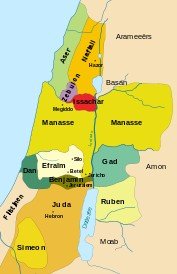 In verses 1-2, Jesus leaves Galilee and crosses the Jordan River to the over-Jordanian area. This proves that Israel does not commit occupation in the Jordanian territories, because this area already belonged to Israel in the time of Jesus. It is the UN that does not respect God, the Bible, and ancient countries.
Verse 3 This time it is the Pharisees in the over-Jordanian who come up with a tricky question for Jesus. It fits into the discussion of that time. The school of Hillel, which declared divorce lawful. The school of Sjammai, which recognized divorce, but upon much less recognized divorce reasons. The Pharisees desired to bring Jesus in conflict with (the law of) Moses.
Verses 4-6 However, Jesus goes a step back, earlier than Moses, back to the creation by God. God has created the earth; God is much more than Moses. Moses received the commandments of God; therefore, God is more than Moses. God created man and woman as a unit, independently bonded to each other. By virtue of the fact that a man leaves his father and his mother and cleaves to his wife, and they become one flesh (sexual relationship) (Genesis 2:24). Marriage is instituted by God from the beginning of creation, a full community of life between men and women, including sexual. This unity consists of two people: a man and a woman. There is no room here for bigamy and polygamy. King David and Solomon violated God's institution with the polygamy of many women, who also led to their fall.
Therefore no man has the right to bring separation and to violate God's command.
The marriage starts with the first sexual intercourse between man and woman. No sex before marriage, as illustrated by the words of Mary in Luke 1:34! The attitude and respect for God's Word seize back to God's commandment given 4000 years back. Therefore, now (2000 years after Maria, 6000 years after the first time that God gave this commandment), we CANNOT say that it does not belong to this time (age). Every believer who has sex before marriage shows that he and she HAS NO RESPECT for GOD and can expect little of God's blessings until they confess their grave sin (second degree) and marry each other.
The Apostle Paul is very clear in 1 Corinthians 6:16: "Do you not know that he who joins himself to a prostitute becomes one body with her?" Thereby Paul refers back to Genesis 2:24, that sexual intercourse is a unification between man and woman. From the moment on that a man and a woman have sex with each other, from that moment, these two persons are married in the eyes of God. If man and woman do not respect this, then they show no respect to God. Forces the man on with the words "that is out of date," then shows the man clearly that he has no respect for God and his lack of self-control. It is better to break this relationship than to maintain it. Research has clearly shown that the divorce rate among people who had sex before marriage is much higher in cases where both partners entered as virgins into marriage. That is not so surprising; after all, it is a lack of respect for God and for each other, a lack of self-control (a fruit of the Holy Spirit). Marriage requires respect for each other and respect for each other's opinions and actions. Lack of respect and self-control leads to tensions within the marriage, which can lead to divorce. Partners who have much less marital tension and thus many fewer divorces. God knows what is best for man—in this case, no sexual relationship before marriage.
Verse 7 The Pharisees defend themselves with a harking back to Moses and the establishment of the bill of divorce; see Deut. 24:1-4. Jesus relies on Scripture; the Pharisees also, in turn, rely on Scripture. However, they oversee that Moses has set this up personally, and it is not an institution of God and is only given after the first commandment at creation.
Verse 8 Jesus' answer is clear: from creation, it is NOT so. It is your hardness and the hardness of man, who do not know how to reconcile. The persistent stubbornness of not wishing to accept God's way and the lust of adultery. That is not enough to have one woman (or man). The bill of divorce of Moses had a purpose, namely, not to leave the woman without rights. See and study what the apostle Paul teaches on behalf of Jesus and on himself in 1 Cor. 7.
Yes, but what about cases of beating (violence) within marriage and cases of alcoholism and drugs? OK, my personal response is to leave the house and go and live in a safe (unknown) place (with the children). But as a believer, request no divorce. Also no sexual relationship with another person. Then in the case of liberation from alcoholism or drug use of the partner, a return might be possible, and so a continuation of the marriage.
Verse 9 When it concerns fornication (unchastity) or having sex with someone other than the married partner. Then the marriage is already broken. The fornication and adultery of the wedding promise have already been nullified, and the marriage is broken.
God's institution is that both husband and wife are obliged to marital fidelity, a lifelong faithfulness to each other until death puts an end to the marriage.
In the time of Jesus, the status of women was low; in Palestine, it was permitted that men had concubines, and only the man had a right to send away his wife.
The controversial question arises: Does Jesus allow in this verse a new marriage (remarriage) by the one who is innocent? The one who has committed adultery has dissolved the marriage and, by the sexual relationship, has already entered into a new marriage with another (married another) and thus committed adultery. The opinions are very divided on the interpretation of this verse concerning the innocent partner. Some believe that here Jesus does not give a license to the innocent partner, and the innocent partner should not remarry. Also in connection with 1 Timothy 3 being one woman. Others (myself included) believe that since the adulterous partner has already broken the marriage, here Jesus allows the innocent partner to have the free choice to stay single or to remarry. But remembering 1 Timothy 3 in case of remarriage. To which I have no answer. Thereupon the opinions are also divided, even within the church.
Verse 10 The disciples do not understand the intention of Jesus' explanation. Why should it not be advisable to marry (after all, most people have their sexual needs)? How many marriages do not last and are without sexual problems? The divorce rate is approximately 40%; 60% remain married. After all, from the beginning of creation, God has created marriage and the sexual relationship. Marriage is an institution of God. The Apostle Paul says in 1 Cor. 7:9 that it is better to marry than to be aflame with passion, and in verse 5 remembers, "Do not refuse one another except perhaps by agreement for a season, that you may devote yourselves to prayer."
The Catholic Church uses this verse and the following as a plea for celibacy. But this is in conflict with the institution of marriage by God and the words of the Apostle Paul. Among the Jews, it was an obligation of the religious man (Pharisee) to be married. Who studied the Torah and was married.
Verses 11-12 Jesus replies about the lack of understanding of the disciples by naming three categories:
- the eunuch born so from the mother's womb, that is to say without sexual need or sexually immature
- The eunuch was circumcised by humans (castration) (which was forbidden in Israel); think of a eunuch in a harem.
- The man, the believer who dedicates himself completely to God by studying God's Word and the work of God (the Kingdom of Heaven). Who, through the Holy Spirit, also receives the self-control for this and restrains from a sexual relationship and pornography.
Jesus hereby confirms the institution of marriage by God. However, the voluntary remaining unmarried in order to dedicate himself completely to God's Kingdom is given a legitimate place under the new people of Jesus Christ, the Christians. We can think of Paul, who after marriage (as a result of the death of his wife?) remained single. He was a Pharisee, so therefore he had to be married. Also look at the many experiences he writes about the marriage.
Laying on of hands—Matthew 19:13-15
Verse 13 After the institution of marriage (and God's command to multiply) follows the "then." Then the children were brought to Jesus. Aware that Jesus is divine and pure, without any kind of evil. In the charismatic and Pentecostal communities, it is a habit and has become a cultural phenomenon to impose hands during prayer and to bless children, based upon this verse. It is Jesus, divine and pure, who blesses and transfers the good. In the New Testament, we read nowhere that this laying on of hands upon children is inherited nor is it continued by the Apostles. The Apostle Paul warns seriously in 1 Tim 5:22. "Do not be hasty in the laying on of hands, nor participate in another man's sins; keep yourself pure." Thereby it is clear that the sin of another believer is transferable by the laying on of hands. There are many cases whereby the laying on of hands (children, prayer services, when someone is prayed for) the sin of the handlayer is transferred to the one on whom the hands (on the head) are laid. Partly that is because one does not know the hidden sin of the Sermoner, the eldest handlayer. Cases are known of believers who, after the laying on of hands, thereafter commit adultery, beat their children, use excessive alcohol and drugs, etc.
That is not so surprising; laying on of hands is TRANSFERRING. The priests laid their hands on the sin offering and transferred their sin (and that of the people) onto the sin offering (the animal that was going to be slaughtered for the reconciliation of SIN). Further, we know the laying on of hands at the blessing by the FATHER (Jacob) of his children; hereby, there is no question of an outsider as in the case of a sermon or eldest. In the New Testament the laying on of hands took place at the transferring (appointment) of function: Ananias appointed Paul, commissioned so by God (Acts 9:10-18); the council of elders of the Apostles (who are no longer present) in 1 Tim. 4:14 positioned Timothy into his function; and in James 5:14 the elders of the church were under prayer and anointing with oil. However, there is not a question of laying on of hands!
When Jesus is blessing, He does NOT always lay on His hands. At the miraculous almighty, Jesus raised His hands to heaven and blessed the people, also so when the priest blessed the people.
A number of churches base their infant baptism upon this verse; there is no ground. At the devotion of a newborn, there is also laying on of hands; my opinion is that this should be done by the sermoner AND the eldest at the same time.
In short, let us take Paul's advice very seriously about the laying on of hands and not use it as a cultural practice and be aware of the dangers. By magnetizers, laying on of hands is a common practice whereby people are healed. We can difficultly describe the source as being from God the Father and Jesus Christ (despite the biblical texts in their consulting rooms).
The disciples are trying to prevent the people from bringing and blessing their children by Jesus. We need to view this reaction from the Jewish belief that children are not counted. Children had to listen and to learn. On the other hand, Jewish children were much more fondled, embraced with love, carefully raised, and educated by parents (think of the Virgin Mary, who knew everything about sexuality).
Verse 14 Jesus permeates again the wrong thoughts of the disciples. From Jesus' words, it is clear that also children are part (also in the Kingdom of Heaven). One should not prevent children from coming to Jesus. Already at a young age, provided knowing what he or she does, a child (from the age of eight?) can come to faith and accept Jesus Christ as Lord and put his or her life under the guidance of the Holy Spirit. Here rests the task of the parents to guide and teach the child. Personally, I see no objection to children (babies) participating in the Lord's Supper, but the child who has awareness needs to know what it does. Children of faithful parents are sanctified in the believing parent(s).
Verse 15 Jesus blesses the children and lays hands on them. Just remember that Jesus is completely pure, and no harm can be transferred.
Following of Jesus—Matthew 19:16-30
Verse 16: One, in verse 20 called the young man, came to Jesus. He addressed Jesus with "Teacher," recognizing that He is an authority on the interpretation of the Torah. From his question, "What good deed MUST I DO to have eternal life?" it is clear that there is no awareness of sin, and he thinks that by his own works one can come to heaven (a Catholic thought and especially a human thought). The Jewish thinking was based on the idea that the fate of the man depended on obedience to the Torah. Unreal thinking—we only need to look to the ten commandments, and then everyone knows that no man is able to comply with the ten commandments. Just think of loving God. What man is able to love God completely? How many people do not worship saints? Worship images?
Verse 17 Jesus focuses on "good. " Only God is good; no human being is good, and good works do not exist (selfish because focused on self-interest, by good labor getting into Heaven). What is the will of God? It is revealed in the Torah: recognizing being a sinner. By recognizing this and living accordingly, God has a sense of well-being in the sinner, but man remains a sinner who needs salvation. Jesus refers him to the Torah, all the commandments that God gave to Moses.
Verses 18-19 The young man keeps himself innocent and asks, "Which?" Jesus refers to the sixth to ninth commandments from Exodus 20 and replaces the tenth commandment with "You shall love your neighbor as yourself" from Leviticus 19:18. Oddly enough, Jesus does not refer to the first five commandments to honor and to love God.
Verse 20 But this produces a disappointment by the young man. According to him, he actively complied with the requirements of the Torah. According to the rabbis, man possesses the capacity to maintain the entire Torah. Earnestly they speak to maintain the Torah from A to Z. Apparently, this is also the case with this person. But since he recognized Jesus as authority, and maybe there was doubt in his heart, he followed the question, "What do I still lack?"
Verses 21-22 Jesus is consistent and follows through perfectly. Perfect (tamin) is he who does the will of God completely. Whose thoughts are completely on God? God desires the good for all people, rich and poor. The rich must divide the property with the poor. Jesus' answer is, if you desire a treasure in Heaven, share your property with the poor; see 1 Cor. 3:11-15.
Now the rich young man has problems, for he was very rich. What Jesus asks belongs to the institution of the Torah: love your neighbor as yourself. It is no undivided being with God: toward God and toward property (on earth). Jesus determined the youngster at the core of the Torah: the love of God that goes out to all the people, rich and poor. The way in which he stands towards his property is the critical point. Is he willing to obey God and to share his property with the poor? He is totally focused on God, as he claims in verse 20.
Jesus asks to sell all his property and to follow Jesus (without a home, wandering, with no fixed dwelling place, a very simple life): FOLLOW ME. The young man is unable to do so and leaves sadly. His statement in verse 20 he cannot fulfill until the end. This is unlike the rich in Acts 4:34-35.
Verse 23 Wealth in itself is not a problem, but it quickly leads to selfishness, wishing for more possessions, indifference, and rebellion against God. It provides doom (and loss of eternal life?) when the rich keep their hands closed to the poor. The rich forget that he has to thank God for his wealth and that his possession is of God. God has appointed man as steward. Each man is accountable to God. A rich man can use his possessions for the well-being of the poor. He can own a company with many employees (in that way providing food and salary), handing out food parcels, supporting evangelism and missions, partly paying the salary of a sermon, etc.
Verse 24 Jesus emphasized that it is very difficult for the rich to come to faith and to live according to the commandments and will of God. No camel can pass through the eye of a needle, but there are exceptions of rich people who give up their property, starting with Zacchaeus, the chief tax collector in Jericho, who gives away his possessions in Luke 19:1-10.
Verse 25 The disciples are perplexed, are completely beside themselves, and come up with a question.
Verse 26 Jesus' answer is clear: by humans, this is impossible, but possible with God. The Holy Spirit can convince the man of sin and his wrong way of living and bring insight and repentance, as with Zacchaeus. It is clear that with this statement, both rich and poor need God to get access to the Kingdom of Heaven. Wealth and poverty can both prevent access.
Verse 27 Peter united himself with the fellow disciples. We have forsaken all and followed you. They have given up their homes and jobs and followed Jesus. They also have left their families at home or travelled with their families where Jesus went. We know little about this. Peter had a mother-in-law, therefore a family. See 1 Cor. 9: 5.
"What then shall we have" can be understood as what we will receive in the Kingdom of Heaven; we will have access.
Verse 28 You who have followed me, you 12 apostles (but remember the traitor Judas is replaced by the Apostle Paul), will sit on twelve thrones for the 12 tribes (Judah: two tribes; Israel: 10 tribes). In the first instance, to work with Jesus to judge what each Jew/Israelite has done in his/her life and then reign over the new Israel at the new Earth. See Revelation 4:4, the 24 elders being these 12 apostles and 12, which is the Church of Christ.
Verse 29: The reward of following and doing the will of Jesus Christ is given in Mat. 25:31-46 and 1 Cor. 3:11-18.
"For my sake," whereby one can think of giving up family members and having a home and going to the mission field (for example, in Africa). Leaving your adult children (without contact and seeing grandchildren) if one on the mission field works.
Verse 30 This verse is clarified in Mat. 20. This verse points out that "the workers of the eleventh hour" will be treated in the same way as those who have worked a lifetime for Jesus Christ.
Matthew 20 — The laborers in the vineyard and their wages
 . Verse 1: The working hours of the workers began at dawn and ended at the appearance of the stars. The householder is the owner of the vineyard, who needed laborers to pick the grapes.
Verse 2 There was negotiation with the laborers: the going wage of a denarius was agreed upon. Given the totally different way of life in the time of Jesus, there is no comparison with a value in euros or dollars.
Verse 3 The third hour, which is nine o'clock in the morning. The owner still sees unemployed workers. The Jewish day began at sunset (the previous day). However, the hours were counted from sunrise. The night was divided into four vigils.
Verse 4 Also, these unemployed were hired, but without the owner making an agreement on the wages. These unemployed went to work without knowing what pay they would receive. The owner said only that he would give a fair wage.
Verses 5-7 Similarly came to pass in the sixth, ninth, and eleventh hours. "Origenes" refers to these hours at the different ages at which a man accepted Jesus Christ as Savior.
The eleventh hour is five hours in the afternoon. The work should be finished, and that is why the owner once more went to see if there are any more hands available to complete the work.
Why do you stand here idle all day? Probably these unemployed stood in the blazing sun all day to wait until someone would hire them. The owner also rents them.
Verse 8 According to Lev. 19:13, the wage had to be paid the same evening: "The wages of a hired servant shall not remain with you all night until the morning." The owner (God) calls the steward (Jesus Christ) to pay the wages. Starting at the last, that is, the ones who were hired at the eleventh hour.
Verse 9 These workers of the eleventh hour each received a denarius, the full daily wage, despite the fact that they had worked only one hour. The owner acts here completely different than expected. However, everyone who lives late in his or her life has come to faith in Jesus Christ as Savior and will receive eternal life in Heaven. This is no question of whether you come to faith at a young or old age.
Verse 10 Humanly speaking, the workers from the first hour expected a higher wage. They had worked all day and not just one hour.
Or do we need to think of sermonizers, evangelists, or missionaries who started to work for Jesus at a young age in comparison to the one who has only served Jesus the last years of their life? Or the number of years that a believer has lived under the control of the Holy Spirit? Is this parable in contradiction with 1 Cor. 3:10-15?
Verses 11-12 This wage, despite that it was agreed with the owner, is disliked by the workers of the first hour. They murmur because, in their eyes, the deficit was done. Their argument is that we have worked throughout the day in the blazing sun and heat. The last ones in the much cooler evening. Compare also the reaction of the oldest son in the story of the prodigal son (Luke 15:11-32).
Verses 13-16 The owner recalls the agreement of a denarius. The owner does not dispute their heavy working conditions but points back to the agreed appointment. He is the sovereign Lord, the owner of the vineyard. That is, Jesus Christ is the sovereign Lord of the vineyard—the Church. It freely allows God to give mercy as He wants.
Begrudge: envious, award the other less, malicious. Generosity: God wants to bestow eternal life in Heaven to everyone who, whether sooner or later, has come to faith. Compare Jonah, who grumbles because at the last moment Nineveh repents, receives forgiveness, and is spared. Jesus, who saves the murderer who confesses guilt and recognizes Jesus. Many wonder why Jesus saves a murderer. I am thinking of a story in which a murderer was sentenced to death and had come to faith in Jesus; he asked the parents for their forgiveness but replied that his death sentence at the electric chair was correct.
The disciples/believers cannot assert rights. It is the grace of God; it is the work of the Holy Spirit, who enables the believer to work in the vineyard, the Kingdom of Heaven, and the Church of Jesus Christ.
Jesus goes on to Jerusalem—Matthew 20:17-34.
In verse 17, Jesus goes to Jerusalem, preparing for the heavy task of His 40 lashes and death at the cross. No doubt a large crowd followed Him, so He takes apart the twelve and explains what is going to happen.
Verse 18 With the word "behold," Jesus points to the changing situation. No longer the Messiah who heals and casts out demons, but a Messiah who is going to suffer and die. Who is going to be mistreated by the Jewish spiritual leaders and will ask for His death?
Verse 19 It is the Jewish spiritual leaders who will deliver Jesus to the Gentiles (Pilate, the Roman ruler). Besides the Sanhedrin, the Gentiles (non-Jews) are also fully responsible for the crucifixion of Jesus. It is the Roman soldiers who mock, scourge, and crucify Jesus. The deliberate delivery and action by the chief priests, scribes, and Sanhedrin. With the debt of the Gentiles who had the last and final right to crucify or not Jesus. Thus the fault is with the Jew AND the Gentile, and thereby the debt of sin, whether Jew or Gentile, is accentuated.
Mocking: the sarcastic taunting by the Romans.
Lashing was carried out by the Romans, as well as by the Jews in their synagogue.
Crucifixion was only allowed to be carried out by the Romans as a punishment unknown to the Jews. The Torah knew stoning, hanging (a God-damned Deut. 21:22-23), and burning with fire (Lev. 20:14, Joshua 7:15, 25); therefore, no cremation with the death of a believer. Cremation is burning with fire, which is a punishment from God. A believer is only buried (returns to dust, Genesis 3:19).
The condemned had to carry the lintel to the place of execution. There the body was nailed on the lintel, and subsequently the lintel with the body was raised to a pole standing perpendicularly in the ground. A footrest was not in question. Both feet were beaten with one nail into the wood. The height of the cross varied. Just over man-sized or higher to be visible from far away. On a plate was written the reason for condemnation and placed at the cross.
Matthew used the passive to make it clear that it is God the Father who resurrected Jesus on the third day.
Verse 20 According to Jewish custom, it is the mother who wishes the best for her children and asks Jesus. Apparently she recognizes Jesus as the Messiah (verse 21 in your Kingdom). She is the one who will follow Jesus to the crucifixion. With respect, bending to the ground, she asks Jesus. She knows her place.
Verse 21 Jesus sees her bending and asks, "What do you want?" Jesus goes up to Jerusalem; she is in the expectation that Jesus will set up His Kingdom and reign as King. According to Jewish custom, the most important person was in the middle, the second most important one at the right side, and the third (youngest) on the left. Probably she was not present when Jesus had said that Peter counted as the rock and to whom the keys of the Kingdom were given.
In verse 22, Jesus focuses directly on the two sons, without anger and accusation, with the question, "Are you able to drink the cup that I am to drink?" The Cup had the meaning of "fate." The answer from them is "lightly" or not? Jesus had told of His fate in verses 18-19.
Verse 23 You will drink my cup. From James it is known that he died about 44 years ago (Acts 12:2). Whether John died as a martyr is not mentioned in the Bible. According to Papias, yes; according to Irenaeus, not namely, he would have died a natural death in Ephesus.
But sitting in which place in the Kingdom of Heaven is determined by God the Father and not by Jesus Himself.
Verse 24 The other disciples are annoyed by the request to be taken to the highest places.
Verses 25-26 However, Jesus set things in order. He points to the worldly rulers. They rule out of lust for power, wealth, and power for their own benefit and to the detriment of the people, whom they pressured and paid heavy taxes. Not so in the Kingdom of God. There, the King Jesus wishes the best for His people. Great is the one who wishes to serve. Jesus gave His life under scourging and crucifixion. He will be the first. The largest is the one who wants to give his life and wishes to serve, which was considered to be inferior. With God, serving is fulfilling the commandment to love your neighbor.
The slave was counted as contemptible and inferior. In the Kingdom of God, lord and slave are equal to each other, without ranking.
Verse 28 Equally as the son of man, thus following the example of Jesus. Jesus had left all power and dominion in Heaven and was born as a baby and came to earth. Born as a human, leaving His deity in Heaven behind. He has come to take the punishment upon sin, scourged, despised, and mocked by Jew and Roman (gentile), and dying at the cross.
Ransom was the price that had to be paid for a prisoner or slave so that he became free. Jesus paid with His death at the cross and took the punishment for sin upon Himself as ransom for the death and punishment for the sin of man (for each who wants to believe in Jesus Christ as Savior).
Verse 29: Jericho was a transit place on the way to Jerusalem, prosperous and rich.
Verse 30 Two blind people who were sitting by the road, no doubt to ask for alms for their livelihood. They hope for a cure and speak to Jesus as Lord and Son of David. Lord, a recognition of the teacher (rabbi) and Son of David as the one who would destroy the enemies of Israel and would lead the Jewish people to perfection.
Verse 31 The crowd rebukes them; they do not desire that Jesus be harassed. But the two blind people do not give up; they know that Jesus can cure their blindness, not being able to see, begging for money, and the need to be guided.
Believers ward off people who want to get to know Jesus? We commend them to keep quiet so that we can listen to a sermon. Or do we take the person aside and explain the Gospel? Do we show mercy?
Verse 32 Jesus shows mercy and stands still. He calls them and asks what they want. Of course Jesus already knows what they desire. Even before a believer asks something of Jesus. Jesus already knows what the believer needs and desires. Nevertheless, Jesus wishes that the believer clear the heart and ask for what is desired.
Verse 33 Again, the respectful LORD. With a simple request that we may see.
Verse 34 Jesus has compassion and touches the eyes of the blind. Immediately they see it. The reaction of the two blind people is that they follow Jesus. Thereby, Matthew closes the curing by Jesus as well as following Jesus.