The Bible Book Genesis - Bible study by verse and Encouragement
Conducting a verse-by-verse study of Genesis, the Bible's book of beginnings, reveals profound themes of creation, covenant, and human nature. Structurally, the book divides into two main parts: Primeval History (Chapters 1–11) and Patriarchal History (Chapters 12–50).
Chapter

We are at the beginning of everything. This section of the book deals with the origin of the universe, the origin of order on this earth, the origin of life, the origin of man, the origin of sin, violence, disorder, and the origin of national and linguistic differences.
For his brevity and beauty of composition and style, this vignette on creation is unparalleled. God the creator dominates the scene. He speaks, and immediately order is formed, providing a beautiful dwelling place and abundant supplies for the most sublime creation of all: man. Majesty and power mark every sentence.
In response to the question, "WHO MADE ALL THINGS?", the Bible boldly declares: GOD... CREATED. In response to the question, "WHO IS BEFORE AND GREATER THAN ALL THINGS?", with equal boldness the Bible proclaims: IN THE BEGINNING... GOD. Heaven and earth are not God or gods; nor is God equal to nature. God is the creator, and nature is his handiwork.
Genesis 1:2-5

Although made by God, the earth was not ready for man. It was still in disarray, without form and void, and there was no light. However, there was activity. The Spirit of God moved continually upon the face of the waters.
The Bible does not mention any reason why the Earth was without form and void. Possibly as a result of the battle between God and Satan, when Satan rebelled against God and was cast out of Heaven (to Earth; after all, now he and his fallen angels are living in the heavens, in the atmosphere above the Earth)..
THE DAY OF LIGHT AND DARKNESS.
Energy is a vital necessity for man's habitat, and light is energy. Therefore, God's first command was: LET THERE BE LIGHT (vs 4-5). The emphasis on God's spoken word is so great that each creative day begins with a command or expression of the divine will. Then comes the execution of the command and the culminating declaration: IT WAS GOOD..
Where there is confusion, emptiness, or darkness in your life, God has the power to speak and bring clarity and order. The light of God transforms chaos into purpose..
God does not depend on natural instruments to accomplish His will. He is the primary source of illumination, glory, and truth. Just as God made light shine in the darkness of creation, He shines in our hearts to give us the knowledge of His glory..
We are called to walk in the light, allowing God's Word to illuminate our decisions, family, and actions, rejecting darkness..
God still says today: "Let there be light". He desires to illuminate your path, renew your hope, and bring a new beginning. Surrender your "chaos" to Him and allow the light of Christ to shine upon you.
Genesis 1:6-19
THE DAY OF THE DIVIDED WATERS
The waters were separated, and above the earth there was an expanse. The word expanse or firmament conveys the idea of solidity. God is the Creator, and from this statement the Old Testament begins to show that nature is a creature and a tool.
And God said, “Let the waters under the heavens be gathered together into one place, and let the dry land appear.” And it was so. God called the dry land Earth, and the waters that were gathered together he called Seas. And God saw that it was good" (v2 9-10) Then God said, “The earth brought forth vegetation, plants yielding seed according to their own kinds, and trees bearing fruit in which is their seed, each according to its kind.” This was the third day (vs 11-13). On the third day, God formed a future habitat for man, who is a creature of the earth. Under God's command, land and sea separated, forming life and beauty and adorning the earth. The text does not describe how these separations occurred, nor is there a list of the dynamic and natural forces involved.
And God said, “Let there be lights in the firmament of the heavens to separate the day from the night; and let them be for signs and for seasons and for days and years, 15and let them be lights in the firmament of the heavens to give light upon the earth” And it was so (vs 14-15). And God made the two great lights, the greater light to rule the day, and the lesser light to rule the night; he made the stars also. That was the fourth day (vs 16-19). The pagans worshipped the sun, the moon, and the stars as gods and goddesses of formidable power. But for God, they have a function and nothing more.
We know that the moon is not luminous energy in itself, but a reflector of sunlight. But its unique position proves that God created it and placed it at that crucial position.
Which stars were created at that time is irrelevant. Scientists currently estimate that the universe has a total number of stars from 10²⁰ to 10²² (a 1 followed by 22 to 24 zeros), which is more than all the grains of sand on Earth.
Genesis 1:20-30
On the fifth day, God spoke to the waters, which produced creatures, and birds filled the air. In verse 21, we see another triad: the great whales... every living creature that moves... and every winged bird.
The text does not tell us how the waters collaborated with the Creator, but to emphasize the close connection between God and his creatures, the verb "created" is used. In the Old Testament, divine blessing is a creative act and an empowerment so that the one who receives it fulfills their destiny according to God's will. In this case, God's will is that creatures reproduce abundantly... according to their kinds. This act served to annul the previous condition of "emptiness."
THEN GOD SAID: "Let the earth bring forth living creatures according to their kinds: cattle and creeping things and beasts of the earth according to their kinds".
But this day would be the crowning achievement of the creative act. The deity, in deliberation, said: LET US MAKE MAN. This creature had to be different. God said that MAN had to be made IN OUR IMAGE, having a certain resemblance to reality, but lacking fullness. Man was to be ACCORDING TO OUR LIKENESS, having a general similarity to God, but not being an exact duplicate. He was not to be a little God, but definitely had to be related to God and be the bearer of the distinct spiritual characteristics that mark him exclusively as a being superior to animals.
So we have: "MAN MADE IN THE IMAGE OF GOD".
1- A spiritual being fit for mortality, vs 26.
2- A moral being who has the likeness of God, vs 27.
3- An intellectual being with the capacity for reason and governance, vs 28-30.
In the Ten Commandments, the relationship between God's six days of work and material things, leading to a day of rest, serves as the basis for man's observance of a day of rest (Exodus 20:8-11). This is a day instituted by God that must be respected. On this day, God's commandment for man to overcome nature is set aside, and man recognizes a higher law in which he surrenders to God. Man can work for six days, but he needs a day of rest to work for another six days.
Unlike the Babylonian sabbath, in which dangerous demons roamed freely, the Sabbath instituted here was sanctified by God. It was to be a day of joy and contentment, of inner renewal, and of praise to a merciful God. In pagan belief, certain natural forces, things, places, animals, or people were intrinsically holy, even divine: but nowhere in this creation story is holiness attributed to something that comes from nature. God reserved the Sabbath so that man might deepen his relationship with his Creator.
The basis of the Sabbath was shifted from the event of creation to the event of the resurrection; consequently, the time was changed from Saturday to Sunday. However, the same underlying principle persists; six days are given for man's dominion over nature, but the seventh day is the Lord's Day. It is the beginning of a new life through the Resurrection of the Lord Jesus Christ. And with that, the BEGINNING of the week.
Genesis 2:4-6
In the early chapters of the Bible, God clearly conveys His desire for our lives to be fruitful. Two things necessary for fruitful lives are balance and pruning. To maintain balance, we need to ensure we have the right amounts of healthy nourishment, rest, work, fun, time alone with God, and time to enjoy holy relationships.
Pruning is not always pleasant, but it certainly ensures that situations, activities, or relationships that wear us down will not continue to have that effect on us. This means that something needs to be cut or removed from our lives, but God promises great reward as a result—more fruitfulness than ever before!
Stay balanced by letting God, the wise Master Farmer, prune your life as He sees fit, and you will enjoy abundant times and great fulfillment.
Genesis 2:7
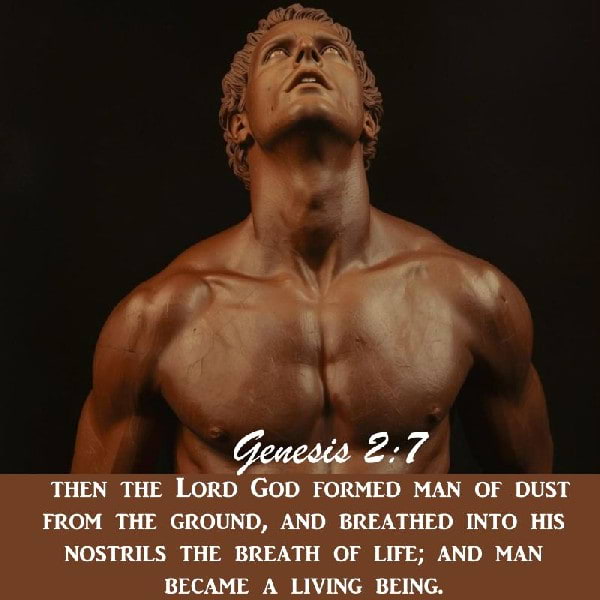
Man is presented as a creature of the earth. He is formed from dust. With profound interest, God breathed life into man, an act that highlights the fact that man's vitality and inner dynamics come directly from God. Any other object of man's affection and hope is an illusion. He is made out of two worlds; therefore, to be separated from God is to wither like the fruit of a cut vine.
1- Matter (Dust of the Earth): Represents human fragility and connection to the earth. Man was physically molded, indicating divine care and design.
2- The Divine Breath (Breath of Life): Unlike the creation of animals, God breathed directly into man. This "breath" represents physical, mental, and spiritual life, making man unique, in the image of God. 3- Living Soul: The combination of the body (dust) with the divine breath results in a human being, a living soul.
4- Theological Significance: Genesis 2:7 emphasizes that human beings are not merely matter, but spiritual beings who need communion with the Creator, being created to live in relationship with Him.
Connection to the New Testament: Paul, in 1 Corinthians 15, contrasts Adam (the first living being) with Christ (the last Adam, who gives life), showing that man depends on God for eternal life.
In short, Genesis 2:7 reminds us that we are dust animated by God's own life, highlighting our dignity and our profound dependence on Him.
Genesis 2:18-27
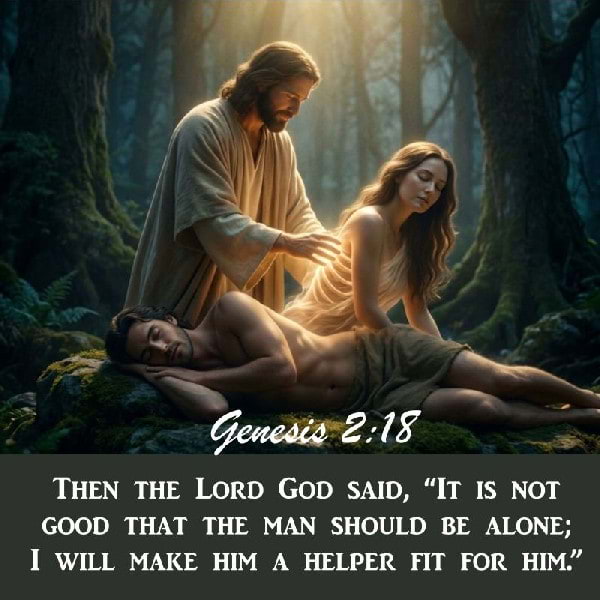
Genesis 1:27 recounts that God created humanity with a binary gender system as male and female. At the end of the creation week, God declares that all His creation was very good (Genesis 1:31). Because God planned for gender binary and because He called it very good, it is clear from the Genesis narrative that the distinction between male and female is important. However, we may not recognize how important this is until we read the more detailed and expanded account of how God actually created the first man and the first woman in Genesis 2. It is in this context that God declares that it is not good for the man to be alone (Genesis 2:18). This is the first time something is said not to be good. The first bad thing recorded is that the woman had not yet entered the scene! This speaks volumes about the importance of women in God's design.
Then God put Adam to sleep and performed a kind of surgery, removing one of his ribs and then healing the wound (Genesis 2:21). From that rib God formed the first woman (Genesis 2:22). When God brought her to Adam, Adam recognized her worth (perhaps because he was first shown that he was alone). Adam understood that she was taken from him and that they were uniquely united (Genesis 2:23). Although equal in value, they were distinct in design. God completed His creative work, with woman as the final brushstroke, and the fundamental ingredients of gender, sexuality, and marriage were initiated (Genesis 2:24–25). God designed man and woman to be equal and yet very different. In a sense, they were opposites, and both were necessary to fulfill His design.
The Institution of Marriage – verses 22-24.
These Biblical passages prove that marriage is a divine institution. God personally performed the first marriage. In fact, marriage was the only institution that began before the fall of man. How sadly man's sin has distorted God's plan. God's intention is that marriage be an indissoluble and blessed union. A man and a woman united and exclusive of all others. Sin brought divorce, polygamy, concubinage, polyandry, adultery, promiscuity, and perversion.
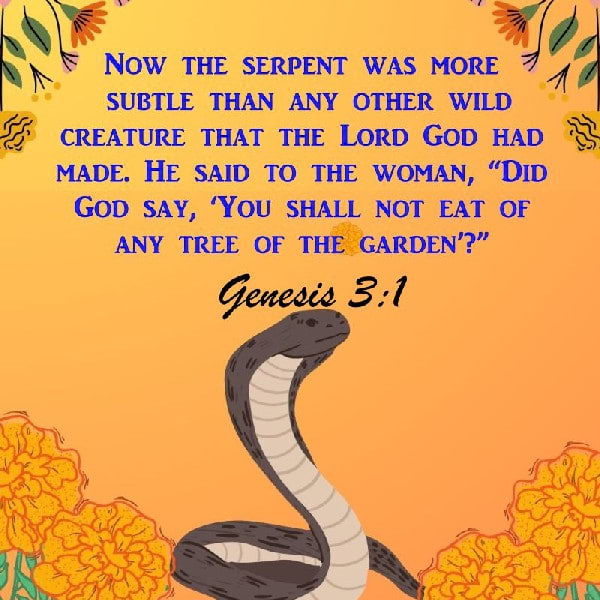
The serpent crept stealthily into the tranquil garden like a sinister visitor. As the story progresses, the serpent is presented everywhere as an instrument of some hidden spiritual power. In the New Testament, Jesus relates the serpent to the devil (John 8:44), as does Paul (Romans 16:20, 2 Corinthians 11:3, 1 Timothy 2:14) and John (Revelation 12:9, 20:2).
The serpent began to speak with an expression of surprise: "YOU SHALL NOT EAT OF EVERY TREE OF THE GARDEN?" and proceeded to erroneously quote God's original command, making it absurd. The original prohibition was related to only one tree, but the serpent said "OF EVERY TREE," note that this technique of distorting words has been used since the beginning. It is the corruption of language already being used from the earliest times. The phrase in 2:16 is found in the permissive order and not in the negative order (2:17). The serpent questions God's goodness: He was too restrictive, unnecessarily withholding valuable benefits.
This first question was seemingly innocent, but it deceived the woman, causing her to also misquote the command. She made the prohibition much stronger than it actually was. God did not say: DO NOT EVEN TOUCH THE FRUIT OF THAT TREE (v. 3). But He made the threat of punishment much more serious than LEST YOU DIE. She unknowingly made the command irrational and the punishment a mere possibility, instead of an inevitable outcome. The woman missed a golden opportunity to defeat the serpent's suggestion. Had she quoted the command correctly and adhered to it, the enemy would not have been able to proceed with his intent. The woman should have realized that animals do not speak and, therefore, should have perceived the evil.
The serpent perceived the advantage and proceeded to categorically deny the truth of God's punitive declaration, stating positively: YOU WILL NOT DIE (v 4). He focused his attack on inciting resentment against the restriction and arousing a desire for power.
Genesis 3:4-5
The serpent focused its attack on inciting resentment against restriction and stirring up a desire for power. God was using the purpose of death as a device to withhold from humankind the discovery of something – THEIR EYES WILL BE OPENED. Was He not preventing man from possessing a good that man had a right to have? The serpent was accusing God of improper motives, of selfishly keeping man at an inferior level of existence. Man's true destiny, the serpent indicated, was TO BE LIKE GOD. The main characteristic of the divine being was the power to know GOOD AND EVIL. This knowledge was not abstract knowledge, but the practical ability to know all things, including the intelligence to invent and establish ethical standards.
Ingeniously, the serpent suggested that disobeying God's command would result not in death, but in a full and rich life for man. No positive promises were made, only the suggestion of possibilities that were fascinating and mysterious. This was the core appeal of paganism, the belief that great achievements, profound thought, or carefully observed ritual would introduce a person into the divine realm. This is also man's basic sin: to achieve the state of being absolutely free and self-sufficient.
So we have: THE SERPENT'S APPEAL:
1- To physical desire
2- To intellectual curiosity
3- To the disposition for self-affirmation.
It was very sad that the woman listened to the serpent. And the devil managed to plant in the hearts of men the same desire he had to be equal to God, or better than God, or above God. Today, with the rise of the internet and podcast channels, old philosophies and deceptions have come to light and become a source of curiosity for many, such as the lies about God in Gnosticism. It is necessary to be careful because, just as the enemy deceived Eve with sneaky words and sophisms, many teachings today bring more of this same deception. Beware! Watch, pray, and study the Bible, which is the Word of God.
Genesis 3:9-13

The question, "WHERE ARE YOU?", was not asked by God to find out their whereabouts, but because He wanted to elicit a response and make the man and woman come out of hiding through their own confession.
Adam's answer, "I WAS AFRAID", clarifies the reason for their hiding. The devil's lie was revealed; eating the fruit of the tree did not make man like God, as the serpent suggested, but compromised his true essence of being human before God.
God knows good and evil from the perspective of divine and sovereign goodness. But man, being dependent on God, can only know good and evil from the perspective of disobedience to God's will. The knowledge of good and evil came along with guilt and fear.
The first question was asked directly to the man: "HAVE YOU EATEN OF THE TREE OF WHICH I COMMANDED YOU NOT TO EAT?" (v. 11). Adam had no excuse because he knew what the command was. It was a simple and clear prohibition. But Adam did not face his responsibility; he passed the blame to his wife - SHE GAVE ME FRUIT OF THE TREE - and did not God give her to him? Surely, she was trustworthy as a guide for action.
The WOMAN also tried to evade responsibility, saying: THE SERPENT BEGUILED ME (v. 13). Then she realized that the serpent "made a fool of her".
So we have:
1- Sin causes personal guilt
2- Sin separates God and man
3- God seeks sinful man
4- God forgives man's guilt.
Genesis 3:14-15a
PRONOUNCEMENT OF THE VERDICTS
The sins committed are reflected in the punishments, which were applied in parts.
The SERPENT was cursed. The serpent posed as supremely wise, but its way of moving would always be a symbol of its humiliation.
The punishment would involve ENMITY, hostility between you and the people. The SEED of the serpent, which Jesus relates to the wicked (Mt 13:38-39; Jn 8:44), and the SEED of the woman, both have a strongly personal meaning. God said to the serpent: The seed of the woman WILL BRUISE YOU (vs 15). Compare Paul's reference to this in Romans 16:20 - THEN THE GOD OF PEACE WILL SOON CRUSH SATAN UNDER YOUR FEET. The serpent could only bruise the heel of the woman's seed. In fact, "to bruised" is not strong enough to translate the Hebrew term, which can mean to grind, crush, destroy. A bruised head that leads to death is contrasted with a crushed heel that can be healed. Verse 15 is called the "proto-Gospel" because it contains a message of hope for the sinful couple. EVIL IS NOT DESTINED TO BE VICTORIOUS FOREVER; God had in mind a Victor for the human race. There is a strong Messianic character in this verse.
Genesis 3:14-19
For some, this is the first prophecy in the Bible. When God created Adam and Eve, He placed them in a beautiful place called the garden of Eden. He created many different trees and said that they could eat from any tree in the garden, except the tree of the knowledge of good and evil. They disobeyed, that is a sin: sin always has a price. God decreed seven judgments because of sin.
- Satan is forever cursed.
- Satan's head will be crushed in the end.
- Throughout history, there will be conflict between the serpent and the fallen angels, and the offspring of the woman, between good and evil.
- Throughout history, women will experience pain during childbirth.
- Throughout history, a woman will have to submit to her husband.
- Throughout history, man will have to work to feed himself.
- Throughout history, human beings will die.
This prophecy is always fulfilled, but it will not be fully fulfilled until after the Millennium. Satan suffered a great defeat when Jesus died on the cross to take away our sins.
It is heartening to know that Jesus will eventually defeat satan, and what God started in the garden of Eden will be completed in eternity. The fall of Adam and all that satan has done in the past or will do in the future will not frustrate God's original plan.
So stay strong!
Genesis 3:16
Here in Brazil this week (Sunday) Mother's Day is celebrated. So I would like to talk about some biblical mothers. And starting with her who is the MOTHER OF ALL LIVING, Eve.
Eve's voice is like a warning from ancient times to every woman to follow the path of obedience. It rings out like a note of hope when a woman fails; she encounters God's justice, but she also experiences His grace.
Purity and innocence were shattered when the serpent entered the scene. Eve chose to believe Satan's lie. She was free to put her will above God's and so she did.
Expelled from her pleasant home, Eve conceived and had children. Her joy at their birth was turned into pain, as foretold by God. Cain killed Abel and was banished and Eve was left childless until the grace of God, once again, visited her giving her another son, Seth, who became the ancestor of the Messiah.
The sentence for the woman was "suffering during pregnancy". Pregnancy, in itself, is not a condemnation. Children are the inheritance and reward of the Lord (Ps 127:3). When giving birth, a woman has the opportunity to join hands with the Creator in the multiplication of humanity. Imagining a pregnancy without difficulties is difficult, but apparently this was the Creator's original plan.
Genesis 3:17
God placed a curse directly on the earth instead of placing it on man. Adam was commissioned to work the land, but it would no longer be for pleasure. Man so easily submitted to the woman's appeal that he ate the forbidden fruit. Now his work on the land would be mixed with pain (v. 17). On all sides he would be confronted by competitors: THORNS AND THISTLES (v. 18), which grow profusely without cultivation and do not produce food for man.
Physical death would not be immediate, but it would be inevitable, FOR YOU ARE DUST, AND TO DUST YOU SHALL RETURN (v. 19). The type of death that man suffered immediately was spiritual: separation from God, the (Holy) Spirit was immediately withdrawn: No more direct speaking/communication with God was possible.
Genesis 3:20-23
Adam names his wife Eve, which means "to live". Literally, Adam called his wife "life" because she would be the mother of all living souls. God made garments of skin and clothed them with them (more next time). This is seen by many as the first animal sacrifice. Up to this point, humanity had not been given permission to eat animals, only plants; permission to eat animals does not occur until Genesis 9. Blood was shed for the death of another in order to provide the garments that God provided by His grace. Later, Israel would offer animal sacrifices to remedy their sins.
God promised that on the day they sinned, Adam and Eve would experience death. What kind of death do they experience here? Death means separation. Physical death occurs when the human spirit separates from the body. Adam and Eve are now separated from paradise, separated from immortality. They are separated from the special relationship with God, they are separated from innocence, they are separated from eternal life and creation. They are even separated from themselves, seeking to shift the blame onto each other instead of taking responsibility for their actions. Finally, upon being exiled from the garden, they are condemned to physical death.
Then the Lord God said, “Behold, the man has become like one of us, knowing good and evil; and now, lest he put forth his hand and take also of the tree of life, and eat, and live for ever” therefore the Lord God sent him forth from the garden of Eden, to till the ground from which he was taken (vs 22-23).
The man and woman had sought to be like God, who knows good and evil, as beings who are sovereign. But they could never attain this status. They only possessed the breath and image of God. As a result of their intrusion into a realm that was not theirs, it was a denial of their creaturely status and a rebellion against the uniqueness of the Creator. Man had to be denied access to the tree of life so that he would not become fixated on rebellion and live eternally in sin, eternally separated from God, but they would receive the opportunity, through Jesus Christ, to be reconciled with God.
Genesis 3:21
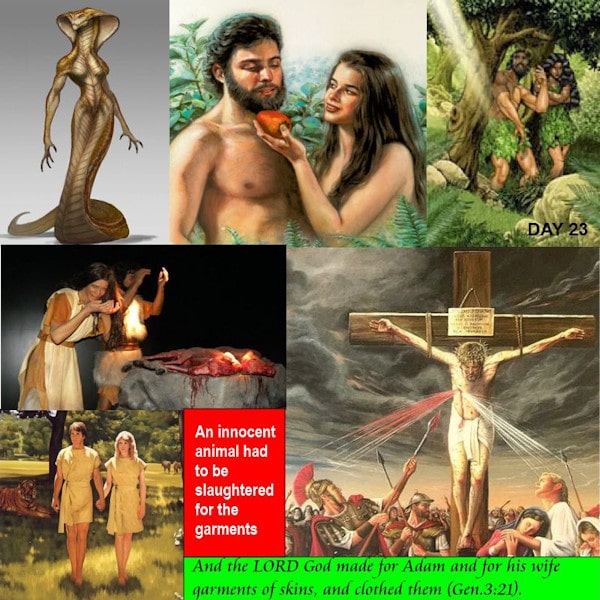
Satan used the body of a serpent and spoke half truths to seduce Eve. Eve offered the forbidden fruit to Adam. Now he had a free choice:
- Or to choose for his wife and AGAINST God
- Or to choose for God and not to eat the forbidden fruit.
Adam chose wrong because of his CONSCIOUS choice, sin is passed on through the sinful male seed, while the female egg is sinless (the egg of the VIRGIN Mary was sinless).
The covering with fig leaves, which digest, did not help.
It was God Himself who killed an INNOCENT animal (s) to make garments, because without shedding of blood there will be no forgiveness.
Jesus made the PERFECT sacrifice. The blood (and water medical evidence of His death) spewed from His body as the soldier stuck the spear in His side.
For anyone who believes in this sacrifice of Jesus Christ, is the possibility of eternal life in Heaven. It is a personal choice, just as Adam, the first man, had to choose. The choice that one makes, has its own consequences.
Genesis 3:7 en 21
Verse 7 Their eyes were opened; they immediately knew the difference between right and wrong. They were aware of their nudity. And now the first people advanced to private action. They try to hide their nakedness. How? By an act of OWN power. They hack leaves. Leaves that, after the hack, die and wither and take away their covering. So a constant hacking is in order to continue to cover their nakedness. Man is UNABLE to provide for an everlasting solution to the separation between God and man. The SOLUTION takes place in the first instance in verse 21 and the final solution through the death and resurrection of God's son, Jesus Christ.
Man did not become equal to God. In his stupidity, he makes a covering of leaves that wither. Man did not obtain the omniscient knowledge of God!
Verse 21 Here many read superficially over this text, but it is one of the two most important events in the Bible. The basis for the second.
In verse 7 the people had taken leaves to cover their nakedness, a private human power! Man thinks himself to be able to release, but with a solution that soon decays.
Clear in this verse is that God does not accept this solution. The leaves wither and do not cover any more. God Himself kills an animal, kills an innocent animal in the man's place. Similarly, Jesus was nailed innocently to the cross and slaughtered for the sins of man. The animal had no debt; Jesus had no debt. The fault of the man was here transferred to the animal; the debt is transferred from the believer to Jesus at the cross. Adam and Eve had to wear the skin of the animal the rest of their lives. Probably for each one, one animal was slaughtered because the Bible talks about garments of skins. However pointing to Jesus, His ONLY ONE sacrifice is sufficient for WHOLE MANKIND and everlasting!
The skin of an animal is going to last a lifetime, not a temporary covering of leaves that wither. Once Jesus brought the sacrifice, which applies for life of man.
The rest of their lives, Adam and Eve will be aware of their wrong choice, from their sin through the clothing of the innocent slaughtered animal. Without the shedding of blood there is no forgiveness of sins; Hebrews 9:22 is fulfilled here.
The human act of covering by leaves is undone. Poor man who thinks he can perform his redemption by his own work. His or her fate by rejecting God's solution is an eternal separation from God after death.
A terrible aspect of sin is that it cannot be easily isolated or obliterated. It progressively executes its devastating work in society, from generation to generation. The sin of Adam and Eve did not cause misfortune only in their lives; it passed from father to son, from generation to generation. The story in chapter 4 painfully illustrates this fact, and the genealogies extend the repercussions of evil throughout all generations.
The story of the two boys born to Adam and Eve highlights the repercussions of sin within the family unit. The boys, Cain and Abel, had remarkably opposite temperaments. Cain enjoyed working with cultivated plants. Abel enjoyed being with live animals. Both had a religious disposition. Adam and Eve's sons brought sacrifices to the Lord, the first sacrificial incident recorded in the Bible.
The fact that Abel also brought the best parts of the firstborn lambs means that he recognized that "Without the shedding of blood there is no forgiveness of sins" (Hebrews 9:22). This was made very clear to his parents in Genesis 3:21, and undoubtedly his parents passed on this teaching. For the reason that Cain did not want to acknowledge this "without the shedding of blood," but instead offered a sacrifice of HIS OWN works, his sacrifice was rejected by God. After all, this sacrificed animal pointed to the sacrifice of Jesus, who died for sin.
The first indication is presented almost immediately. Cain could not bear the fact that God had instituted the sacrifice of an INNOCENT animal. The Lord's preference for Abel, who met God's requirements, filled Cain with fury. Cain desired to be "the first" and bring a sacrifice of HIS OWN works.
Today it is no different; people want to achieve reconciliation through their own strength and works. They reject the work of Jesus Christ and do not wish to acknowledge Him as Savior and Lord.
The Lord was not absent at the time of worship. He approached Cain and gave him a warning. God did not condemn him directly, but through a play on words informed Cain that he was in real danger.
Genesis 4:7

God did not condemn Cain directly, but through a play on words informed him that he was in real danger. In Hebrew, the word for 'accepted' is literally "lifting up." A downcast look is not a suitable companion to a pure conscience or righteous action. The impetus of God's questions was to lead Cain to introspection and repentance.
If Cain had done well, surely God would have received him grandly. But what if Cain had not done well? This was the real question that Cain ignored, for he placed the blame on Abel. The threat to his spiritual life was not far off. Sin was right outside the door, ready to lead Cain to ruin.
The text describes sin as a malevolent demon, ready to pounce on Cain if he leaves God's presence without repenting. God graciously offered Cain the power to overcome sin: YOU MUST MASTER IT.
The last sentence can be paraphrased as follows: "YOU LET THE FIRE OF ANGER BURN INSIDE; THEREFORE, WHEN YOU LEAVE MY PRESENCE, SIN WILL CONSUME YOU. YOU BETTER CONTROL YOUR ANGER SO THAT DESTRUCTION DOES NOT OVERCOME YOU."
Genesis 4:8-16
Unfortunately, Cain left God's presence, and his anger turned to jealousy, which, in turn, became murderous hatred along with a cunning plan. In the field, one day the evil deed was carried out – Cain… deliberately and unprovokedly killed Abel.
But Cain could not escape the LORD (v. 9). Soon the scene of judgment unfolded. LISTEN! THE VOICE OF YOUR BROTHER'S BLOOD IS CRYING OUT TO ME FROM THE GROUND! (v. 10). The earth, that is to say the plants and trees, are capable of speaking with God. See Mark 11:12-20, where Jesus curses the fig tree, which therefore evidently had a responsibility.
The idiomatic expression is vivid, meaning: "You may try to forget your act of violence, but I cannot. Whatever happens to my children is a matter of personal concern to me." The privilege of cultivating plant life was taken from Cain, and he was banished to the desert, to be a fugitive and wanderer (v. 12).
The exposure of his sin changed Cain. Arrogant hatred became cowardly fear mixed with self-pity. He would be susceptible to the same fate he inflicted on his brother. He could not even bear the thought. But God did not mock him. Once again, his mercy softened the punishment. THE LORD PUT A MARK ON CAIN (v. 15). Note that Cain already had brothers and sisters who were able to avenge the death of their brother Abel.
So Cain set out to face a completely new life, far from God. The designation LAND OF NOD (v. 16) means land of wandering, and does not appear to be the name of a specific region.
Genesis 4:16
THE DESCENDANTS OF CAIN: CREATIVE AND RUTHLESS (4:17-24)
Cain's importance has been exhausted, and the lineage of his rebellious posterity is incompletely presented in abbreviated genealogical form.
Verse 17 says that Cain had relations with his wife. Cain's wife was, implicitly, a sister who went with him into exile. Cain began to build a fortified dwelling, a city, and proudly named it Enoch, after his first son.
The descendants of Cain, narrated in Genesis 4, represent the wicked lineage that developed far from the presence of God, focused on material and cultural progress and violence, culminating in the polygamy of Lamech and widespread wickedness. This technological lineage, which includes the inventors of livestock farming, music, and metallurgy, was too eliminated by the Flood.
While Cain's lineage focuses on earthly advancements, Seth's (after Abel's death) is described as one that began to call upon the name of the Lord (Genesis 4:26), marking a contrast between wickedness and piety.
This chapter discusses the descendants of Adam.
And the first thing we can observe is that even with the fall, the image of God was not completely destroyed in humanity. It also shows us that God's purpose remains intact even in a world affected by sin.
The genealogy follows a pattern:
1- Name of the patriarch
2- The age at which the highlighted son was conceived
3- Lifespan after the son's birth
4- Mention of other sons and daughters
5- Total age
6- Refrain: "and he died".
Adam begets Seth in his own image and likeness. This language is intentional and points to the continuity of God's image through the lineage of the promise, not through Cain, but through Seth.
FROM SETH TO JARED
Each generation follows the established pattern, emphasizing long life, the blessing of fertility, and, in the end, inevitable death. The extraordinary longevity of these patriarchs is noteworthy. Some scholars point out that in the early stages of humankind, before prolonged and persistent sin reduced human vitality and disease developed, old age and vigor were quite possible. Even so, no number of years on earth can change the fact of death. This is the result of sin, physical death, and the only one who avoided this fate was Enoch. He walked... with God; and he was no more, for God took him (verse 24). What is clear is that even in a corrupt world it is possible to live in communion with God. There is no excuse.
Genesis 5:29
Lamech was Noah's father. The name Noah means consolation or rest. And when we read this passage, we imagine what pains, difficulties, or sufferings Lamech was facing to give his son this name? Jesus said that the mouth speaks what the heart is full of. Lamech was perhaps exhausted from the hard work of agriculture, under the sun, plowing the land. So, upon the birth of a son, he gave him this name as a hope for better days. But the question is, was Lamech prophesying about his son's life? Some scholars say yes. But they are very crude in restricting to agriculture what is applicable to all the miseries of human life that proceed from God's curse and are fruits of sin. For, under one type of work, he encompasses the entire miserable state into which humanity had fallen.
For, undoubtedly, we must remember what Moses related above, concerning the laborious, sad, and anxious life with which Adam was condemned: and as the wickedness of man increased daily, no mitigation of the penalty could be expected unless the Lord brought unexpected help. It is probable that they sincerely sought God's mercy; for their faith was strong, and need ardently urged them to desire help. But, as the name was not rashly given to Noah, we may therefore deduce that this name certainly carries a meaning.
Lamech clearly saw the fulfillment of the divine promises. He spoke concerning his son Noah: "This one will comfort us". While the first Lamech will be remembered for his arrogance, the second, for his longing for hope. He awaited what God had promised in Genesis 3:15 and certainly never imagined that his son's mission was crucial to preserving a human seed and thus bringing about the future birth of the Messiah. None of us can measure the impact that our dedication to the Kingdom of Christ can have on the society to which we belong. When we clearly see God's promises regarding His eternal plan of redemption, our smallest acts of obedience can bear fruit that will impact generations. Dare to obey Christ!
The interpretation of Genesis 6:1-4 is difficult and controversial. The debate centers on the interpretation of the expression "sons of God." Who are they? The crucial question concerns whether the expression refers to human beings or to spiritual beings (demons).
Option 1: Sons of God = Sons of Seth
One viewpoint is that the "sons of God" would be descendants of Seth. In this interpretation, the pious descendants of Seth were intoxicated by the beauty of the women descended from Cain, then marrying those who rejected God, leading to greater wickedness.
The strongest evidence for this position is found in Genesis 4-5, which describes two lineages from Adam: one from Cain and the other from Seth. The Old Testament sometimes refers to God's covenant people as sons of God (Deut 14:1, Jer 3:19), although the exact expression "sons of God" is not used in relation to them. If this view is correct, it could explain why God later forbade the Israelites from marrying Canaanite women (Ex. 34:16, Deut. 7:3).
Option 2: Sons of God = Fallen Angels
The oldest, and probably the most widely held, interpretation is that the "sons of God" are fallen angels (demons). This was the favored interpretation in ancient Judaism and the early church (cf. 1 Peter 3:19-20; 2 Peter 2:4; Jude 6). The expression "sons of God" is clearly used elsewhere in reference to the angelic hosts in God's heavenly court (cf. Job 1:6; 2:1; 38:7). Furthermore, the narrator seems to contrast "man" and "the daughters of men" with the "sons of God" in Genesis 6:1-2.
Whichever interpretation is correct, the main point is clear: humanity was falling deeper and deeper into sin and drifting further and further away from God.
Genesis 6:3
NOT FOR LONG
Genesis 6:3 ("My Spirit will not abide in man for ever... his days shall be 120 years") marks the limit of divine patience before the Flood. It does not refer to general human longevity, but rather to the time of grace (120 years) given for repentance while Noah built the ark and humanity lived in corruption.
The central idea of Genesis 6:3 is that the Lord will not continue to deal with humanity indefinitely. Because man is flesh, there is a limitation to divine patience: the time until judgment is set at 120 years. This warning sets the stage for the flood and for Noah's salvation, showing both the gravity of sin and God's mercy in granting time for a response of faith.
In essence, the verse points to the need for a response in the face of impending judgment. The expression highlights human frailty and God's sovereignty in setting a deadline. From here, the text goes on to describe the instructions for the ark and Noah's life as an example of faith and obedience amidst the corruption of his generation.
Just as Noah was saved because of his obedience and found favor in God's eyes, we too can be saved from the tragedies that will come in the end times. If you are walking in disobedience and rebellion against God, please rethink your concepts and turn to Jesus. Amidst the corruption and evil that surrounds you today, how can you be like Noah and live righteously before God in your generation? By living righteously, like Noah, people on your right and left may commit wrongdoing, but you must be upright. Today and always, people are destroyed by sin; they harbor wickedness in their hearts, allow impure imaginations, and have evil thoughts. And God knows the heart, the innermost being of people; He sees us from the inside, our thoughts are visible to Him. So, strive to have a pure heart before God, and you will reap abundant life instead of destruction.
Genesis 6:5-8

God's reaction to the affairs of human society intensified as sinful corruption became dominant on a universal scale. The degradation of man was inwardly complete; they were entirely evil.
The phrase "The Lord repented" in verse 6, and others similar (see Ex 32:14; 1 Sam 15:11; Jer 18:7-8; 26:3, 13, 19; Jon 3:10), troubles many Bible scholars. The common concept of repentance is related to turning away from immoral acts. Thus, a change of direction, character, and purpose is inherent in the act. Two passages in the Old Testament definitively assert that God does not lie and repents as man does (Num 23:19; 1 Sam 15:29). A study of the passages mentioned above shows that divine repentance does not spring from sorrow for evil deeds committed. Changes in man's relationship with God result in changes in God's dealings with man. When man turns away from God into sin, God changes the relationship from communion to a relationship of judgmental rebuke. When man turns away from sin to God, He establishes a new relationship of communion. This is divine repentance. In our text, God changes from communion to judgment (v. 6).
The relationship changes that God performs are never described in the Old Testament as something impersonal or passive. God is always deeply involved. Since the change in relationship is personal, what better human terms could be used than deeply emotional expressions? Thus, God was grieved in his heart.
When man sins, God judges; but He also suffers intensely.
God did not glory in the act of judgment implemented next. Every word of the pronouncement is imbued with agony.
Verse 8. BUT, NOAH FOUND FAVOR IN THE EYES OF THE LORD. At that time, only one man (and his family) worshipped God.
Genesis 6:9
At the beginning of Noah's story, some things are made very clear about him. We quickly see that he was unusual, although the characteristics associated with him are not uncommon among men of God in the Old and New Testaments.
1- He was righteous, that is, he lived according to a standard, marking his life with obedience to God and concern for humankind.
2- He was upright, that is, he was undivided in his loyalty, oriented toward a defined goal and motivated by a driving passion.
3- He walked with God – Like Enoch (5:24), Noah walked with God, that is, he enjoyed uninterrupted and intimate communion with God. This walk infused the previously mentioned characteristics with a tenderness and depth of interpersonal relationship with God that transcends formal religion.
The moral condition of Noah's generation not only contrasts with Noah's own life, but makes it clear that the corruption of the people stood out as the opposite of Noah's righteousness. Noah displayed faithfulness and conformity to God's will; the people did not. Noah's authenticity, his healthy quality of life, was radically different from the violence that permeated society in his day. A comparison of verses 11 and 12 with verse 5 indicates that this violence was internal, severely contaminated with immoral imaginations and corrupt tendencies.
In Matthew 24:38, Jesus warned that in the end times, the time in which we live NOW, when He returns, the earth will be as in the days of Noah; wickedness, corruption, violence, rejecting God and His Word will dominate people. And we, as servants of God, even though it is very difficult, need to be faithful to God. We must be like Noah, righteous, upright, and intimate with God.
Genesis 6:11-13

Adam and Eve's sin was the beginning of a moral crisis on earth. Cain, their son, killed his own brother, Abel. Cain withdrew from the presence of God, and society got worse. When Lamech, son of Cain's great-great-grandson, came on the scene, he was a polygamist, married to two women. And in the days of Noah, almost two thousand years after Adam, great evil covered the land. So, God decided to destroy His creation with a flood.
Sin is not only a degenerative disease, it is also contagious. Being very serious, it is to be expected that it will not stop having a negative influence on individuals and society. It did not take long for the fallen man to discover the ways of sin.
God is very loving, but He is also holy. He is very patient, but the man is not free to do whatever evil he wants. God cannot and will not ignore the sin of a corrupted society forever. He will punish the guilty.
The flood part of this prophecy was fulfilled, but Jesus made a comparison between the wickedness in the land during the days of Noah and that which will exist during the end times, in the tribulation. He said: "As were the days of Noah, so will be the coming of the Son of man. For as in those days before the flood they were eating and drinking, marrying and giving in marriage, until the day when Noah entered the ark, and they did not know until the flood came and swept them all away, so will be the coming of the Son of man." (Matthew 24:37-39). The bad news is that humanity will get worse and worse. But the good news is that Jesus will return and put an end to it.
Genesis 6:17-18

In verse 17, God says to Noah: For behold, I will bring a flood of waters upon the earth, to destroy all flesh in which is the breath of life from under heaven; everything that is on the earth shall die".
A flood of water was the expedient of judgment, but a COVENANT would be established with Noah. This is the first time the word COVENANT, PACT, or AGREEMENT appears in the Old Testament. In later passages, it is the preferred way to describe the personal relationship between God and the people with whom He chose to have a special relationship. In this case, Noah and his immediate family, including daughters-in-law, were gradually chosen. At this point, the covenant relationship was only a promise.
After the ark was ready, the Lord appeared to Noah again. He was praised for his obedience, identified by the word RIGHTEOUS. What Noah did had God's approval.
The lesson for us today is: GOD IS COMMITTED TO THOSE WHO ARE COMMITTED TO HIM. See, The Lord was going to destroy everything, but Noah was righteous, upright, and God-fearing; he didn't live like most people. He did not use the tactic we hear so often these days: "OH! EVERYONE DOES IT!"
If it is wrong, do not do it!
If it is against the law, do not do it!
If it is outside the rules, do not do it!
You may suffer or have difficulties for a while, but God will bless you, and you will be able to lay your head on the pillow and sleep in peace. Your heart and mind will not be accusing you of anything. Be like Noah, A SAINT AMONG SINNERS.
Genesis 8:21-22

BUT GOD REMEMBERED! The statement GOD REMEMBERED (v. 1) is like a ray of light in a dark scene. Violence and corruption bring a harvest of destruction, but the faithful obedience of a few evokes expressions of kindness from the Heavenly Judge. The flood was not going to last forever, nor were those who were in the ark going to stay in it. Soon, the ark ran aground on the mountains of Ararat, a mountain range in eastern Turkey.
Leaving the ark, Noah directed his thoughts and actions first to God. He sacrificed clean animals and birds on the altar, and God responded. Here the phrase SMELLED THE PLEASING ODOR (v. 21) does not indicate that God was ravenously hungry, but that He was aware of Noah's act and approved of it. God makes the inner resolution not to use a flood again as a means of punishment. The reasons for such punishment still remained, BECAUSE THE IMAGINATION OF MAN'S HEART IS EVIL FROM HIS CHILDHOOD, but God's mercy would prevent a flood as punishment. This does not mean that there would be no more punishments. As long as sin persists among men, punishment will come, although by other means, see the punishments in the Biblical book of Revelation.
s a sign of His decision, God established a regularity of natural sequences that would encourage man to have hope for the future. God has not forgotten you either! Just as Noah was in that ark seeing for many days the dark sky, the sound of constant rain, the rocking of the waves shaking the ark, only after 150 days, that is, five months, did the ark run aground on the mountains. Do not be sad, the sun of righteousness will still shine in your life, God does not forget His own.

A PROMISE TO BE REMEMBERED
After the flood, Noah's first act was to build an altar and offer a sacrifice to God. He was particularly humbling himself, giving thanks to God for saving him and his family and declaring his faith. God was pleased with this and promised that as long as the earth would existed, there would always be different seasons.
This prophecy is always being fulfilled and will continue to be fulfilled until the earth is destroyed sometime after the Millennium.
What God promises, He fulfills!

God blessed Noah and his sons, and as in Genesis 1:28-29, they received an equal command to populate the earth. They had to have dominion over all other creatures on earth. Besides vegetables to eat, they were now permitted to eat meat, with certain limitations. They were not allowed to eat meat with blood (v. 4). Blood is a symbol of life and soul, and in man it should not be treated lightly. God made man in his own image and, therefore, he had a special condition.
Noah's experiences related to the flood are implicit, but clear. The origin of the difficulty lies in man's rebellion against God, his imagination and propensity for evil. God does not tolerate sin beyond a certain measure. There is a terminal point that results in judgment for man, but not without pain for God. God took the first step in preparing for judgment by providing sustenance for those who live obediently in his presence. The others were judged because they excluded God from their lives. Noah's experiences depict God as the complete Lord of all natural forces, some of which He uses as tools for judgment or salvation. God's concern in the midst of judgment is highlighted in the statement that He remembered those who were in the ark. However dangerous the situation, they were never absent from God's thoughts. He is the Creator God who demands righteousness and punishes corruption. His dealings with man are deeply personal.
Genesis 9:18-29
Even with the lessons of the flood, men were not entirely faithful to God.
THE LEVITY OF NOAH'S FAMILY - Noah was a farmer, as was Cain. Caring for plants became his great passion, and among them was the grapevine. This is the first time wine production is mentioned in the Bible, and it is significant that it is linked to a situation of misfortune.
Noah may have been innocent, not knowing the effect that fermentation has on grape juice nor the effect that fermented wine has on the human brain. Then shame entered the family circle. Losing consciousness, Noah took off his clothes and lay down naked.
One of Noah's sons, Ham (v. 22), entered the tent. Seeing his father, he did not help him, but irreverently scorned Noah's condition to his brothers. The other two sons immediately covered their father's nakedness (v. 23), entering the tent discreetly, backwards (not looking).
Regaining his senses, Noah learned what had happened and spoke to his sons. He left Ham without a blessing and focused his rebuke on Canaan, whose descendants became a people historically marked by sordid morals and a major source of corruption for the Israelites. Canaanite worship of Baal descended to the lowest depths of moral degradation.
The blessing placed on Shem has a strong religious connotation, and this lineage of Noah's descendants played an important role in transmitting the message of redemption to the world. The most prominent was Israel, to whom the revelation of God preserved in the Bible was given.
The blessing of Japheth (v. 27) involved a play on words, as the name means "that which increases". Japheth's lineage multiplied and played a role as a political power through the Persians, Greeks, and Romans. Few significant events occurred in Noah's last days. Like those who preceded him, he died (v. 29).
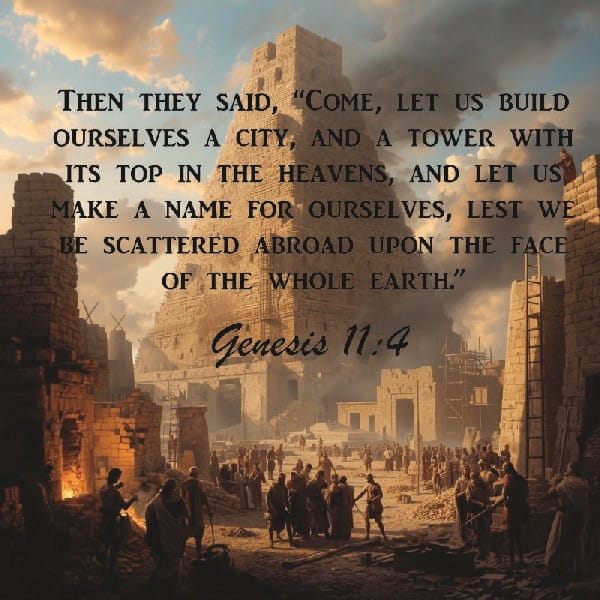
LESSONS WE CAN LEARN FROM THE TOWER OF BABEL:
The Tower of Babel (Genesis 11) teaches about the dangers of human pride, the importance of dependence on God, and divine sovereignty over human plans. The account shows that the pursuit of fame and power, ignoring God's will, results in confusion, disunity, and failure.
Main lessons from the Tower of Babel:
1- The Danger of Pride and Arrogance: The construction was motivated by the desire to make one's own name famous and reach the heavens, reflecting arrogance and an attempt to equal God.
2- Divine Sovereignty and Intervention: God demonstrates sovereignty by interrupting the human project that disobeyed the command to spread out and fill the earth, showing that plans without God are vain.
3- Unity Without Divine Purpose: Human unity, when based on selfish ambition, is destructive; true harmony depends on being aligned with God's purposes.
4- The Purpose of Babel (Confusion): The confusion of languages acted as a judgment, but also as a means of dispersing humanity, fulfilling the original divine plan.
5- Human Limitation: The narrative highlights human frailty and the need for humility and obedience, reminding us that human strength and wisdom are limited.
In short, the story is a warning to align life projects with divine values, valuing humility over unbridled personal ambition.
Genesis 11:27-28
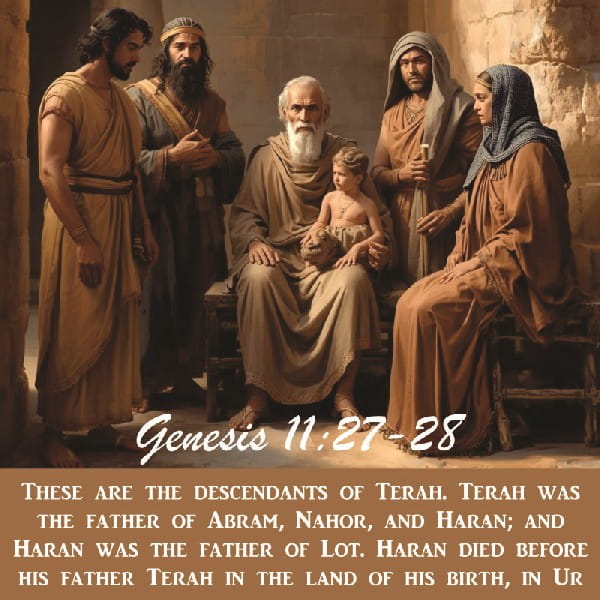
ABRAHAM, THE MAN GOD CHOSE
Here begins the story of one of the most extraordinary men of ancient times, who is the focus here. Abram is exalted as a man of God in three major religions in the world today: Judaism, Christianity, and Islam. During his early years, his name was ABRAM, meaning "exalted father."
Many names from this short genealogy still persist in the names of cities in the upper Mesopotamian valley. Ur of the Chaldeans was one of the richest city-states ever unearthed. The moon god Nanar was worshipped there. Joshua 24:2 states that Terah's family worshipped idols. The city was destroyed around 2100 BC, and soon after, a great westward migration occurred. Terah's family was among the migrants. They planned to go to the land of Canaan (v. 31), but were detained because Terah died in Haran (v. 32).
In chapter 12, God calls Abram. THE LORD HAD SAID TO ABRAM: "LEAVE YOUR HOMELAND, YOUR RELATIVES, AND YOUR FATHER'S FAMILY AND GO TO THE LAND I WILL SHOW YOU."
Abraham's response to the divine call to move to another country captures the imagination of many researchers as the will of God. His journey of faith was not like a fantastic fairy tale, but a realistic struggle in a hostile world. Abram had setbacks, but he persevered in the pursuit of what he believed to be God's will.
And about God's will, I have heard people say that when something is God's will, doors open naturally. From Abram's story, we see that it is not quite like that; he struggled a lot. So, if God has commanded you to do something, or made you a promise, things won't always be easy; hostile forces may rise up against you. But persevere, and in your strength, persistence, and patience, God will open the way.

- FAITH IS AN EXAMPLE THROUGH THE LIFE OF ABRAHAM. A friend of God (James 2:23).
- We learned that faith is not perfect character or integrity. Rather, faith is appropriating God and his Word.
- In doing so, Abraham became the model of faith for the believer.
DO NOT FEAR when God's guidance takes some direction you do not understand. He knows what He's doing. - BELIEVE IN GOD'S PROMISES TO YOU. He knows how to fulfill them, although you may not know (Gen 15:6).
AVOID fulfilling God's promises by your own strength (Gen. 16:1-4).
TRUST that God will provide according to His promises. Caring for you is part of His nature (Gen. 22.1-17). - God's providence is strategically located along the path of faithful obedience.
Genesis 12:1-7

ABRAHAM: AN EXAMPLE OF FAITH:
1- THE COMMAND AND THE DIVINE PROMISE - verses 1-3
The structure is simple. There is a command mixed with a promise, the act of obedience of Abram (v. 4-6) and the theophany or appearance of God to Abram marked by a promise, to which Abram responded by worshiping (v. 7-9).
The command is clear, but severe. Abram had to leave his home and relatives and move to a new land. When he arrived in that land, the Canaanites inhabited it, but God promised: TO YOUR DESCENDANTS I WILL GIVE THIS LAND (v. 7). The other promise concerned his posterity, who would become a great nation (v. 2). Abram would be a channel of blessing to others. In addition to obeying God's voice, God's direction in his life would bless the lives of many. And so, when Jesus enters our lives, and Jesus is God. He blesses us by giving us salvation for our souls, but our lives also change, our focus, our direction, and we also become channels of blessings in the lives of our family, friends, and neighbors. Jesus within us must reach the lives of those close to us as well; if this doesn't happen, something is wrong. We need to be obedient to God's guidance. It cannot be like this: "Oh! God told me to do it this way, but I think it is better to do it this way". Brothers and sisters, that is not obedience.
Then, Abraham would know God's blessings and be known as a great man. God would bless him in such a way that people's destinies would be determined by how they treated him. "I will bless those who bless you, and I will curse those who curse you". God would be gracious to those who helped him and would punish those who cursed him. Abraham's influence would be worldwide, a divine grace and a blessing to many nations.
Genesis 12:11-13
ABRAHAM FACES THE FUTURE
It seems that Abram made the decision to go to Egypt without thinking about the consequences. No sooner had he crossed the border than he began to contemplate the dangers that lay ahead.
Sarai was a very beautiful woman; there was good reason to fear the fate of a foreigner whose wife was so attractive. The husband was easily discarded in such situations. Therefore, Abram suggested that she accept his solution to the security problem. He asked her to pretend to be his sister so that he would not be killed. She was his half-sister, so it was a half-truth.
The plan was truly ingenious. One of the local men would come to Abram to ask for his sister's hand in marriage. He would consent, but demanded a long betrothal (long enough for the time of famine to end). During this period, Sarai would stay in Abram's house, where their marriage would continue secretly and his safety would be guaranteed. The benefits of this arrangement were quite large and the risks, quite small. However, for several reasons, the plan was terrible.
Abram's plan was a mistake because it jeopardized his wife's purity and God's promise. God had promised to make him a great nation. From him would come a great victory for all nations, the Messiah. Now he was willing to risk another man taking Sarai as his wife. How, then, could she be the mother of Abram's descendant?
Abram was clinging to his wife's skirts for victory and protection, instead of clinging to God's promises. Abram was not wrong to consider the possibility of someone being charmed by his beautiful wife as a casual woman to desire. Nor was he wrong to suppose that someone might kill him to marry her. His mistake was presuming that this would happen and the only way to avoid it was to mention it. Instead, God's promise and protection were disregarded. The sinful plot, therefore, was initiated even before there was any real danger.
Genesis 12:10-20
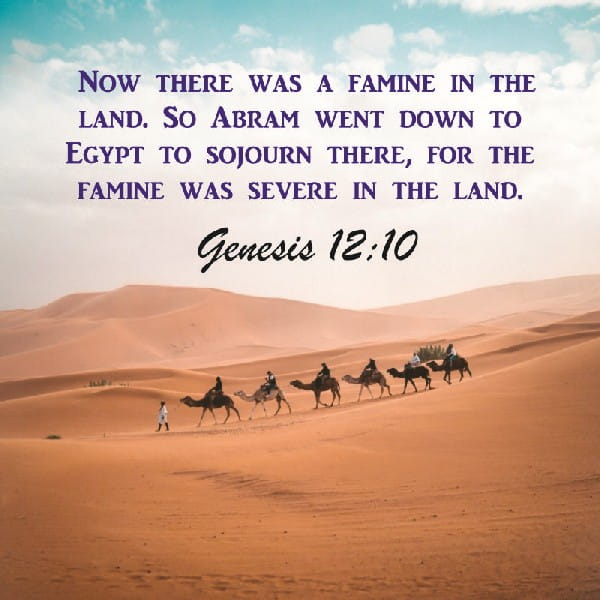
INSTEAD OF A BLESSING, A PROBLEM-CAUSER (v. 12:10-20)
God had promised that Abraham would be a blessing and that all the families of the earth would be blessed through him. But when he went down to Egypt because of the famine, he was not a blessing to the people of that country.
Brothers, God took Abraham, let us say, as a rough rock. A man who came from a pagan culture and had certain customs. We, looking at the situation today, might say: "Abraham lacked faith!" Yes, he might have lacked it, but this is the beginning of everything; faith grows when it is tested, so we understand this as a first test.
The famine was severe, and this led Abraham and his people to the well-irrigated Nile Delta in search of food for their livestock and families. Being responsible for so many people and animals, he needed to act somehow. It seems he heard of the rampant immorality of the Egyptians, and that was why he feared losing his wife and even being killed.
I suspect that he, as an immature saint, had not yet grasped that suffering and action were part of God's curriculum in the school of faith. Although he believed in God, Abram knew very little about Him. In his mind, the God who had called him might not be able to control nature. In the pagan pantheon, the "gods" had various limited powers. Perhaps his "god" was someone who did not bother with trivial things like rain or harvest. It seems he did not realize that God is not only superior to famine, but is also the One who gives it, as a test of faith.
Instead of somewhere, Abram is directly condemned for his decision to go to Egypt, but the later revelator of the story makes it clear that his actions did not stem from faith. He did not consult God, but acted independently. As far as we know, no altar was built in Egypt, nor is it written that he invoked the name of the Lord in that place. His request to Sarai is also a reflection of his spiritual condition. Therefore, it would be safe to say that he lacked faith in the face of famine.
Genesis 12:14
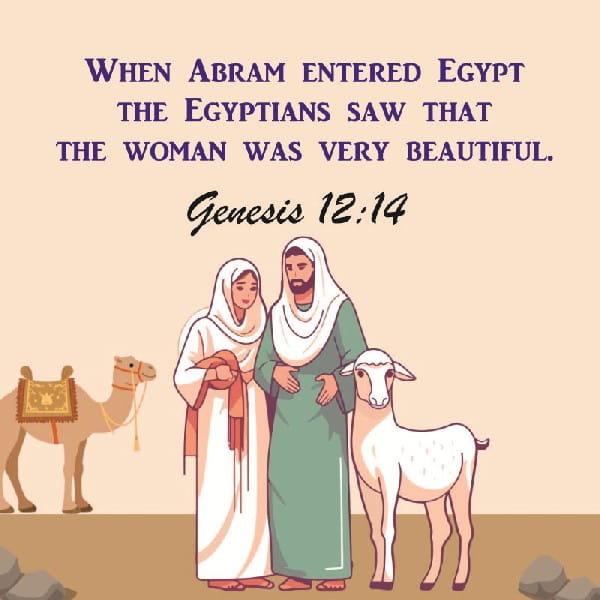
ABRAHAM'S FEARS CAME TRUE
Surely, some people would say, "But Abram's fears were not hypothetical. What he feared actually happened." Not at all! He was not a victim; he was the cause of what happened. His fear of the future, and his faithless plan of action, were the real causes of what followed. Many of our fears are self-inflicted.
It is quite true that Sarai's beauty was noticed and reported to Pharaoh. However, the most important thing in what followed was the claim by both Abram and Sarai that she was his sister, and thus available for marriage. Although we can imagine what Pharaoh's attitude would have been if he had known the truth, he felt fully justified in taking Abram's sister into his harem.
Everything was very well thought out and planned. Sarai would present herself as his sister, and Abram would postpone the marriage until the famine passed and they could leave. However, his plan only considered the men of Egypt: "When the Egyptians see you, they will say, 'This is his wife,' and they will kill me, but let you live" (Genesis 12:12).
It never occurred to Abram that Pharaoh might be interested in Sarai. Even though Abram could protect the plan from others, Pharaoh wouldn't take no for an answer. He took Sarai to the palace, waiting for the right time to consummate their union.
Can you imagine the agonizing and lonely nights Abram must have spent, wondering what was happening inside the palace (sexual intercourse)? He had asked Sarai to lie so that things would go well for him (verse 13). And everything went well. Pharaoh sent him many gifts and treated him like a king. The only thing preventing Abram from enjoying this treatment was his understanding of its meaning. Pharaoh was giving him all of that as a dowry. Everything was going well for Abram, but without Sarai, his wife. Prosperity is never victory without the peace that comes from walking directly before God.
Genesis 12:17-19

Divine Deliverance and the Royal Rebuke (12:17-19)
Significantly, God is not mentioned in this event until verse 17. Abram could have failed and slipped until the situation seemed hopeless. We do not know if he applied God's help.
Suddenly, without warning, God intervenes in the story. Pharaoh and his court are afflicted with some kind of plague. The symptoms may suggest that the nature of sin is related to sex. We have no details about the plague, nor about how they understood its meaning.
Abraham was confronted by Pharaoh and severely rebuked. He had no excuse or explanation. From what is written, he did not say a word in his defense. Undoubtedly, it was the wisest thing to do in the circumstances. Pharaoh was not someone to be challenged or angered unnecessarily.
The irony of the situation is obvious. Here is a rebuke correcting a prophet (cf. Gen 20:7). It was a real scolding that Abram would painfully remember. How sad it was, however, that he could not speak, for this undoubtedly prevented the testimony of his faith in the living God who had called him. The conduct of the Christian truly affects his testimony.
And Pharaoh gave orders to his men concerning him; and they escorted him, his wife, and all that he possessed. So Abram went out from Egypt to the Negev, he and his wife and all that he had, and Lot with him. Abram was very rich; he possessed livestock, silver, and gold (Genesis 12:20 - 13:2).
Some lessons:
1- When God promises the "ends," He also provides the means.
2- There are no shortcuts to holiness.
3- When our faith fails... God does not fail.
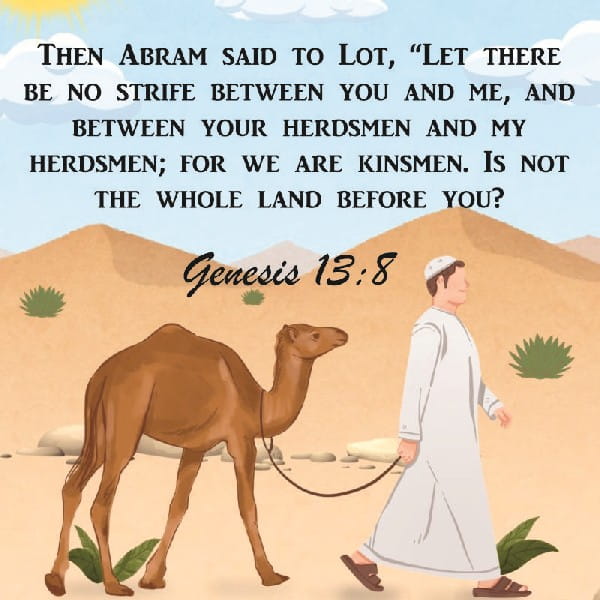
We cannot help but smile when we read these verses, for God works in strange, and sometimes even humorous, ways to accomplish His will. Long before, God had told Abram to leave his homeland and his kindred. At that time, leaving Lot was primarily a matter of principle. Abram needed to leave him because God told him to. Now, years later, reluctantly, he acknowledges that separation is necessary, not as a matter of principle, but as a practical matter. Taking the lottery along caused problems that persist to this day.
My friend, one way or another, God's will shall be done. It could have been in Ur, but it was not. In His providence, God brought discord and competition between Abram and Lot, which forced separation. Sooner or later, God's purposes will be fulfilled. If we see no need for obedience, God will create one. You can count on that.
Apparently, it was obvious that they needed to separate. The only problem was: who should leave, and where to? Abram left the decision to Lot. Whatever his choice, Abram would act accordingly. The offer gave Lot an advantage and left Abram vulnerable.
That is how Lot chose his portion, clearly a shrewd decision and, apparently, an option that gave him a decisive advantage in the competition with Abram. It was a selfish decision — taking the best and leaving Abram with what seemed worthless.
A simpler and fairer separation would have been to use the Jordan River as a border between them. Would not it have been fairer for Lot to live on one side of the Jordan, leaving the other to Abram? However, Lot chose "the whole plain of the Jordan" (v. 11). He did a masterful job thinking only of himself. He could have written a book on the subject.
And so they parted ways. Abram stayed in Canaan, while Lot advanced further and further toward Sodom.
Genesis 13:10-13

LOT'S CHOICE
When Abram made the offer to Lot, it seems that the two were on a high place, from where they could see all the land around them. Lot's decision was coldly calculated. With the eyes of an appraiser, he examined the land, weighing the advantages and disadvantages of the options.
The Jordan plain was literally a paradise. It was exactly like "the garden of the Lord" (13:10). And it also seemed to be supplied by irrigation, not by rain (Genesis 2:6, 10 ff). It was also like the land of Egypt. It was not necessary to live by faith in a place like that, because water was abundant, it was not necessary to wait on God for rain.
And that is how Lot chose his portion, clearly a shrewd decision and, apparently, an option that gave him a decisive advantage in the competition with Abram. It was a selfish decision — one that took what was best and left Abram with what seemed worthless.
A simpler and fairer separation would have been to use the Jordan River as the border between them. Would not it have been fairer for Lot to live on one side of the Jordan, leaving the other for Abram? However, Lot chose "the whole plain of the Jordan" (v. 11). He did a masterful job thinking only of himself.
And so they separated. Abram stayed in Canaan, while Lot advanced further and further toward Sodom.
Abram dwelt in the land of Canaan, and Lot dwelt in the cities of the plain, and pitched his tents as far as Sodom (Genesis 13:12).
Lot had carefully considered the economic factors of his decision, but had completely disregarded the spiritual dimensions. God had promised to bless Abram, and other people through him when they blessed him (Genesis 12:3).
Material prosperity should never be sought at the cost of spiritual risk.
When the decision was made to settle in the Jordan plain, the place was practically paradise (13:10). Moses, however, includes a parenthetical remark that casts this beauty in a very different light: "before the Lord destroyed Sodom and Gomorrah" (Genesis 13:10).
Genesis 13:14-17
The Lord appeared to Abraham a second time and, on that occasion, told him that He would give the land of Canaan to him and his descendants forever.
God also told Abraham that he would have a large number of descendants. So many that no one could count them.
God gave this land to Israel, but there is a problem. Muslims do not believe that the God of Israel is the true God. They worship Allah and believe that he gave them the land. This makes the conflict over land a theological conflict. The question is: who worships the true God? The media and the crowds are lining up against Israel, and at the same time, STANDING AGAINST GOD. It will take the Great Tribulation and the Second Coming of Christ for the problem to be resolved. But make no mistake: God's word says what He will do just that.
The people of Israel inhabited the land several times, but because of sin, God allowed them to be temporarily removed a few times. Thus, the part of this prophecy related to the land is always fulfilled, but it will only be fully fulfilled in the Millennium.
Genesis 13:14-17

GOD RESTORES ABRAHAM'S CONFIDENCE (GENESIS 13:14-17)
It is interesting that God only speaks to Abram (at least, as far as Scripture is concerned) after he makes the decision to separate himself from Lot. This was not accidental, but fundamental, for we read: "The Lord said to Abram, after Lot had separated from him..." (Genesis 13:14).
As far as we can see, God's call to Abram (12:1-3) was only for him. Just like the confirmation in chapter 13. God told him to leave his kindred (12:1). The blessing could not come without obedience to His revealed will; nor the restoration. In human terms, the only thing that stood in the way of divine blessing was human disobedience. Providentially, God removes this barrier by separating Lot from Abram, and then He reaffirms His promise.
God assured Abram that all the land he was contemplating would be given to him. Lot could have chosen to live in Sodom, but God had not given him possession of the land, nor would He. Lot would be a sojourner in Sodom (cf. 19:9), and for a very short time. Giving Lot the advantage was not giving up hope for the future, for ultimately it is God who bestows blessings on men through His sovereign choice.
The promise "for I will give it to you" (v. 17) is future. It was only fulfilled when the Israelites, under Joshua's leadership, occupied the land. It takes time to take possession of God's promises, for that is how He has planned it.

Chapter 14 of Genesis speaks of a war of four kings against five kings. An international war, so to speak. And what was this war about? Why did it happen? This war was a commercial war, a war for control of the trade routes of the time. The first bloc of nations was that formed by the four Mesopotamian kings of the east (14:1). Chedorlaomer, king of Elam (present-day Iran), appears to have been the leader. Shinar was the region of ancient Babylon (cf. Genesis 10:10). The second coalition was composed of five kings, including the kings of Sodom and Gomorrah (14:2).
After 12 years as vassals of the eastern kings, the five kings of the south planned to free themselves from their shackles. The eastern kings could not allow such a rebellion to go unpunished. The five kings of the south controlled the territory where "the king's highway" was located. This was the land route through which trade between Egypt and the four eastern kings needed to pass. Whoever controlled this piece of land would have a monopoly on international trade. And in this confusion, Lot and his family and possessions were captured (v. 13).
Abram joined with some allies and went to Lot's rescue, managing to save him. In the end, Abram meets Melchizedek. Melchizedek is a crucial figure in this narrative, as he puts Abram's victory into the correct theological perspective. There was no back-patting or politicking. Melchizedek was king and priest, not king and politician. His words were intended to remind Abram that the victory belonged to God, and the success was a result of His victory. In fact, Melchizedek's words were a reminder of God's covenant with Abram when He called him in Ur to go to Canaan.
Abram's response was a testimony of his faith in the one God, worshipped by him and Melchizedek. His tithe was tangible evidence that it was God who deserved the glory.
We are led to believe that Abraham gave Melchizedek a tithe of all his possessions. But when Moses writes, "...he gave him a tithe of everything," what did he mean by everything — everything what?
Genesis 14:20c
Many people cite verse 20 as proof for tithing: "...And Abram gave him a tenth of everything." They say this was the first tithe, and that it occurred before the law was given. Therefore, its practice is beyond the law, and is thus obligatory for Christians today.
This may be a shock to you, but Abram did not tithe his possessions. First, he was not at home with his goods, but on the way back with the goods of the king of Sodom and his allies. The writer to the Hebrews informs us of the content of Abram's tithe:
Consider how great this man was, to whom even Abraham the patriarch gave a tenth of the spoils (Hebrews 7:4).
Imagine a scene: Abram is found by the king of Sodom, who undoubtedly showers him with praise. The king of Salem arrives and urges Abram to give glory to God. The king of Sodom then watches, astonished and wide-eyed, as Abram gives a tithe of Sodom's spoils to Melchizedek. What a testimony to the glory of God and the sinfulness of Sodom!
The king of Sodom knew very well that "to the victor belongs the spoils." Furthermore, he witnessed the giving of a tenth of his possessions to the king of Salem (Jerusalem). The best deal this king could reach was to recover the people and give the goods to Abram:
Then the king of Sodom said to Abram, “Give me the people, and keep the goods for yourself” (Genesis 14:21).
Abram's words must have been a far greater shock to the king of Sodom than the act of dividing the spoils with Melchizedek:
But Abram said to the king of Sodom, “I have sworn to the Lord God Most High, maker of heaven and earth, that I would not take a thread or a sandal-thong or anything that is yours, lest you should say, ‘I have made Abram rich.’ (Genesis 14:22-23).
I believe the arrival of the king of Salem was a decisive moment for Abram, as it put his victory into the correct perspective. Although men may give glory to men, the saints must give glory to God, for any victory, in the end, is His, not ours.

Why should Abram fear? He had just won a great victory over Chedorlaomer and the other three eastern kings (Genesis 14:14-15). Because of this, no doubt, he had received considerable recognition, even from the pagan king of Sodom (14:17, 21-24). What kind of fear could assail his faith on such an occasion?
Perhaps he feared future military reprisals from Chedorlaomer and his allies. He had won the battle, but had he won the war? God's Word, "I am your shield," may well have been intended to quell the fear of a possible military confrontation.
But this could not have been his greatest concern, especially in light of the following verses. His victory did not seem so sweet in the light of a question that seemed to overshadow everything else: "What good is success without a successor?"
The confirmation is found in Abram's response to God: "But Abram said, 'O Lord God, what wilt thou give me, for I continue childless, and the heir of my house is Eliezer of Damascus?'" Abram also said, 'Behold, thou hast given me no offspring; and a slave born in my house will be my heir.' (v. 3).
In the ancient Near East, there was a recognized practice to ensure an heir, even if a man had no children. A childless couple would adopt one of the servants born in their household. This "son" would care for them in their old age and inherit all their possessions and property when they died. In this time of crisis of faith, Abram thought this was the best he could hope for.
Then the Lord replied, "This man shall not be your heir; your own son shall be your heir." (v. 4).
To reassure Abram, God took him outside and showed him the stars of the sky. His descendants, who would come through his son, would be as numerous as they were.
Verse 6 describes Abram's reaction to the divine revelation: "He believed the Lord, and he reckoned it to him as righteousness" (v. 6). Verse six is the first time the word "believed" is used.
Genesis 15:6
- Abraham is the father of those who believe. Faith is exemplified throughout your life.
- From this “friend of God” (James 2:23) we learn that faith is not a perfect character or integrity. Rather, faith is appropriating God in his word.
- In doing so, Abraham became a model of faith for the believer. His life shows how we benefit when we believe what God says, despite the evidence to the contrary.
- Do not be afraid when God's guidance takes a direction you do not understand. HE KNOWS WHAT HE IS DOING! (Gen. 12: 1-9).
- BELIEVE IN GOD'S PROMISES TO YOU. He knows how to fulfill them, although you may not know (Gen. 15:16).
- TRUST THAT GOD WILL PROVIDE ACCORDING TO HIS PROMISES. Watching for yours is part of your nature (Gen. 22: 1-14).
- God's providence is strategically located along the path of faithful obedience!
God bless you! He called you and put you where you are! So, ONLY BELIEVE.
Genesis 15:6

Verse 6 is the first time the word "believe" is used. It is also the first time Abram is recognized as righteous.
However, why did Moses wait until this point to say that Abram believed and was justified by faith? Luther's answer, in my view, seems the most satisfactory. His faith had not yet been mentioned in order to emphasize that saving faith is that which is focused on the person and work of Jesus Christ. Here, the faith professed by Abram was in the promise of a son, through whom blessing would come to the whole world. Although we cannot clearly determine how much Abram grasped of all this, we cannot overlook the Savior's words in this regard: "Your father Abraham rejoiced that he was to see my day; he saw it and was glad" (John 8:56).
When Moses says that the faith professed by Abram was credited to him as righteousness, he did not mean that it was somehow exchanged for righteousness. His faith, like ours today, was not something invoked by mental or spiritual power. Faith, in itself, is a gift (Ephesians 2:8-9). The faith professed by Abram was in the son who would come and in his descendants, one of whom would be the Messiah. It was because Abram trusted in the One who could provide his justification that God declared him righteous. Technically speaking, salvation (and faith) is a gift; righteousness, however, comes through a legal process of imputation. Abram was declared legally righteous by God because he trusted in the One who was righteous. The righteousness of Christ, imputed to Abram because of the faith given by God, saved him.
God's way of saving men is not new. Nothing has changed from Old Testament times to the New. God has always saved mankind by grace, through faith. There is no other way. While Abraham was saved by faith in the One who was to come, we are saved by faith in the One who has already come. This is the only difference.
Genesis 15:7-12

After addressing Abram's greatest concern — that of an heir — God continues, strengthening his faith regarding the land that would one day be his: "Then God said to him, 'I am the Lord, who brought you out of Ur of the Chaldeans, to give you this land to possess'" (Genesis 15:7).
Abram's question does not seem to reflect any kind of disbelief, only bewilderment about how this would happen: "Abram said, 'O Lord God, how am I to know that I shall possess it?'" (Genesis 15:8).
God does not rebuke Abram for his question, but confirms His promise with a covenant.
He replied, "Bring me a heifer three years old, a she-goat three years old, a ram three years old, a turtledove, and a young pigeon." And he brought him all these, cut them in two, and laid each half over against the other; but he did not cut the birds in two. And when birds of prey came down upon the carcasses, Abram drove them away (Genesis 15:9-11).
In Abram's ancient world, legally binding contracts were not documents written by lawyers and signed by the parties involved. Instead, the two parties reached a mutually acceptable agreement that was then formalized in the form of a covenant.
The covenant was sealed by dividing an animal (or animals) in half. In fact, the technical term literally means "to cut a covenant." The animal was cut, and the parties involved passed between its two halves. It seems that in this oath the men acknowledged that the fate of the animal should be theirs if they broke the terms of the agreement.
Some time seems to have passed between the preparation of the animals and the ratification of the covenant (cf. verse 11). Because of this delay, Abram fell into a deep trance: "As the sun was going down, a deep sleep fell on Abram; and lo, a dread and great darkness fell upon him" (Genesis 15:12).
The essence of the faith professed by Abram was his satisfaction with God's presence while he waited for the promise of future blessings. He did not get the worst part. His great reward was God himself: "Fear not, Abram, I am your shield; your reward shall be very great" (Genesis 15:1).
Genesis 15:13-16
There seem to be two reasons for the four-hundred-year wait until the possession of Canaan. First, Abram's descendants were not yet able (or numerous enough) to take possession of the land. Second, the people of the land were not yet wicked enough to be expelled: "And they shall come back here in the fourth generation; for the iniquity of the Amorites is not yet complete" (Genesis 15:16).
Here is an important principle governing the possession of the territory of Canaan. God is the owner of the land (Leviticus 25:23), and He leaves it to those who live according to righteousness. When Israel forgot their God and practiced the abominations of the Canaanites (cf. 2 Chronicles 28:3; 33:2), God also cast them out of the land.
The decisive factor for Abram was that God's promise was now much more specific. He would have a son of his own, through whom the blessings would be poured out. His descendants would be very numerous and, in due time, would take possession of the land. However, before that, they would have to go through a long period of waiting and much hardship.
Abraham was not deceived or tricked in God's timing and in the difficulties he and his descendants faced. He was blessed, for God is our portion, and that was enough.
Genesis 15:17

A smoking fire pot. The word really means the circular firepot which Orientals use in their houses to sit round for purposes of warmth. The smoking fire pot and the flaming torch symbolize the smoke of destruction and the light of salvation (Isa. 62:1). Both symbolizes God.
Note: The patriarch Abram did not pass between the sacrifice and the reason was that in this transaction he was bound to nothing.
Normally both parties passed through the divided offers. Here it is ONLY God, since only God is able to fulfill the covenant of verse 18-21. It is God Who owns the land. Not Abram, no human can give this land in possesion.
Ezekiel 37 is fulfilling NOW: The valley with the dry bones (The bones of the 6 million Jews killed in the Second World War) and the growing of the sinews and skin (the returning of the Jews to Israel). It was the United Nation which gave the land Israel to the Jews.
However, the covenant indicates much more land than the present state of Israel. Observe nowadays it are only the two tribes, the Jews living there. For the 10 tribes to live in Israel it needs the land of this covenant. Probably God will fulfill this in the 1000-year of Kingdom. During the Great Tribulation the 10 tribes might remain living under the nations to proclaim the Kingdom of God.
Genesis 15:18-21
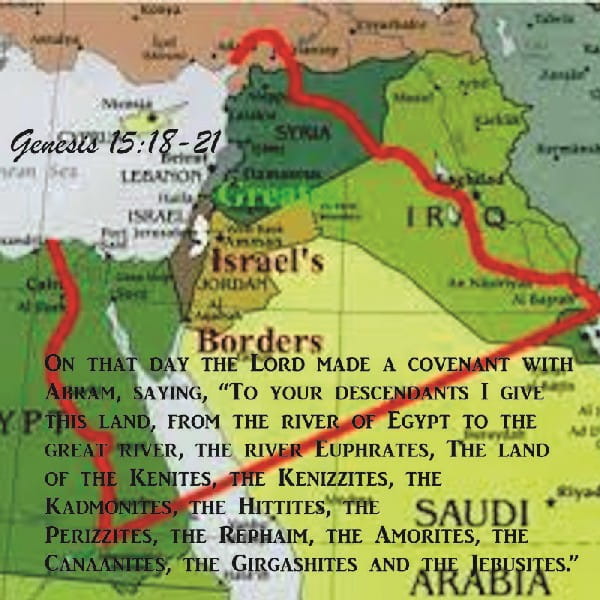
The Promised Land extends from the "river of Egypt" (often interpreted as the Wadi el-Arish or a tributary of the Nile) to the "great river, the Euphrates." This Promised Land is therefore an area much larger than the present-day Israel. The Israelites do not need to take possession of this land; it is God who will grant this land to the Israelites by virtue of this covenant. It is NOT human work! No human can stop God! When? The Bible does not mention that, possibly in the 1000-year Kingdom of Christ.
- Kenites: Lived in the extreme south and southeast, primarily in the northeastern Negev Desert, often around the city of Arad and in the region of Edom and Midian.
- Kenizzites: A nomadic or pastoral group that lived primarily in the Negev and the outskirts of Edom.
- Kadmonites: Also known as the "Children of the East." They lived in the far east and northeast, in the Syrian desert between the Promised Land and the Euphrates River.
- Perizzites: Scattered across the central and fertile lowlands of Canaan, mainly in the open land and hills south and southwest of Mount Carmel.
- Rephaim: A people of giants who lived in the mountainous region on both sides of the Jordan, including the regions of Bashan and the area around Hebron.
- Amorites: A powerful people who ruled over large parts of the mountainous region of Canaan (both east in Transjordan and west in the central hills).
- Hittites: In a Biblical context, they lived mainly in the mountainous region of Judea, around Hebron. (These are the Biblical Hittites, not to be confused with the great Hittite Empire in Anatolia).
- Canaanites: The collective name for the indigenous population of the coastal strip (Phoenician Coast) and the valleys along the Jordan River. They are descendants of Canaan, the son of Ham (who saw Noah's nakedness and was cursed because of it) and the grandson of Noah.
- Girgashites: A people whose precise location is difficult to determine, but who probably lived in the north, in the region of Galilee and around the Sea of Tiberias.
- Jebusites: A specific, powerful tribe that ruled over the city of Jebus, modern-day Jerusalem.
Sarai felt personally responsible for the absence of this child. She realized that, because she had never given birth to a child and her advanced age seemed to prevent it, something else necessary had been done so that Abram could have a child with another woman. She thought: "Behold, the Lord has prevented me from bearing children" (Genesis 16:2).
Therefore, Abram could be the father of a child, even though Sarai was not the mother.
The culture of that time provided the means to realize Sarai's interests. Ancient documents reveal that when a woman could not give her husband a child, she could give him one of her slaves as a wife and claim the child of that union as her own.
However, the consequences of Sarai's plan tell us that this proposal was a serious mistake.
When Sarai says, "The Lord has prevented me from having children..." we have here the sin of presumption. Not trusting God to give her a son, Sarai forced the situation, instructing Abram to take Hagar as his wife. Later in the book of Genesis, having more than one wife was always accompanied by conflict and competition (cf. Genesis 29:30 ff).
Perhaps she persisted with Abram until he accepted her proposal. Faith does not try to force God to act, nor does it act in His place, much less does it do what is supernatural in the power of the flesh.
Now Sarai, Abram's wife, bore him no children; but she had an Egyptian maidservant named Hagar (Genesis 16:1).
Is it mere coincidence that Hagar was Egyptian? There is a high probability that Hagar was a gift from Pharaoh to Abram, as part of Sarai's dowry (Gen 12:16).
In chapter 16, Abram is more of a fool than a patriarch.
What an opportunity for Abram to show his strength! But instead, he made a fool of himself. Obviously, with little or no protest, he passively obeyed his wife's instructions. She wanted an heir. And Abram did exactly what she told him to do.
Genesis 16:2b

Thinking from a woman's perspective: When Sarai made this proposal to Abram, did she really want him to accept it without question?
Was she asking him to say he loved her even if he could not give her a child? Was she asking him to restore his trust in God's love and infinite power? Did she need to be reminded of God's promise? Did she want him to say NO? Perhaps Abram obeyed without even understanding what she was trying to tell him.
Hagar also had her share of the blame. As far as I can tell, she was not wrong when she went to bed with Abram. She was a slave, subject to her mistress's will. She had little or no power of decision. However, she erred when she felt pride and contempt for Sarai.
He possessed her, and she conceived. When she saw that she had conceived, her mistress treated her with contempt (Genesis 16:4). It seems she gained Abram's favor, especially when he learned that she was carrying his child. She felt superior to her mistress, but she was still her slave. She boasted of what was not a reason for pride. And so, we see a sequence of sins, beginning in Egypt and ending in the bed of an Egyptian slave.
Genesis 16:5-6
Each of them — Sarai, Abram, and Hagar — was caught in the web of sin. Sarai acted presumptuously; Abram slipped into passivity; and Hagar was a victim of pride. And, in yet another round of sin, each of them reacted badly to the dilemma caused by their own mistakes.
Sarai discovered that the plan backfired. A child was born, but even though loved by Abram (17:18, 20; 21:11), she despised him (21:10). Ishmael brought discord between them, not unity. Even Hagar, who had once been loyal, now despised her mistress.
I gave my maid to your embrace, and when she saw that she had conceived, she looked on me with contempt. May the Lord judge between you and me!” (v. 5).
Despite all the religious words spoken by Sarai, they do not hide her guilt for what happened. Although she was furious with Abram, she had to know that she herself had made the bed for Hagar. There are no words of confession or sorrow from her lips, only bitter remorse.
Abram also did not change course. He should have learned that passivity is not synonymous with piety. Letting Sarai do things her way was renouncing his own leadership. He was complicit in Sarai's sin by not saying no to her or rebuking her. Sarai's tremendous scolding only served to push him further away. He did not acknowledge his sin, nor did he confront Sarai with hers. Instead, he continues to allow her to do things her way.
But Abram said to Sarai, “Behold, your maid is in your power; do to her as you please.” Then Sarai dealt harshly with her, and she fled from her (v. 6).
Before, he had agreed to her plan to produce an heir. Now, he gives her the freedom to deal with Hagar however she wants. Sarai seems to have acted within the bounds of legality, although she may have exaggerated the standards of morality. Hagar, tired of facing Sarai's tyranny, ends up fleeing, heading towards Egypt.
Genesis 16:7-12
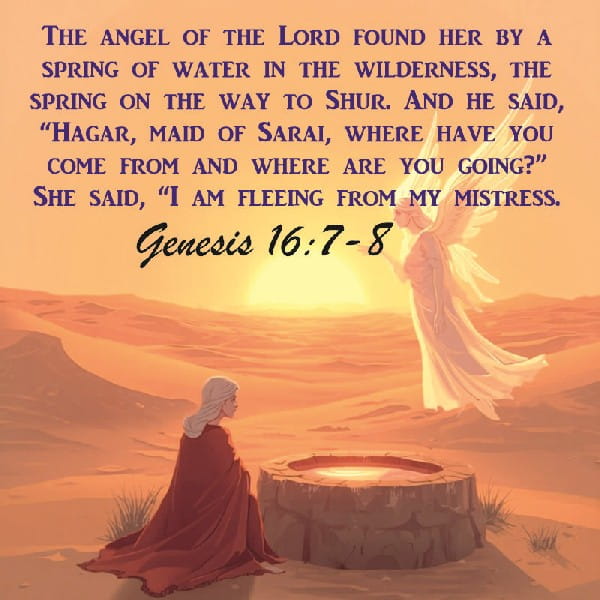
WHEN GOD NEEDS TO INTERVENE
Initially, when Abram and Sarai make the decision to have a child through their slave, we see no consultation with God. When things start to go wrong, Sarai mentions God. It is sad to remember that today we are also like that; we have our "brilliant ideas" on our own, we do not ask God for direction, permission, or anything else. It seems that when man chooses to follow his own path, God gets out of the way, leaving him to suffer the consequences of his disobedience. God speaks only to Hagar. He seeks her out while she is fleeing. The reason for this divine intervention is in verses 7 to 16.
Fleeing does not change relationships, nor does it remove responsibility. Jonah, even inside the belly of the fish, was still God's prophet with a message for the Ninevites. Hagar continued to be Sarai's servant and still had the duty to serve her mistress. The question "Where are you going?" seems to have been intentional to bring Hagar back to reality. Raising serious questions about Hagar's decision, God continues, reminding her of her obligations. He commands her to return to the one who has authority over her: "Return to your mistress, and submit to her" (v. 9).
(1 Peter 2:18-20) speaks of servants being submissive to their masters, even if they are wicked. This pleases God. In our days, we want to talk much more about pleasures and achievements than about duties and obligations. But what did God say to Hagar? To attend to her duty, even if it was extremely difficult and disturbing.
Along with the command, however, came a promise. In fact, the command was a condition for the fulfillment of the promise that is in verses 10-12.
Ishmael would live free, without restrictions, without shackles, and would be a thorn in the flesh of his brothers (v. 12) and deadly to his brothers. For Hagar, Sarai's distressed servant, this was a source of great hope and comfort. Even under her mistress's cruel hand, she could almost be heard murmuring, "You won't lose anything by waiting, Sarai".
Genesis 16:13
HAGAR - REJECTED BUT NOT ABANDONED - Who was Hagar? She was an Egyptian servant who was acquired by Sarai and Abraham when she, along with Lot, moved from Canaan to Egypt in order to escape the famine. The relationship between a servant and her master's wife consisted of honor, obedience and loyalty. Since Sarah was barren, Hagar could step in as a surrogate mother, which was perfectly legal, although it was a clear violation of God's law (see Genesis 2:24) and is evidence of Abraham and Sarah's lack of faith.
Now imagine that as a slave, Hagar never had anything, no family, no possessions, no husband... nothing. And then she was chosen to have the boss's child, she could not contain herself... as they say today, pride and self-worth went to her head. Maybe she thought she was better than her mistress, because she could give her boss a son, something that Sara, with all her wealth, could not. Maybe she even thought she could take Sara's place! There are people who are like this when they do not have much life experience, they act with pride when they achieve something.
Sara reacted and showed who the mistress was there. She started complaining to Abraham and he told her to take responsibility for her maid. So Sarah acted harshly, and because of Sarah's mistreatment, Hagar fled.
And it was in this situation that God revealed himself to this runaway slave (Thou art a God of seeing). This tells you that God is good and in the midst of our greatest afflictions He sees us and comes in our favor.
Hagar may represent the large number of resourceless and disadvantaged women today. They are not outside of God's watchful care under any circumstances. Just as God provided what Hagar needed, she will provide what you need. Twice the angel of the Lord came to assist her (Gen 16:7; 21:17). God was with Hagar and her son in periods of crisis and at other times too (Gen 21:10).
Hagar can also represent many abandoned single mothers who go through such near-death despair as happened to Ishmael, and there is no one to help you, it is just you and God. In the God who sees all things, Hagar found refuge and life. And the same God can do for you too.
Genesis 16:13-16

The predominant theme in verses 7-16 is expressed by Hagar in verse 13: "Thou art a God of seeing".
Her son's name served as a record of God's compassion for the afflicted. Literally, Ishmael means "God hears". Even when chosen by God as the source of affliction, He hears and cares for the oppressed. This truth greatly helped Hagar in the difficult years that followed.
Let me make one more observation. God spoke to Hagar in this chapter, but not to Abram or Sarai. In fact, Moses tells us that (at least as far as the historical record goes) God did not speak to Abram for 13 years (cf. 17:1). When we choose to act based on situations, God may only speak to us through those situations—loudly, clearly, and painfully.
It seems that Abram preferred to exercise the leadership he received from God through his wife, since he did not question her opinions or seek divine guidance (at least in our passage). Is it not interesting that Abram only knew what name to give his son through the words God spoke to Hagar (16:11, cf. verse 15)? When we choose to be guided by others instead of being guided by God, He may let us do things our way for a while. But, woe to us, how lonely that time will be! How we will miss His company and intimacy with Him!
One final observation. Many people want to help God save them. They want a system of salvation that allows them to participate in the salvation process. Friend, there is nothing you can contribute to your salvation. As the Scriptures teach,
...as it is written: There is no one righteous, not even one (Romans 3:10).
Just as Abram could not help God produce a son through human effort, you also cannot help God save your soul. Salvation is a gift from God, through faith in what Jesus Christ did for lost sinners.
The words of God in chapter 17 break the 13-year silence.
God reveals Himself to Abram in a very intimate way. He also manifests Himself more fully regarding His character and attributes. He refers to Himself as the "God Almighty", El Shaddai. This is the first time God is called by this name.
Just as Abram hears God refer to Himself by a new name, he also receives a new name, a symbol of his destiny:
"Behold, my covenant is with you, and you shall be the father of a multitude of nations. No longer shall your name be Abram, but your name shall be Abraham; for I have made you the father of a multitude of nations" (Genesis 17:4-5).
The obligation that rests upon Abraham and his descendants is that they be circumcised:
"This is my covenant, which you shall keep, between me and you and your descendants after you: Every male among you shall be circumcised" (Genesis 17:10).
In a way, circumcision seems like a very simple thing. How could God demand only that of Abraham? It is important to remember what God told him: "Walk before me and be blameless" (verse 1). Circumcision is not all that God requires of Abraham — it is, above all, a symbol of his relationship with God, and indicates how his moral conduct should be. Circumcision, for Abraham, means that he is bound to God in this covenant. He longs for His victories, but also submits to its terms.
And God said to Abraham, “As for Sarai your wife, you shall not call her name Sarai, but Sarah shall be her name. I will bless her, and moreover I will give you a son by her; I will bless her, and she shall be a mother of nations; kings of peoples shall come from her” (Genesis 17:15-16).
Sarah will indeed bear a son, and spiritual victories will come through him. You and I cannot have a static relationship with God. No, if we are truly born again, God will not allow that to happen. Perhaps He will allow us to fail, just as Abraham often failed. Perhaps He will leave us to our own devices, as He did with Abraham, remaining silent for thirteen years. However, sooner or later He will enter our lethargic lives and we will draw closer to Himself. In the Christian life, it all comes down to this.
IMMEDIATE obedience is the only type of obedience that exists.
DELAYED OBEDIENCE IS DISOBEDIENCE
Whenever God calls us to a duty, He is offering us a covenant with Him, performing the duty is our part, and He will do His part by blessing us richly.
The only way to obey is to obey "that same day," as Abraham did.
Luther said that "the true believer will crucify the question: Why?" He will obey without asking.
I do not want to be one of those who, if they do not see signs and wonders, the I would not believe. I want to obey without question.
Obedience is the fruit of faith; patience is the strength of that fruit.
Genesis 18:1-8
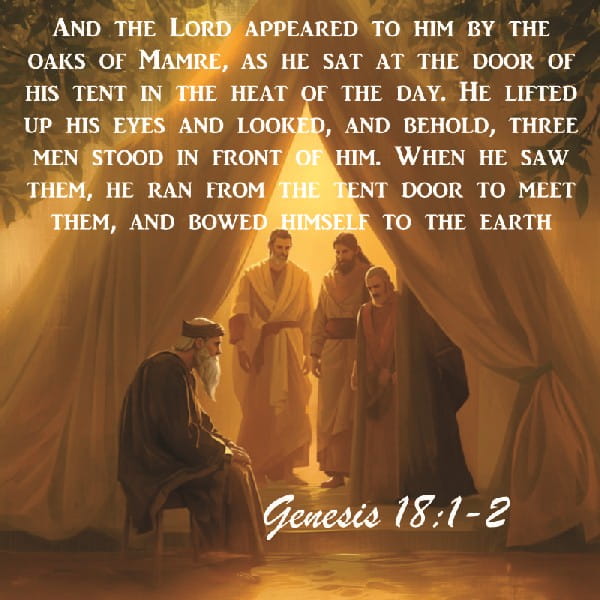
The Heavenly Trio and Abraham's Hospitality (18:1-8)
Although this is not the first appearance of our Lord to Abraham, it is certainly unique. Previously, God had spoken directly (12:1-3; 13:14-17), through a spokesman (14:19-20), by a vision (15:1ff), and in an apparition, which may have been accompanied by glory and splendor (17:1ff). Now, God comes to Abraham appearing as an ordinary man, accompanied by two others who are later identified as angelic beings (compare 18:2, 22; 19:1). Nothing is said to distinguish these three 'travelers' from any other travelers.
The timing made the need for hospitality even greater, as these guests would be thirsty and tired from the heat. Abraham's hospitality would be put to the test, as his "nap" would have to be interrupted so that he could serve his guests.
Abraham said, “My lord, if I have found favor in your sight, do not pass by your servant. Let a little water be brought, and wash your feet, and rest yourselves under the tree, while I fetch a morsel of bread, that you may refresh yourselves, and after that you may pass on” (vs. 3-5).
Any one of us would have gladly prepared such a banquet if we knew the identity of the guests, but it seems quite certain that Abraham did not yet know. Undoubtedly, the author of the Epistle to the Hebrews was referring to this when he wrote:
“Do not neglect to show hospitality to strangers, for thereby some have entertained angels unawares” (Hebrews 13:2).
What a scene that must have been! Abraham, standing, serving his Heavenly visitors, without knowing who they were. Meanwhile, beyond and below, lay the cities of Sodom and Gomorrah amidst tumult and festivities, enjoying the last day of the season of sin, and Lot somewhere there, still unaware of what that day would bring.
Genesis 18:9-14
Then the visitor asked, ““Where is Sarah your wife?” And he said, “She is in the tent.” The Lord said, “I will surely return to you in the spring, and Sarah your wife shall have a son.” And Sarah was listening at the tent door behind him. Now Abraham and Sarah were old, advanced in age; it had ceased to be with Sarah after the manner of women. So Sarah laughed to herself, saying, “After I have grown old, and my husband is old, shall I have pleasure?” The Lord said to Abraham, “Why did Sarah laugh, and say, ‘Shall I indeed bear a child, now that I am old?’ Is anything too hard for the Lord? (Genesis 18:9-14)
The Lord then assured him that within a year she would have a son. The essence of this promise is somewhat different from the previous promise, as recorded in chapter 17 (verses 19, 21). For Abraham, this must have resolved the question of the identity of his visitors.
Humanly speaking, a child was out of the question for both Abraham and Sarah. Their laughter was a combination of surprise, shock, exultation, and disbelief.
Here is a fundamental issue. The only reason for such distrust is a failure to understand the extent of God's ability to work in us and through us.
Sarah seems to have left the tent when Abraham was questioned about his distrust. Fearing, she denied laughing to herself. Curiously, she did not deny the thoughts denounced by the Lord. Her denial was quickly labeled false.
The mature Christian becomes less dependent on spectacular manifestations of God and more involved in daily intimate communication with Him. Previously, God had revealed Himself to Abraham with greater splendor and glory. This time God would not have been recognized were it not for prior knowledge of Him and the eyes of faith. God was recognized by His promises, by His word, not by a spectacular or splendid presence.
Can you have a more intimate communion than sharing a meal with God?

Many couples want to have children in their marriage. In fact, children are part of God's plan for a man and woman united in marriage since God instructed Adam and Eve to be "fruitful" and multiply (Gen. 1:28).
Sterility is defined by the medical community as the inability to achieve pregnancy after a year or more of sexual intercourse without the use of contraceptives or the inability to carry repeated pregnancies to term.
Barren couples were not abandoned by God. God does not give children to all couples. But this does not mean that He does not have a different blessing for your life. Notable women in the Bible were not associated with the blessing of bearing children: Midian, Esther, Priscilla, Mary and Martha, Mary Magdalene.
Sara had a good marriage with Abraham, it seems they had a common mind, affinities, she wanted to be a mother, build a family, he wanted to give her this happiness and agreed to the arrival of a son through Hagar. How would Abraham know that this would not be the son of promise? In chapter 15:4 the Lord said that Eliezer would not be the heir, but would be someone begotten by Abraham. BUT HE WHO SHALL BE BEGOTTEN OF YOU SHALL BE YOUR HEIR. He did not talk about Sara. He thought that Sara's idea might be good.
Following the story, we see that it went wrong, Sara and Agar did not adjust, there was no harmony. What happened was jealousy, intrigue and envy to the point that Hagar had to leave the scene with Abraham's long-awaited son.
Back to square one. Time passed and Abraham and Sarah entered the stage of impossibility, naturally speaking. Sarah may have thought that she did something wrong, that she hindered God's work and now God would no longer bless her. All lost. Her experience as a mother swings from feelings of skepticism, embarrassment, envy, and cruel criticism to a feeling of intense joy and ecstasy. Even though Sarah fell into sin, God faithfully kept the promise that she would be "the mother of many nations" (Gen. 17:16).
The name Isaac is linked to laughter. Isaac ("He laughs") shows not only the laughter of Abraham and Sarah, but that God also smiles on His children.
Genesis 18:17-18

- The inhabitants of two cities that existed while Abraham was alive were particularly bad, so God decided to destroy them. But God had a special relationship with Abraham, and this raised a question: 'Should I hide my intentions from Abraham', since I promised that he will become a great nation and a source of blessing for all people?
- How beautiful is the suggestion made by the divine soliloquy!!! 'Will I hide from Abraham what I am about to do?' God's friends are allowed to know his secrets, precisely because they are his friends. God regards Abraham as someone who had a right to know what he was about to do (Psalm 25:4; Amos 3:17).
- God revealed himself to be a plan for Abraham and then cities of Sodom and Gomorrah were destroyed. Abraham's descendants eventually became the nation of Israel. During the Millennium, Israel will be the great nation foreshadowed in the Bible.
The whole earth (believers) was blessed when Abraham's descendant named Jesus died for the sins of the world. Other blessings will be fulfilled at Jesus' second coming. Those who are part of the covenant with God have a special relationship with him.
Genesis 18:20-33
Verses 20 and 21 dramatically portray the sin of Sodom and the just occurrence of a holy God. The city's sin is so great that it practically cries out to Heaven for retribution (v. 20). God's personal interest and attention are described as "coming down" to deal with the matter. This does not mean that the text is conveying God's omniscience, for He knows all things. God is not "coming down" to learn about the facts, but to personally care for them and correct the problem. This is how Abraham understood that God would destroy the city, although this is not specifically stated.
Even speaking reverently, Abraham displayed unprecedented boldness before God.
"Then Abraham drew near, and said, “Wilt thou indeed destroy the righteous with the wicked? 24Suppose there are fifty righteous within the city; wilt thou then destroy the place and not spare it for the fifty righteous who are in it? 25Far be it from thee to do such a thing, to slay the righteous with the wicked, so that the righteous fare as the wicked! Far be that from thee! Shall not the Judge of all the earth do right?" (vs 23-25).
Undoubtedly, Abraham's primary concern was for Lot and his family. Although this is not explicitly stated, it is implied (19:27-29). His appeal was based on God's justice. Justice would not allow the righteous to suffer the punishment due to the wicked (v. 25). Abraham appealed to God to spare Lot, not so much to save the city or the wicked.
However, as we are informed in chapter 19, Abraham's hopes were greater than reality.
This would be a tragedy, were it not for a great divine truth: God's grace always exceeds our expectations. In a final analysis, there were only three righteous people in Sodom: Lot and his two daughters. Some questions about the righteousness of Lot's daughters may arise because of their behavior in the following chapter. Still, God remembered Abraham's request. Although He did not spare the city of Sodom, God spared the righteous. He is able and willing to do far more than we ask or imagine, as the Scriptures teach (cf. Ephesians 3:20).
If it were not for the words of the apostle Peter, we would never know for sure that the character known as Lot was a true believer:
"and if he rescued righteous Lot, greatly distressed by the licentiousness of the wicked 8(for by what that righteous man saw and heard as he lived among them, he was vexed in his righteous soul day after day with their lawless deeds)" (2 Peter 2:7-8).
Although this is not stated explicitly, it seems that Lot's insistence was motivated both by fear for the safety of the strangers and by his generosity. He must have known very well the fate of those who had no roof over their heads. In any other city, sleeping in the public square would not be uncommon or imprudent. However, the depravity of Sodom made Lot gently insist that his guests stay with him and share his table.
If Lot thought his guests entered his house unnoticed, he must have been very disappointed. Sick as they seemed, the men of the city had eagle eyes for any foreigner besides Lot. Their motives were depraved and their interests indescribable. In a short time, the whole city surrounded his house, trying to have sex with the strangers. What occurred was not a "liberal" attitude from a city whose laws permitted this type of consensual and private conduct between two adults. It was not even an indecent request to sin. In fact, it was an attempted rape of the worst kind. Just imagine, an entire city, from the youngest to the oldest. Surely, this prompts a drastic reaction.
Lot went out, closing the door behind him, hoping to solve the situation. He begged them not to be wicked and, just when we are about to applaud his courage, he offers his daughters to satisfy the depraved appetite of these degenerates. It is simply inconceivable! Lot's promptness (concern for his guests) turned into debauchery (willingness to give his own virgin daughters in place of the strangers). When the mob rejects his offer, one can even breathe a sigh of relief; however, it must be said that the consequences of this concession were yet to come.
Genesis 19:9-14
Lot lived in Sodom for twenty years, but to the men of the city, he remained a stranger. I suspect the reason he was left in peace all that time was because they still remembered Abraham's military might. If Lot were attacked, His uncle would settle accounts with them.
Over the years, Lot apparently contented himself with keeping his distance from the city's sin, but did nothing to combat it. Now, he acted as judge, speaking against their wickedness. This was too much for that mob. When finally asked to protest against their depravity, the crowd became enraged. First they would deal with Lot, then the two other visitors.
Lot, who supposed it was his duty to save the strangers, was rescued by them. By the words they spoke to him, they revealed to Lot their identity and what they were going to do. As for the men of the city, they were either blinded or had their vision distorted and blurred; The truth is that they groped around looking for the door until they were exhausted (cf. 2 Kings 6:18).
Verse 12-13a. The angels asked Lot, "Have you any one else here? Sons-in-law, sons, daughters, or any one you have in the city, bring them out of the place; for we are about to destroy this place".
In the last hours of the early morning, before sunrise, Sodom saw more missionary activity from Lot than in all previous years. However, his efforts were not focused on the people of that city, but rather on a vain and frantic attempt to save his own family, whose salvation he had neglected.
His in-laws were awakened and warned in a somewhat surreal way. It was like trying to preach the gospel at the last minute to someone on the verge of death. Undoubtedly, Lot's attitude must have given a very bizarre impression. Have you any one else here? Sons-in-law, sons, daughters, or any one you have in the city, bring them out of the place; 13for we are about to destroy this place (v. 14). Why? Why did not they take him seriously? Notice that it is not written that they did not want to believe him, but that they did not take him seriously. There seems to be only one possible explanation for this: He had never mentioned his faith. His words were not a repetition of a lifetime of warnings about sin and righteousness — they were entirely new and unprecedented.
Genesis 19:15-25
The day dawned without a single convert, much less a righteous soul to escape God's wrath. Time was up. The angels told Lot to take his wife and two daughters and get out of the city before judgment came.
The unbelief of the citizens of Sodom is to some extent predictable, but Lot's reluctance is unbelievable. Never has anyone tried so hard not to be saved. There are many reasons why he was reluctant and stalled during the rescue. First, in his carnal state, perhaps he did not fully grasp the reality and gravity of God's judgment. Second, perhaps he hoped that by delaying and postponing his departure, his friends and family might be preserved, for he knew that judgment would not come before he left (cf. verse 22). Third, he was so attached to his friends, his family, and the things "of this present age" that he could not bear the thought of leaving. Finally, he was literally dragged out of the city by angels.
The sun rose as soon as Lot, his wife, and his daughters arrived at Zoar (v. 23). When he was safe, out of reach of the devastation, the Lord rained fire and brimstone from heaven upon the cities of the valley. Many suggestions have been made about the causes of this destruction. Although it is possible that natural means were used, such as lightning, earthquakes, or volcanic eruptions, this does not mean that a miracle did not occur. The judgment came from the Lord (vv. 19:13-14; 24-25), arrived at THAT hour, and He was in absolute control of both its extent and its duration (vv. 22, 24-25). The devastation destroyed four cities, including the land on which they were built. It was complete devastation.
RECURRING SINS
We all struggle with recurring sins. They are like a piece of furniture you constantly bump your shin against. At some point, you think you will learn to avoid it. But when time passes and you stop thinking about it — Bam! You bump it again.
Genesis 20 shows us Abraham, the father of faith, bumping his shin against the same piece of furniture. He makes the same mistake he made in chapter 12: he claims Sarah is his sister, and she is taken into a king's harem.
After the peak of Abraham's communion and prayer (chapter 18), you would not imagine this could happen. If the Bible were a fairy tale, it would not. But the Bible is a realistic book that shows us the humanity of all its heroes. Abraham's weaknesses show us the struggles of the life of faith and give us hope. If God could work with a sinner like Abraham, then He can work with me!
There is a delicate balance here. If the text only portrayed Abraham's sin and God's grace, we might be inclined to permissiveness: "Do not worry about your sin, because God is merciful". But the chapter does not allow for this erroneous application. God's holiness and the harm caused by our sin are balanced by His grace, so that we do not treat our sin lightly.
Why did God appear to Abimelech but not to Abraham? Why did not God stop Abraham from his foolish action? The reason is that God sometimes allows us to fail to teach us that our salvation depends entirely on His sovereign grace and not on ourselves. This event occurred on the eve of Sarah becoming pregnant with Isaac. This would not have happened if she had been in Abimelech's harem. In his attempt to protect himself, Abraham almost thwarted God's promise to give him a son through Sarah the following year (18:10). This grave failure, right before the fulfillment of the promise, showed Abraham, once again, that if God's promise were to be fulfilled, it would be entirely because of God and not because of Abraham.
Genesis 20:3-9
As strange as it may seem, Abimelech far surpassed Abraham in this passage. We must admit that there is no sin into which a Christian cannot fall in moments of disobedience and unbelief. In these moments, unbelievers can shame the Christian regarding their integrity and morality.
What makes this passage so surprising is not the fact that Abraham regressed so much in his spiritual growth and maturity. Although Abraham's unfaithfulness is no surprise, God's faithfulness to him in this moment of failure is admirable.
Even if his own character demanded that he remain faithful to the promises, I would not have revealed to Abimelech that Abraham was a believer, albeit a carnal one. And yet, God revealed the fact that Abraham was the object of His special care. More than that, Abraham was identified as a prophet (v. 7). He was God's representative and the intermediary through whom Abimelech was to be healed.
This must have left Abimelech perplexed. How could Abraham be a man of God and, at the same time, a liar? Abimelech, however, did not have the opportunity to take punitive measures, despite the problems that Abraham's disobedience had caused the king's house. Abraham was the source of Abimelech's suffering, it is true, but he was also the solution. Abimelech and Abraham found themselves in a very delicate situation.
The next day, Abimelech rushed to return Sarah and gave Abraham a tremendous reprimand. In verse 9 he says: "What have you done to us? And how have I sinned against you, that you have brought on me and my kingdom a great sin? You have done to me things that ought not to be done!"
Abraham here is like one of our children who is caught red-handed. He regrets being caught, but does not repent of the wrong he has done.
Verse 17 says that Abraham prayed to God, and God healed Abimelech, his wife, and his female servants so that they could have children. Take a few moments to reflect on the lessons of this story.
The events in verses 1-7 can be viewed from three different perspectives. In verses 1 and 2, we see the divine dimension in the birth of the son as a gift from God. Verses 3-5 record Abraham's reaction to the birth of this son. Finally, in verses 6 and 7, we have Sarah's joy at the arrival of her long-awaited son, who is the joy of her life.
But the birth of Isaac threatens Ishmael, Abraham's son with Hagar. For 13 years, he was the only heir, the center of his father's attention, the hope of his father's dreams. But now he is sidelined in favor of this newcomer. Thus, tension in Abraham's family begins to grow. It reaches its peak at the feast held for Isaac's weaning, probably when he was about two or three years old. Ishmael mocks Isaac, and Sarah gives an ultimatum: "Cast out this slave woman with her son [Sarah doesn't even use their names]; for the son of this servant will not be an heir with my son Isaac" (21:10). Abraham is plunged from the heights of joy to the depths of sorrow because of his love for his son.
Abraham was conflicted; after all, Ishmael was as much his son as Isaac. Sometimes it is hard to say goodbye to those we love. But observe this principle carefully: just as... darkness comes before dawn, so difficulty often precedes triumph. Problems may come from various sources... but God will provide a way out.
Evidently, Ishmael provoked Isaac (verbally, physically, or both, we do not know), ridiculing him, mocking him, and this caught Sarah's attention. Ishmael is already a teenager, probably 16 or 17 years old. Abraham faced the most difficult decision of his life. Should he make Sarah face reality and learn to live with Hagar and Ishmael? Or should he yield to her request, which was clearly based on jealousy, and send Hagar and Ishmael away? At that moment, the Lord intervened and told Abraham to do what Sarah had said (21:12). And why did God side with Sarah?
Genesis 21:12
Frankly, this is a bit surprising. From Hagar and Ishmael's perspective, it seemed unfair. Hagar had no choice regarding the conception of Ishmael with Abraham. Ishmael did not ask to be born in that situation. His jealousy toward Isaac is understandable for a teenager. While Sarah's attitude was also understandable, it was not commendable. So why did God side with Sarah?
God's reason is stated: "for through Isaac shall your descendants be named" (21:12). God was not endorsing Sarah's jealousy, but in His sovereign purpose, He chose Isaac to be the one through whom His blessing would flow to all nations. Being God, He has the right to make such sovereign choices without giving us the reasons (see Romans 9). But in this case, we can discern the reason behind God's choice.
Isaac represents that which only God can do. Sarah had always been barren. Now, due to their age, Abraham and Sarah were physically unable to have a child. Thus, Isaac was the result of God's power, independent of human ability. But Ishmael represents what man can do without God. Abraham and Hagar conceived Ishmael through natural means Galatians 4:21-31. Paul says that this story has a spiritual lesson behind it. Ishmael was born according to the flesh, but Isaac was born according to the Spirit (Galatians 4:23, 29). Abraham and Sarah could not boast in Isaac, but they could glorify God only through him. Abraham, however, could boast in Ishmael because he was the one who fathered him.
God chose Isaac so that we would know that the life of faith requires total dependence on God, so that all the fruit comes from Him. That which comes from our flesh, that which we can do independently of God, will never please Him. It exalts human pride and steals God's glory. That which the Spirit produces in us and through us brings to God the glory due to His name. Therefore, although it seems unjust that Hagar and Ishmael were expelled, this was necessary for God's purpose and glory.
Genesis 21:13-16
We should note that both Hagar and the boy are important figures in Abraham's heart. Until then, Hagar had been referred to as Sarah's servant, but here she is called "his servant" by God. Sarah, as we recall, was very jealous of Hagar and her son (cf. Genesis 16:5). It is impossible for a man to enter into an intimate relationship like the one Abraham had with Hagar and simply leave. Sarah knew this, and so did God. In a way that went beyond the physical, Abraham had become one with Hagar, and Ishmael was proof of that union.
In chapter 17, God refused to accept Ishmael as Abraham's heir. Isaac, God insisted, would be the heir of the promise (17:19). Therefore, it was necessary that Ishmael be sent away and forever eliminated from the status of heir. For this reason, Sarah's demands had to be met, and Ishmael had to be sent away. However, the promises that God had made to Hagar (16:10-12) and to Abraham (17:20) concerning Ishmael would be fulfilled: "I will make a nation of the son of the slave woman also, because he is your offspring" (v. 13).
Abraham rose early to say goodbye to Hagar and Ishmael. Certainly, leaving early would be prudent in the desert, since journeys should be made in the cool of the day. Furthermore, an early departure would facilitate the farewell without Sarah's interference. Abraham probably wanted to express his deep love for Hagar and Ishmael without encountering a hostile audience.
Some suggest that Hagar got lost in the desert and that this explains why she "wandered in the desert of Beersheba" (v. 14). Finally, the provisions Abraham had given them ran out, and death seemed imminent. The boy was not a baby, as we might suppose, but a teenager, since he was almost fourteen years older than Isaac (cf. 17:25). Not wanting to see him die, Hagar left Ishmael some distance away, under the little shade offered by the bushes. Then she raised her voice and wept. Even in the most difficult moments of pain, God, in his grace, softens. the suffering of those who cry out to Him.
Genesis 21:17-21

Many times despair grows so much in our minds that we become blind and paralyzed to the solution, which is sometimes so close to us. This happened to Hagar.
The solution to Hagar's problem was already there. Because of her tears, she could not see the well nearby. Most likely, the well was not a visible structure, just a small water source hidden among the bushes. God then made her see things as they really were, and she and the boy were refreshed and revived.
We also see God's compassion for Hagar and Ishmael. She abandoned him, thinking he was about to die. She begins to sob. But in verse 17, it says that God heard, not Hagar, but the boy's cry. Then He calls Hagar and shows her the well of water she had not yet seen.
The point is that, many times, we think we are the only ones who care about our suffering loved ones. We cry out to God. But God has already heard their cry even before He heard ours! He cares about them far more than we do! Even in the most difficult moments of pain, God, in His grace, eases the suffering of those who cry out to Him.
Genesis 21:22-34

Verses 22-34 describe a particular incident in Abraham's life. The agreement made between him and Abimelech is important both to him and to us. By implication, the agreement says much about Abraham's fears and faith.
At that time, Abimelech and Phicol, the commander of his army, said to Abraham, “God is with you in allng you do. now therefore swear to me here by God that you will not deal falsely with me or with my offspring or with my posterity, but as I have dealt loyally with you, you will deal with me and with the land where you have sojourned” (Genesis 21:22-23).
They recognized that the main reason they approached Abraham was because he was a person beloved by God.
Abimelech sought to make a deal with Abraham because he never wanted to fight against him. To contend with Abraham was to attack Abraham's God and to contend with Him. On the other hand, to make a covenant with Abraham was to have God on his side. No wonder Abimelech was so eager to make this agreement.
However, do you see the lesson this must have taught Abraham? He had lied to Abimelech about Sarah, because he thought that in that place there was no fear of God and therefore, in a pagan nation, there was no protection for him (cf. 20:11). God rebuked his unbelief through this testimony from Abimelech's lips.
As a lesson from this passage, we learn that most of our fears are totally unfounded. Abraham was concerned about his safety and that of his wife. He believed that God would be obeyed and His people protected only where He was known and feared. Abraham was to learn from the deal made with Abimelech that God cares for those who are His. If Abimelech did not dare to take a well of water, how much less a wife or a life. All of Abraham's schemes were in vain. Faith rests on the promises of God's covenant; fear is meaningless.
Do you belong to Him, my friend? If you believe in the saving work of Jesus Christ on your behalf, then you belong. And if you belong, God takes care of you. Those who belong to Him need not fear, for He is with them; indeed, He is in them. And, the greatest of all wonders, He treats us with grace. He is faithful.
Several factors must be considered to understand this proof properly. First, we must admit a strong bias in this matter. We, as parents, feel repulsed at the mere thought of sacrificing our children on an altar. Therefore, we project our aversion onto God, assuming that He also never considered it. Second, we view this command from the perspective of the culture of that time, which actually practiced child sacrifice. If pagans practiced it, and God condemned them for it, the practice must be wrong in any context.
But we are forced to conclude that the sacrifice of Isaac could not be wrong, whether it was merely attempted or carried out, because God is incapable of doing evil (James 1:13 ff; 1 John 1:5). Much more than that, it could not be wrong to sacrifice an only son because God truly sacrificed His only Son:
"For God so loved the world that he gave his only Son, that whoever believes in him shall not perish but have eternal life" (John 3:6; cf. Matthew 26:39, 42; Luke 22:22; John 3:17; Acts 2:23; 2 Corinthians 5:21; Revelation 13:8).
In this sense, God did not ask Abraham to do something that He Himself would not do. In fact, God's command was intended to foreshadow what He would do centuries later on the cross of Calvary.
Only by understanding the typological importance of the "sacrifice of Isaac" can we understand that God's command is holy, just, and pure. Abraham's willingness to renounce his only son humanly illustrated God's love for mankind, which led Him to give His only begotten Son. The profound agony experienced by Abraham reflected the Father's heart in the face of His Son's suffering. Isaac's obedience typified the Son's submission to the Father's will (cf. Matthew 26:39, 42).
Abraham's faith was amply demonstrated in his complete willingness to fulfill God's will. Without a doubt, if God had not intervened, Isaac would have been sacrificed. In practice, Isaac had already been sacrificed, so the act was unnecessary.
May we have the same obedience, faith, and courage as Abraham to surrender everything to God without reservation.
DEALING WITH DEATH REALISTICLY
How should we think about and deal with death, whether it is the death of loved ones or our own?
This question has caused some confusion among God's people. Some say that, since Christ conquered death, we should be joyful and victorious amidst it all. They deny the grieving process. Others are quick to explain how God will make all things work together for good, which is true. But we still feel sadness and pain.
Death is the ultimate test of our faith. Being a faithful Christian does not exempt us from death, unless we are alive when Christ returns. We cannot escape it nor postpone it when our time comes. As Christians, we need to face death realistically.
There is the reality of loss and grief. Even though Sarah lived a relatively long life (she is the only woman in the Bible whose age at death is mentioned), Abraham mourned and wept when she passed away. It is never easy. There is nothing unmanly or unbiblical about crying during a time of grief. Jesus himself wept at Lazarus' tomb (John 11:35). Paul tells us to weep with those who weep (Romans 12:15). There is also the reality of loneliness, as the loved one is no longer with us.
Death brings the harsh emotional realities of loss and loneliness, even for a man who is a special friend of God. There is no problem in saying, "Even with God, it will be difficult!"
Death, even for believers, brings harsh realities. It always hurts, always leaves us with an emptiness in our hearts. Often, it also brings harsh financial realities. The Lord does not spare us these things just because we believe in Him. But, along with the pain, which reminds us of our sin as the reason why death entered this world, He gives us the hope of His promises. Christ died for us, so that the sting of death would no longer exist. Yes, we suffer with the death of loved ones, but we do not suffer like those who have no hope. He went to prepare a place for us. We will be reunited with our loved ones who have fallen asleep in Jesus!
Abraham was already quite old, Sarah had died some years before, and now came the concern of a father who did not know how much longer he had to live and wanted to leave his son married with a settled family.
Abraham's servant stood out for his fervent obedience and attention to the instructions given to him. He diligently carried out his task, without eating or resting until it was completed. There was a sense of urgency, perhaps the perception that his master believed time might be short.
We see that God guides His children, once in motion, through "his angel" (v. 7). All true Christians are guided by the Holy Spirit (Romans 8:14). He prepares the way for us to walk according to His will and feel His direction. We must proceed in faith, just as Abraham did, knowing that God guides us.
God's will was discerned through prayer. The servant presented a plan to God, by which the woman who would be Isaac's wife would become evident. It was not about a fleece of wool, but rather a test of character. The servant could thus determine the character of the women he would meet. God, providentially (through circumstances), brought the right woman to the servant, and, by her generous act of giving water to the camels, she proved to be the one chosen by God to be Isaac's wife.
Humbly, he prayed for guidance, but wisely proposed a plan that would test the character of the women he would meet. There was no spectacular revelation, nor did there need to be. Wisdom could discern a woman of great worth.
If you are in this phase of life, seeking marriage, invite God to participate in your search; don't despair thinking that all is lost and you should marry just anyone outside of God's will. Pray, wait, trust, and when you find someone, put them to the test with God, ask for discernment, and know that God is very interested in helping you with the person to be chosen.
Genesis 24:12-28
Abraham’s religious faith clearly influenced the servant, who was also a deeply devout man. Stopping by the well just before the time when young women would come out to draw water, he lifted his voice in prayer. His greatest desire was that the choice of a wife for Isaac not be his own decision, but rather God’s choice.
To know God’s guidance, we must set aside our own will and seek the will of the God who called us. This is the fundamental principle for determining God’s will in any situation: to empty oneself, as much as possible, of one’s own will and commit to seeking and obeying God’s will.
Aware of his own difficulty in discerning God’s will, he asked the LORD God to reveal His will through a series of events. These events would also serve a second purpose: revealing the young woman’s character.
The servant was in the right place at the right time, and he entrusted his needs to God. BEFORE HE HAD FINISHED SPEAKING, the answer to his prayer began to unfold before his eyes. REBEKAH, Abraham’s niece, appeared by the well. Stunned, Eliezer saw his request fulfilled to the letter. He asked about the young woman’s family. Upon learning that she belonged to Abraham’s lineage, he expressed great joy; verse 26 tells us that the man bowed down and worshipped the Lord.
God’s actions in the lives of those who follow Him align with the promises made to them. Yet, there was another surprising outcome: the servant conducted himself obediently throughout the journey, remaining completely open to the LORD’s guidance.
But be warned! Just as it was harder for Abraham to find a wife for Isaac among his own people than among the Canaanites, it will also be harder for you to find a spouse committed to God’s purpose. Let us face it: there are many handsome and attractive single pagans out there. There are also many handsome and attractive churchgoers who live for themselves, not for Christ. Yet, it can be quite difficult to find a single and God-fearing person.
And when you see other single Christians marrying people who are not as committed to the Lord, it is easy to start thinking, "Maybe I am being too rigid. Maybe there are some Canaanite young women (or men) out there". But if you want God’s guidance regarding a spouse, you must remain unwavering in your commitment to God and His purpose.
Genesis 24:67

Not every love that starts quickly, starts right. The story of Isaac and Rebekah reveals a path different from what we are accustomed to today. It was not impulsive; it was not based solely on feelings. It was guided, tested, and aligned with God.
Isaac did not go out looking for just anyone. Rebekah was not trying to be found. Yet, they found each other.
When God is involved, the right encounter does not depend on haste, but on alignment.
Before Isaac met Rebekah, someone was praying. Before the meeting, there was guidance. Before the connection, there was dependence on God.
We tend to do things the other way around. We get involved first, then pray for it to work out. We connect first, then ask if it was God's will.
Relationships do not begin at the meeting; they begin with the decisions you make beforehand. If you are not clear about what you are looking for, just about anyone can seem like the right person. It goes deeper than that: if you are not aligned with God, even the right relationship can arrive at the wrong time.
Relationships fall apart because they were built on versions of people, not on truths. You cannot sustain a relationship based on an edited version or the image projected at the beginning. And even more importantly: you do not need someone perfect; you need someone with character.
Character does not reveal itself in public or in displays; it shows up in the small details, in words spoken in private, in invitations, and in how one treats others in everyday situations. Pay attention to that, to the details. To how they treat people who can offer nothing in return. To how they react when no one is watching.
What does the phrase "he loved her" mean? The verse is remarkable because it shows a clear dynamic: love emerged after their union and life together. Rather than being a case of blind, purely impulsive passion, Isaac's love for Rebekah developed through commitment, marking the beginning of a new family within the lineage of the promise.
What does the phrase "he took Rebekah and she became his wife"? mean. Isaac had a sexual relationship with her. This means that sexual intercourse constitutes marriage. There is no such thing as casual sex or sex without commitment. If you have sexual relations with another person after that, it amounts to divorce and remarriage. God hates that.
Evaluate your relationship (or future relationship). Be honest: Is there direction, or just emotion? Is there purpose, or just companionship? Is God at the center, or is it simply a desire not to be alone?
We have already encountered Hagar (Genesis 16:1–16 and 21:8–21), and now we are introduced to Keturah. "Abraham took another wife, whose name was Keturah" (25:1). Like many men of faith in the Old Testament, Abraham had more than one wife. It was common to have multiple wives in order to bear children. But this practice was contrary to God's will for marriage, which states: "herefore a man leaves his father and his mother and cleaves to his wife, and they become one flesh." (Genesis 2:24). This practice was a concession to cultural standards that contradicted God's standard. It conflicted with God's intention for marriage, just as divorce did.
It is important to note that Abraham loved Sarah and grieved her passing; he continued to live with Hagar at Sarah's request.
However, it is important to note that these concubines never enjoyed the same status as Sarah which perhaps explains why their sons received gifts from Abraham (Genesis 25:6) but did not share in the inheritance with Isaac.
Aside from her name, the only thing we really know about Keturah is the names of the six sons, seven grandsons, and three great-grandsons she bore to Abraham (25:2-4). We know little else beyond the names of these descendants of Abraham. What we do know is that Abraham sent them "eastward to the east country" (25:6b) likely to Syria or Arabia (cf. the sons of Ishmael, Genesis 25:18) where they became the progenitors of six Arab tribes (cf. 1 Chronicles 1:32-33). We also know that the descendants of Midian (the Midianites) became fierce enemies of Israel.
Therefore, a biblical lesson taught by this account of the end of Abraham's life is that godly parents do not always have godly children.
It is sad, is not it, that a godly and faithful man like Abraham fathered descendants who became so ungodly and so opposed to God's people? What we learn from this is that godly parents can raise their children in the "discipline and instruction of the Lord" (Ephesians 6:4), but they cannot control how they will develop spiritually. To this end, we must entrust our children to God's sovereign care and control. Again it is a fruit of the flesh, a failure to control sexual desires and that at an advanced age.
Genesis 25:21
Isaac, Abraham's son, married at the age of 40. Rebekah, his wife, was barren, and he prayed for her during 20 years. When Isaac was 60 years old, Rebekah was healed in answer to his prayer, conceived and gave birth to the twin sons, Esau and Jacob.
Lessons on Isaac's prayer:
- There is no lost cause when we put it in the hands of God.
- Victory in prayer requires perseverance. Isaac did not fail to insist on God.
- He was specific in his prayer.
Time of praying is necessary, to experience the power of God through prayer!
Genesis 25:21-23

With the genealogy and life of Ishmael concluded, Isaac and his descendants become the primary focus of the remainder of the Biblical narrative. Another genealogy begins, distinct from Ishmael’s. Ishmael’s line is recounted briefly; all his sons are listed, along with the regions where they settled. Then, the genealogy of Isaac begins: "This is the genealogy of Isaac, son of Abraham" (v. 19).
However, much like her mother-in-law Sarah, Rebekah struggled to conceive: she was barren. Instead of attempting to have children through concubines or other wives, Isaac turned to God for help: "Isaac prayed to the Lord on behalf of his wife, because she was barren" God’s intervention appears to have been immediate: "The Lord granted his prayer, and Rebekah his wife conceived" (v. 21).
The pregnancy was difficult. Rebekah felt "the children struggled together within her" (v. 22). She was carrying twins, and their movements were so vigorous that they distressed her; it seemed as though they were fighting one another. Yet, she did not necessarily know the reason for the struggle, nor did she realize she was carrying twins rather than a single child. A pregnant woman feeling such intense movement within would naturally grow anxious and wonder if something was wrong. Given her previous difficulty in conceiving, one can imagine Rebekah’s anxiety that the pregnancy might end in a miscarriage.
So, she inquired of God to discover the reason. The Lord’s answer confirmed the significance of the activity within Rebekah’s womb:
And the Lord said to her: "Two nations are in your womb, and two peoples, born of you, shall be divided; the one shall be stronger than the other, the elder shall serve the younger" (v. 25:23). Without all the sophisticated medical tests used today, God informed Rebekah that she would give birth to twins. He also revealed that these twins would form two nations that would struggle against each other, and that the younger would prevail over the older.
This prophecy is a highly significant revelation—not only for Rebekah but also for Christians of our time—as it points to the principle of divine election.
Genesis 25:23

She sought an explanation from the Lord regarding the struggle taking place within her womb.
"Jehovah answered her: 'Two nations are in your womb, and two peoples, born of you, shall be divided; the one shall be stronger than the other, the elder shall serve the younger.'" (Genesis 25:23).
God then revealed to Rebekah that she would bear two sons — two peoples, that is, two nations. This was a special kind of "revelation" from God Himself. The two nations and the two peoples would come forth from Rebekah's womb; she would bear more than just two babies — she was carrying two great groups of people.
Each son would grow up to be the father of nations: the nations of Edom (Esau) and Israel (Jacob). These two nations would wage many battles against each other throughout history. The two brothers would also experience conflict with one another throughout their lives, setting the stage for an ongoing struggle between the Edomites and the Israelites. Ultimately, God declared, "one people shall be stronger than the other." The stronger people would be the Israelites (Jacob), and the Edomites (Esau) would be the weaker.
In Romans 9, the Apostle Paul referred to this incident as an illustration of the principle of election:
And not only this, but also Rebekah, when she conceived twins by one man, our father Isaac; for though the twins were not yet born and had done nothing good or bad — so that God's purpose according to His choice might stand, not because of works but because of Him who calls — it was said to her: "The older shall serve the younger" (Romans 9:10-12).
Although we must acknowledge that God, in His omniscience, knew all the deeds of both sons from eternity, Paul asserts that the choice of Jacob over Esau had no connection whatsoever to the deeds they would perform. Jacob was chosen while still in his mother's womb, regardless of the deeds he would do in the future. In other words, it was God's election.
Esau was born first, emerging from the womb red and hairy. Jacob came out of the womb grasping his brother Esau's heel. The name Jacob was suggested by the Hebrew word for "heel."
Genesis 25:29-31
Living in pursuit of instant gratification will deprive you of spiritual blessing.
1. You can lose great blessings if you do not value them.
Esau was born into a situation of great blessings. He was not born into a pagan home where his parents worshipped idols and mistreated him. He was the son of Isaac and Rebekah, and the grandson of Abraham, the friend of God.
The fact is that each of us possesses great spiritual privileges: we hear the gospel, we have the Bible, and we live in a free country where we can attend a church that teaches the Bible and meet other Christians who can help us grow in our walk with God. But, just as Esau despised his birthright, we can lose all these spiritual blessings if we do not value them.
2. Small choices can have drastic consequences.
Esau’s decision was impulsive, yet it stemmed from years of neglecting spiritual matters. Hebrews 12:16 calls Esau an ungodly (or profane) person. He lacked God’s perspective on life. He was unconcerned with spiritual matters. He lived for the here and now. "Who needs a birthright?" he thought. "After all, I could die tomorrow. What I need right now is a good meal. What good is a birthright if I starve to death?"
Those who reject God’s moral standards often justify themselves by saying they needed to satisfy their "needs." We are accepting the idea that our needs take priority. After all, the argument goes, if you do not love yourself first, you cannot love God and others! But Jesus says: "God knows your needs, and you can trust Him to take care of them. Your true need is to seek first His kingdom and His righteousness" (see Matthew 6:31-33).
3. It is easy to mistake something for essential when, in reality, it is not.
Esau thought he needed food. This sounds like an essential need, but it is not. His essential need was to obey God and seek His purpose.
4. It is easy to cling to the right things for the wrong reasons and in the wrong way. Jacob was right to want the birthright, but wrong in his motive and the way he obtained it.
Genesis 25:32
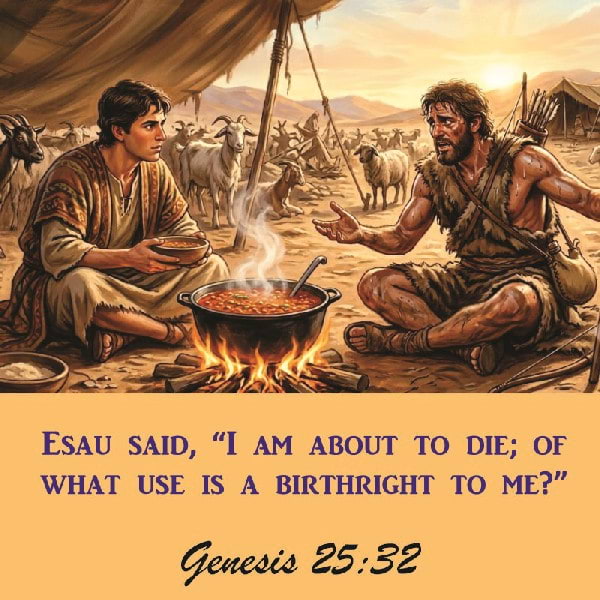
The right of primogeniture was the right to rule over the family. By selling his birthright, Esau was expressing a lack of interest in his future inheritance. He was saying, "I do not care about the future; I only want to satisfy my appetite today." Esau's fundamental attitude—trading a future and a great inheritance reward for a meal that would satisfy him for only a few hours—serves as an example of an attitude believers must be careful to avoid:
"See to it that no one fail to obtain the grace of God; that no “root of bitterness” spring up and cause trouble, and by it the many become defiled; that no one be immoral or irreligious like Esau, who sold his birthright for a single meal. For you know that afterward, when he desired to inherit the blessing, he was rejected, for he found no chance to repent, though he sought it with tears" (Hebrews 12:15-17).
The greatest reward for faithfulness appears to be sharing in Christ’s reign (Revelation 3:21; Philippians 2:5-10; 2 Timothy 2:12). We lay hold of the reward of our inheritance by living as faithful witnesses who endure hardships yet continue to walk in obedience to Christ (Colossians 3:23; Revelation 1:3; 3:21). All believers are children of God and possess God unconditionally as their inheritance simply by believing in Jesus (Romans 8:17a). However, some believers will receive the reward of being "co-heirs with Christ" in the reign over the new earth. Earning this reward comes with a condition; Believers in Jesus are:
"heirs of God and fellow heirs with Christ, provided we suffer with him in order that we may also be glorified with him" (Romans 8:17b).
To be "co-heirs with Christ" is to share in His birthright as the firstborn over all creation (Colossians 1:15). The example of Esau tells us that if we prioritize the comforts of this world over walking in faithfulness to Christ—following Him in the suffering that comes from being rejected by the world for living and speaking the truth—then we are selling our birthright for a fleeting pleasure.
But it is interesting to note that there was a famine in that land. Which land? The Promised Land! The land God had promised to Abraham and his descendants — later described as flowing with milk and honey. There was a famine in that land. Although God could easily have provided abundant food for Isaac despite the famine all around him, He did not do so. The man chosen by God had to suffer alongside all his pagan Canaanite neighbors.
Trials are the common lot of God’s people; they always have been and always will be, until the Return of Jesus. Isaac did not ask, "God, why do You allow this famine in the Promised Land?" Isaac did not rebuke the famine in the name of the Lord. Admittedly, he did not react in the right way. But this was neither the first nor the last trial of this kind to strike God’s people in the Promised Land.
Trials are the normal experience of God’s people, even when they are exactly where He wants them to be. Somehow, we have internalized the idea that if God has called us to a place or a specific ministry, we will not encounter problems. Everything will be a bed of roses. When the path gets rough, we wonder what is wrong. "Perhaps I am not following God’s will."
Trials are the common experience of God’s people. And, following a passage that describes repeated disputes over wells with local herdsmen, the Lord appeared to Isaac and said (v. 24): "Fear not, for I am with you". The Lord never says "Do not fear" unless someone is afraid. Isaac had many fears.
Do you have any fears? We should bring our fears to the Lord in prayer and be open to asking for prayer regarding our fears. The people God uses are ordinary people with ordinary fears.
Had Isaac not faced difficulties in Gerar, he likely would have been content to stay there for the rest of his life. God used those difficulties to lead him back to where he was supposed to be.
Genesis 26:2-11
In verse 3, God commanded Isaac to remain in Gerar for a time. In verse 2, God promised Isaac that He would guide him to the land where he was to go at God's appointed time. The remainder of God's revelation is a reiteration of the Abrahamic covenant.
Repetition of Abraham's Sin (26:7-11)
What? Again? Unfortunately, yes. Strangely as it may seem, that same old sin of deception rears its ugly head for the third time in chapter 26. If nothing else proves it, this does: Isaac is his father's son. Fearing for his own safety, Isaac succumbs to the temptation to pass his wife off as his sister. In doing so, he was willing to risk Rebekah's purity as the price for his personal protection.
We are not told what role Rebekah played in all this. It is possible that she refused to actively cooperate, thereby arousing suspicion in the minds of the Philistines. Abimelech discovered the deception by observing Isaac's conduct toward Rebekah. He did not treat her like a sister, but like a wife. There may well have already been a seed of doubt in the minds of Abimelech and perhaps other Philistines, for when he saw Isaac caressing Rebekah... he said:
"...Behold, she is certainly your wife!..." (verse 9).
We know that lying is wrong (Psalm 34:13). But if we look closely, we can find an even deeper sin here. Both Abraham and Isaac lied because they were afraid. Both feared for their safety — which is understandable given the culture in which they lived. Yet, in both instances, God had just promised to be with them and to bless them. God ALWAYS keeps His promises. If God promised to be with them and bless them, would He allow them to be killed by wicked men who wanted to steal their wives? Of course not. We know that both were men of great faith — Abraham is even called the father of faith. But in times of trouble, Abraham and Isaac took their eyes off God's promise and focused on the dangers around them.
Genesis 26:13-25
Despite Isaac’s deception, God poured out His blessings upon him. For reasons we will discuss later, Abimelech did not recognize Isaac’s prosperity as a blessing from God. All he knew was that Isaac was a powerful figure — someone with whom he did not want to come into conflict. Abimelech also knew that the Philistines were becoming uneasy about Isaac’s presence in the land.
Now the Philistines had stopped up all the wells that his father’s servants had dug in the days of his father Abraham, filling them with earth (v. 15).
The Philistines' sentiments were concisely expressed in Abimelech’s succinct suggestion that Isaac leave Gerar (v. 16). Instead of fighting for possession of that property, Isaac withdrew. The meek would inherit that land, but in God’s perfect timing.
By all indications, Isaac developed a strategy for determining where he would settle. Essentially, Isaac refused to stay where there was conflict and hostility.
In verses 23 through 25, something very strange happens. Up to that point, Isaac’s decision regarding where to stay was based on the abundance of water and the absence of hostility. But now, having dug a well that was not contested, one would expect Isaac to remain there. Instead, we are told that he moved to Beersheba, with no apparent reason for the move: "From there he went up to Beer-sheba" (v. 23).
Isaac knew that God had promised to give him the land promised to his father Abraham (26:3–5). He finally understood that, through all the opposition regarding the wells he had dug, God was guiding him back to the promised land—back to the places where Abraham had walked in fellowship with God. It is likely that Isaac went up to Beersheba because he sensed, on a spiritual level, that this was where God wanted him to be. If God had previously been "leading" him through opposition, Isaac was now willing to be guided. Here lies a great lesson in faith and guidance: the place for God's people is the place of God's presence. The place of intimacy, worship, and communion with God is the place where we must remain.
What was this highly coveted blessing?
The patriarchal blessing served as a form of last will and testament. Oral blessings were considered just as irrevocable for all parties involved as a written contract. The recipient of the blessing was under divine protection; anyone interacting with him would incur a curse for cursing him and a blessing for showing him favor.
"I AM OLD, I DO NOT KNOW THE DAY OF MY DEATH"... It appears here that Isaac was ill and in a hurry. Because Esau was his favorite son, Isaac’s action disregarded God’s message to Rebekah "the older will serve the younger" (25:23) of which Isaac was certainly aware. It also ignored the sale of the birthright to Jacob. Yet, Isaac was far from death; we learn from Genesis 35:28 that he died more than forty years later at the advanced age of 180!
The second impression conveyed by verses 1–4 is one of secrecy. Normally, the blessing would have been bestowed before the entire family, as it was, in reality, an oral testament legally determining the disposition of all the father’s possessions. Had it not been for Rebekah’s vigilance, the entire matter would apparently have been settled with only two parties involved.
There is no doubt that Isaac intended, through this clandestine feast, to bestow his blessing upon Esau while completely excluding Jacob (which explains why Isaac had no further blessing to give Esau; cf. verses 37–38).
Whether out of a genuine or feigned sense of urgency, Isaac sought to secretly subvert God’s revealed will and Jacob’s legitimate claim by clandestinely bestowing an oral blessing. Through his deliberate participation, Esau disregarded the legal agreement he had made with his brother. In both instances, a meal provided the occasion for such deception. Sitting at the table of Abraham (and even that of Lot) meant receiving hospitality and protection, but sitting at the table with Isaac and his sons meant facing the dangers of deception and falsehood.
Genesis 27:5

Isaac sought to advance his own interests through cunning and deceit. God’s solution was to give Isaac a wife far more skilled in manipulation than he was. What a master of deception this woman was!
Rebekah could easily have met the requirements for a position at the CIA. She acted as a counter-spy in her son's service. She played the part of a faithful and loving wife, yet beneath it all, she sought to advance Jacob’s interests — even if it meant undermining her husband, Isaac. It was Rebekah, not Jacob, who masterminded the "mission impossible" of deceiving Isaac to secure the blessing for Jacob.
Such a plan could hardly have been conceived on the spur of the moment. Rebekah had likely been considering it for some time, and many of the props for the charade were already prepared. How could she have thought of such minute details — like the goatskin gloves and the coverings — in such a short time? And how could they have been crafted so masterfully in mere moments, well enough to fool Isaac? Did she happen to have Esau’s garments on hand, even though he was married and perhaps no longer living at home? Rebekah was too shrewd to leave such matters to chance or to last-minute improvisation. Thus, the scheme was orchestrated well in advance.
The complete absence of moral considerations here is baffling. Jacob did not rebuke his mother for the wrong she proposed. A simple statement would have summed up the matter concisely: "It is not right."
One question remains: "What should Rebekah have done in those circumstances?" Isaac was wrong in his intentions. Jacob was the son God had chosen to be the "heir of the promise." Yet, evil must not be met with evil; it must be overcome by good (Romans 12:21).
The first thing Rebekah should have done was to speak honestly and frankly with her husband about the sin he was contemplating. Submission to authority never includes silence in the face of evil. We must "speak the truth in love" (Ephesians 4:15), even to those who have authority over us (cf. Acts 16:35-40).
Genesis 27:18-24
Adolf Hitler believed in the use of the "Big Lie." Small distortions and lies might arouse suspicion, but the "Big Lie" would be so unbelievable that people would assume it must be true. When Jacob impersonated his older brother, it was nothing short of an ancient application of the "Big Lie" principle.
Jacob may never have intended for that lie to grow so large, yet it snowballed with every statement he made. It all began with the words: "I am Esau, your first-born" (v. 19). From there, lie upon lie began to pile up: "I have done as you told me" (v. 19); "eat of my game" (v. 19). In response to Isaac’s pointed question "Are you really my son Esau?" Jacob replied: "I am" (v. 24). Yet, the lie that makes one shudder to read it appears in verse 20:
And Isaac said to his son, "How is it that you have found it so quickly, my son?" And he answered, "Because the Lord your God granted me success."
Well, before hastily criticizing Jacob, consider how Christians today do the exact same thing. Jacob justified his sin by claiming God was his accomplice. We often say, "The Lord led me to..." when, frequently, it is something we had always wanted to do and finally gathered the courage (or the foolishness) to pursue. "The Lord told me to..." "The Lord blessed us with..." Be careful with such statements. They may be evidence of the same kind of thinking that led Jacob to tell his father that God had prospered him by providing a goat instead of wild game. With what pious words we seek to cloak our sin!
Genesis 27:25-30
One cannot ignore the fact that the decision Isaac made was based on all five of his senses: sight, hearing, touch, taste, and smell. The garments Rebekah had at hand were Esau’s, and they carried his scent as well.
It was not the scent of Esau’s deodorant, but rather the scent resulting from his absence, that gave him away. Even Isaac’s dulled senses did not fail to detect his son’s smell. Just imagine: in the end, Isaac was led by his nose.
Isaac’s error is illuminating in light of our scientific age, which insists on making decisions based solely on empirical evidence. If we cannot see, hear, feel, or smell something, then it does not exist. Let me say that the Fall of Adam and Eve in the Garden (Genesis 3) rendered all mankind sinful. Every aspect of our being has been contaminated by sin: intellect, emotions, and will. A man whose heart is at enmity with God can look at empirical facts and reach a completely false conclusion. The problem lies not in the facts but in the man, whose mind and heart lead him astray from the right path. So it was with Isaac; so it is today.
We are kept in suspense until the very last moment to see if Jacob will survive his father's interrogation and inspection. The blessing is not pronounced until the end, leaving us fearing that at any moment Esau might burst into the room, expose his brother's fraud, and bring a curse upon him, even as Jacob receives the blessing for himself. Moses tells us that Jacob had just left when his brother arrived at his father's house with the meal (v. 30).
While Isaac savored the taste of Jacob’s "game," Jacob savored the taste of his victory over Esau. He departed triumphantly and with a sigh of relief. Esau must have approached his father's bedside with an expectant look, sensing that the blessing was almost within his grasp. What a smug sense of satisfaction and vindication Esau must have been harboring! And Isaac? Finally, he had outwitted his wife and blessed Esau, or so he thought.
Genesis 27:31-45
How bewildered Esau must have been to see the look of terror on his father’s face and the violent trembling that shook his body as he lay in bed. What could have gone wrong? A sense of dread must have slowly gripped Esau as it became increasingly clear that his brother had, once again, gotten the better of him. The irony of it all was that, although Isaac had intended to give everything to Esau, nothing remained that could be considered a blessing for his favorite son, for everything had already been bestowed upon Jacob.
The consequences for Rebekah and Jacob are recorded in verses 41–45, but the tragic results of the scheme involving Isaac and Esau are evident earlier. Isaac had attempted to give everything to his favorite son, Esau, at Jacob’s expense. Instead, he ended up giving everything to Jacob at Esau’s expense. Isaac had set his heart on something contrary to God’s revealed will, and consequently, his world collapsed around him when God’s purposes prevailed. Esau had despised spiritual things, thereby selling his destiny for a meal. Later, he tried to reclaim it by renouncing his solemn oath and conspiring with his father to dishonestly recover what he had lost through his own profanity. Esau learned that there comes a point of no return in every man's life, a moment when repentance cannot reverse past decisions. In light of this Biblical understanding, all who have rejected Christ as Savior will live in eternal regret and remorse; yet, this will not undo the consequences of having chosen to live independently of God (cf. Luke 16:19–31; Philippians 2:9–11; 2 Thessalonians 1:6–10; Revelation 20:11–15).
It also demonstrates how dangerous it is to favor one child over another.
Genesis 27:46

MANIPULATION – Manipulation is rooted in pride and selfishness. It involves viewing others as objects rather than as individuals. The Bible is filled with vivid examples of manipulation; Rebekah is one such case, having manipulated both her husband, Isaac, and her son, Jacob, to achieve a personal goal regarding her favorite son. And in this instance, as in many others, manipulation brought more sorrow than joy.
In verse 42, we learn of Esau’s desire to kill Jacob; this news reached Rebekah, instilling fear and prompting further scheming. She advised Jacob to leave home in search of safety. Perhaps she thought the journey would be brief, assuming Esau’s anger would be short-lived. It was never her plan to lose Jacob after her deceptive scheme had already driven Esau completely away from her.
Rebekah’s immediate challenge was to justify Jacob’s journey to Haran. Esau could not suspect that this evasive move was intended to thwart his plan to kill Jacob, or he might have acted before their father’s death. Rebekah’s first move was to complain about Esau’s wives —the Hittite women (v. 46) — and then express her feeling that if Jacob were to marry a local woman, she would rather die. The ruse was conceived with shrewdness and great efficiency.
Rebekah’s criticism convinced Isaac that there should be no more pagan daughters-in-law. Isaac did not realize that Rebekah was succeeding in saving Jacob. She never told Isaac what to do; she simply framed the situation in such a way that he was left with no other choice. So Isaac called Jacob, blessed him, and gave him this command: "Do not take a wife from among the daughters of Canaan. Arise, go to Paddan-Aram, to the house of Bethuel, your mother's father, and take a wife for yourself from there, from among the daughters of Laban, your mother's brother" (Genesis 28:1-2).
It seems that this was the last time Rebekah was with Jacob.
On his journey to Haran, Jacob was accompanied only by his staff (32:10) and his thoughts. It would not be difficult to speculate with reasonable accuracy about the content of those thoughts. He surely must have reflected on the wisdom of his actions in deceiving his father. He must have compared his expectations regarding that plan with the actual outcome. He must have felt guilt when thinking about how he had treated his brother and his father. Undoubtedly, he lamented having to leave his mother. He must have wondered what kind of reception he would receive from Laban. He could not ignore the fact that he had nothing to offer Laban as a bride price. What would his wife be like? When could he return home?
Whatever his thoughts were, Jacob had likely finally reached his limit. He realized that he would never prosper based on his own schemes and struggles. This was the ideal moment for God to intervene in his life, for Jacob now knew how much he needed God in order to be blessed.
Night fell, and Jacob looked for a place to sleep; in his sleep, he had an impressive vision (vv. 12–13). The words spoken by God are very similar to the earlier declarations made to Abraham and Isaac.
All of Jacob’s efforts to attain God’s blessing had also been in vain. It was only by entering into a relationship with the covenant God of Abraham and Isaac that Jacob could experience God’s blessings. The foundation for such a relationship was the revealed word of God.
It is interesting that, although Jacob failed to find God through his own efforts, he was found by God while he slept. God is surely trying to tell us something through this. It is by resting in Him and in His Word that we can be blessed. This does not imply an absence of activity on our part; rather, it means that self-effort will always be futile.
Another point is that a profession of faith will not always place us on a bed of roses. After his conversion, Jacob spent twenty years of struggle getting a taste of his own medicine, being deceived by Laban.
Genesis 28:15-22
Jacob's response to this dramatic revelation of God's divine purposes and promises can be summarized in three statements.
1. Jacob erected a pillar.
Then Jacob rose early in the morning, took the stone that he had put under his head, set it up as a pillar, and poured oil on top of it. He called that place Bethel; but before, the city was called Luz (verses 18-19).
The pillar would serve as a memorial. It would mark the place to which he would return to build an altar and worship God.
2. Jacob made a profession of faith.
Then Jacob made a vow, saying, “If God will be with me, and will keep me in this way that I go, and will give me bread to eat and clothing to wear, so that I come again to my father's house in peace, then the Lord shall be my God” (verses 20-21).
Some tend to see the “ifs” in these words as evidence of Jacob's negotiating nature. It is as if Jacob were making a deal with God. Although Jacob's faith was certainly immature at this point, I, like others, tend to interpret the "ifs" more in the sense of "since," as a contradiction.
3. Jacob made a promise.
"And this stone, which I have set up for a pillar, shall be God's house; and of all that thou givest me I will give the tenth to thee" (v. 22).
Jacob planned to return, according to the purpose of the vision he had. At that time, he would build an altar and give tithes to God. Although the Scriptures record the construction of the altar (35:7), there is no mention of the giving of tithes. It may be, however, that this tithe was included in the sacrifices that would be offered on the altar. There was no commandment to tithe; this was a voluntary act of Jacob.
One thing that should be highlighted is that the place is important. It certainly was important in Jacob's case. Experiencing God's blessing meant being in the place where God had promised to bless. I hear people say things like, "I can worship God just as well by the lake as in a church." But God's Word tells us, "...not neglecting to meet together, as is the habit of some..." (Hebrews 10:25). Certainly, there are certain places where it would be difficult, even impossible, for a Christian to be present for the glory of God.
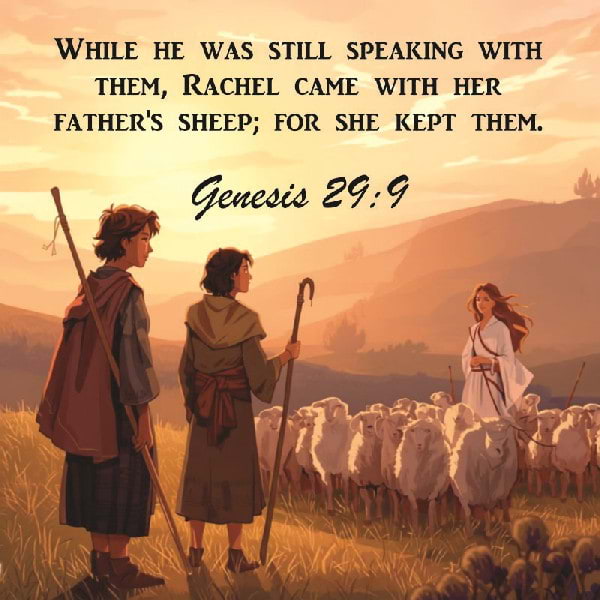
God, in His grace, uses circumstances, consequences, and difficult people over time to shape His people.
God promises to bless everyone who trusts in Christ. Like Jacob, we say, "That sounds like a great plan! Sure, I shall let You be my God if You bless me!" But we fail to read the fine print telling us that God’s blessings always come through His discipline. To bless us — and use us to bless others — God must free us from dependence on the flesh and mold us into the image of His Son, who learned obedience through suffering.
Remember, Jacob is traveling to his uncle with nothing but the clothes on his back (32:10). He has no gifts — unlike the servant Abraham sent — so he needs some bargaining power. These shepherds seem rather lazy and passive. Jacob sees his chance. When Rachel arrives, he springs into action. He rolls the massive stone off the well’s mouth and waters her sheep. While she is still trying to figure out who this hero is, he kisses her, bursts into tears, and introduces himself. It is a whirlwind approach!
For a month, everything went well for Jacob. He fell head over heels in love with Rachel. Tending the sheep alongside her gave the work of shepherding a whole new dimension for him. Life was looking up. His past was behind him. Uncle Laban seemed to like him—even calling him "my bone and flesh" (v. 14). He was part of the family. Up to that point, it seemed Jacob had gotten away with his past sins scot-free.
But God never lets us sin and get away with it. He forgives the eternal penalty for our sin when we trust in Jesus Christ, but He does not remove all the temporal consequences. If He did, we would take sin lightly and fail to deal with its roots in our lives. It may take some time for the seeds we planted to germinate, but they will sprout.
Genesis 29:14c-15
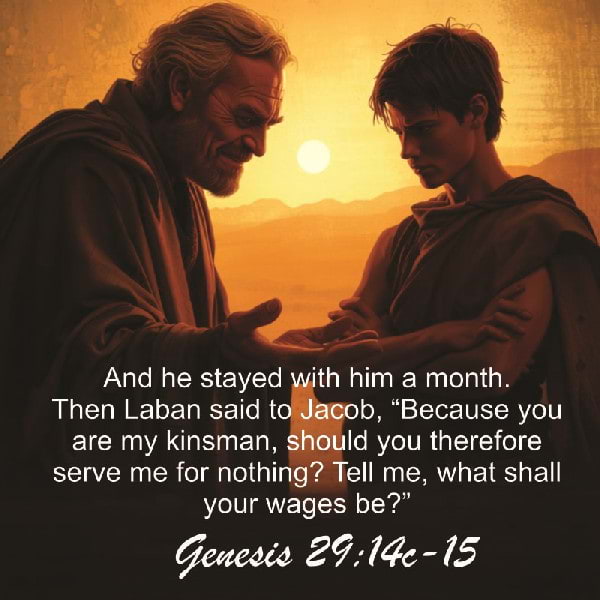
Laban is a shrewd man who always looks out for his own interests. In effect, he is warning Jacob that he will not live off him indefinitely; he must work to support himself. Although the cunning Laban calls Jacob "brother," he also makes it clear who serves whom ("serve me"). Laban has skillfully brought Jacob under his control!
Thus, Jacob begins to reap what he has sown. He had never worked for anyone in his life. Undoubtedly, he helped tend his father's flocks and performed household chores, but he was the son of a wealthy man; servants waited on him. Had he not deceived his father and brother and fled for his life, he would have had ample resources. Like Abraham’s servant who secured Rebekah for Isaac, Jacob could have offered gifts, taken his bride, and gone on his way. But because of his deception, he had nothing; he would have to work for his bride.
So, he tells Laban he will serve seven years for Rachel. Laban agrees to the arrangement but does not reveal the condition: his seven years for Rachel would be followed by seven years of work for her older sister, as custom dictated that the eldest daughter must marry first. Thus, Jacob would have to work seven years for a woman for whom — had he been given the choice — he would not have served even seven days.
Recognize and submit to God’s hand in the daily events of your life. Things do not happen by chance. You are not merely going through a streak of bad luck. God orchestrates your circumstances to mold you into the image of Jesus Christ. We all tend to see God’s hand in major crises, but we need to see it in minor irritations as well, car trouble, a sick child forcing a change of plans, or interruptions. I have found that if I acknowledge God’s hand in these things and submit to Him, I am able to grow through them. But if I grumble, I am "making light of the Lord’s discipline" (Hebrews 12:5), and I will miss the opportunity for growth.
Genesis 29:16-29
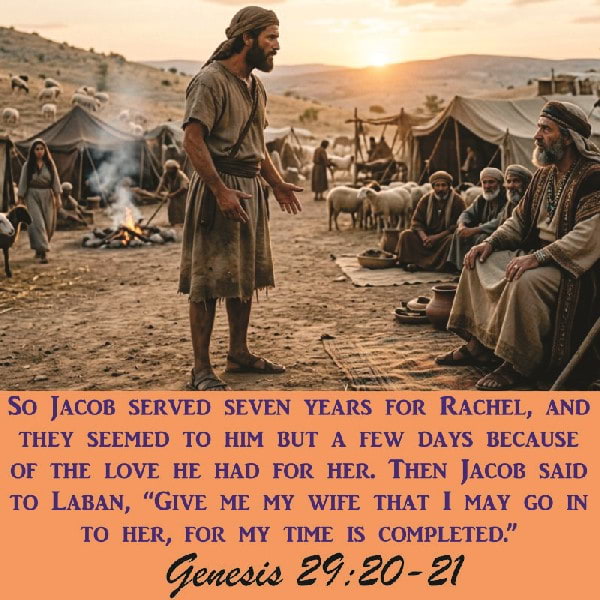
Finally, Jacob’s seven years came to an end. He had to remind Laban of this (v. 21). Certainly, both were keeping count (for different reasons), but Laban was not about to remind Jacob if he could gain a few more days of labor. Jacob was ready for his wedding night, but he was not ready for Laban’s treachery. The text describes the situation delicately: "And in the morning, behold, it was Leah!" (v. 21). It was dark when Jacob took her into the tent. Leah’s face was veiled; she was likely dressed in Rachel’s clothes and wore the same perfume. She must have had a similar physique to Rachel. There is debate regarding the meaning of "weak eyes" (v. 17); she likely lacked the sensual sparkle in her eyes that Rachel possessed. But in the darkness, the unsuspecting and eager Jacob did not notice the details. Yet, when he turned in the morning to embrace his bride, he received a huge shock!
Thus, the deceiver was deceived! He met his match in Laban. There are obvious parallels between Jacob’s deception of Isaac and Laban’s deception of Jacob. Jacob deceived his blind father; he is deceived in the darkness. He deceived his father; he is deceived by his bride’s father. He deprived his brother of his birthright; he is deceived because of the firstborn’s right to marry first.
Jacob’s "harvest" does not end here. Laban would later take advantage of him by altering his wages (31:41), just as Jacob had taken advantage of Esau regarding his birthright. Jacob had deceived his father concerning his favorite son (Esau) by covering his hands with goatskins. Later, Jacob would be deceived by his sons regarding his favorite son (Joseph) when they dipped his robe in the blood of a goat (37:31). Jacob sowed deception; he would reap deception. God uses the consequences of sin to shape His people.
God does not use only circumstances; He uses people like Laban to serve as His drill sergeants. This does not justify Laban’s sin. He was a greedy, selfish man from the start. Yet, it is precisely this type of person God often uses in the lives of His people to smooth out their rough edges.
Genesis 29:20

Today, in many countries around the world, Valentine's Day is celebrated. There are many versions about the origin of this day. But the most publicized is:
The one that pays homage to a Roman priest who believed in love. The most accepted version of this story says that, in the 3rd century, Emperor Claudius II banned marriages. And yet Valentine continued to have ceremonies, because he believed that marriage gives meaning to life.
But the emperor found out and ordered the priest to be arrested. And then comes the most romantic detail: a jailer's blind daughter, named Artes, went to visit Valentine in prison. The two fell in love so much that the young woman regained her sight. But the emperor didn't care and, on February 14, 270, he beheaded Valentine.
But what is love? At first love is action, not words. Love is what love does. So today is a good day to remember a biblical passage that will not let us be carried away by the tide of empty romanticism. I Corinthians 13:4-13:
"Love is patient and kind; love is not jealous or boastful; it is not arrogant or rude. Love does not insist on its own way; it is not irritable or resentful; it does not rejoice at wrong, but rejoices in the right. Love bears all things, believes all things, hopes all things, endures all things. Love never ends; as for prophecies, they will pass away; as for tongues, they will cease; as for knowledge, it will pass away. For our knowledge is imperfect and our prophecy is imperfect; but when the perfect comes, the imperfect will pass away. When I was a child, I spoke like a child, I thought like a child, I reasoned like a child; when I became a man, I gave up childish ways. For now we see in a mirror dimly, but then face to face. Now I know in part; then I shall understand fully, even as I have been fully understood. So faith, hope, love abide, these three; but the greatest of these is love.”
As we see in the text of Genesis 29:20 Jacob worked 7 years for Rachel and it seemed like just a few days because of how much he loved her.
Mainly, the girls are very attentive to the boy's words, promises and affection, but they don't pay attention to what he really does for her. For example, he talks a lot about marriage, but has never bought an engagement ring or made a formal proposal, or, he talks a lot about getting married but does not get a job. Or he gives a ring with promise, they have sex, but never get married. Girls want to get married, but sometimes they don't know how to fry an egg and they don't have the will to learn. Pay attention to the details.
Last but not least, love God above all else. If God is the center of this union it will go well. When we love God first, we obey her commandments.
Genesis 29:30
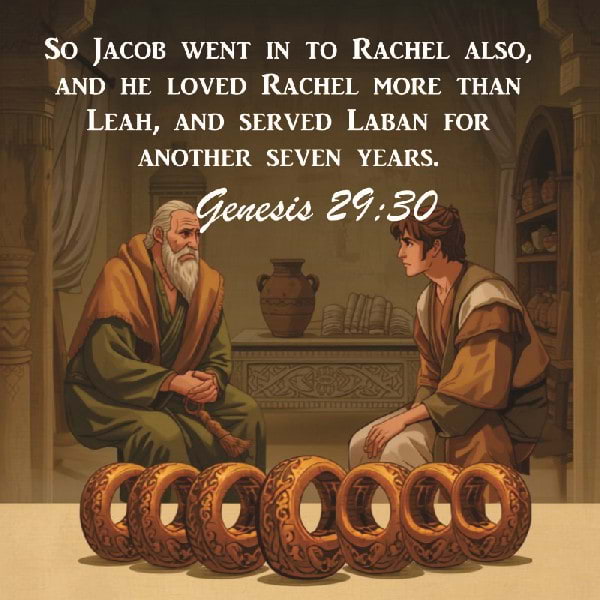
God takes time to shape His people
When Jacob’s mother sent him away, she told him he would stay in Haran for "stay for a while" (27:44). Jacob did not expect an intensive twenty-year training period, but that is exactly what happened. During fourteen of those years, he earned nothing but food, shelter, and two wives, one of whom he did not even want. Yet, God seemed in no rush to propel Jacob into His plan to bless all nations through Abraham’s descendants.
God always takes the time He deems necessary to train His servants. Joseph spent twenty years in an Egyptian prison. Israel spent 400 years in slavery in Egypt. Moses spent forty years tending sheep in the wilderness and another forty in the desert with a stubborn nation. David spent twenty years fleeing from King Saul, the madman. Even the apostle Paul spent about ten years in obscurity after his conversion before his ministry began to flourish. God has an eternal perspective. His training does not consist of nine-week courses. It takes a long journey to shape His people into the image of Jesus Christ.
In His grace, God uses circumstances, consequences, and difficult people over time to shape His people.
Plan to persevere for the long haul. Christianity is not a 100-meter run; it is a marathon. Many people want instant answers to their problems, and when they do not find them, they give up and look for another solution. It requires living a life of discipline.
Instead of complaining because God does not give you what you want, be thankful that He does not give you what you deserve! With love and grace, He uses the circumstances of your life, the consequences of sin, and difficult people, in the long run, "but he disciplines us for our good, that we may share his holiness" (Hebrews 12:10). It may be like military training, but it is far better than living apart from His promises of grace in Christ!
Genesis 29:31-35

THE BATTLE OF THE WIVES
Now the Lord saw that Leah was unloved, and He opened her womb; but Rachel was barren. And Leah conceived and bore a son, and she called his name Reuben, for she said: "Because the Lord has looked upon my affliction; surely now my husband will love me" (v 32).
What a pathetic situation Leah was in. She was married to a man who never wanted her as a wife and who refused to give her the love she so desperately needed. God, in His mercy, reached out to Leah, giving her a much-desired son, Reuben. Reuben means something like "look, a son". It was a great joy for Leah to be able to give Jacob a male child, who would become his heir. This child rekindled Leah's hope of being loved by Jacob, whose love for Rachel was so strong that he barely acknowledged Leah's existence. Rachel's barrenness, at least, brought Jacob to Leah's tent, allowing her to bear children who would bring him prosperity.
Leah's hopes of receiving even a small measure of Jacob's affection did not materialize, as evidenced by her reaction to the birth of her second son:
Then she conceived again and bore a son, and said: "Because the Lord has heard that I am hated, he has given me this son also”; and she called his name Simeon (v. 33).
Leah had perceived no change in Jacob's attitudes or actions; thus, when the second son was born, she recognized the child as the tender response of a loving God who knew the very thoughts of her heart. The name Simeon "one who hears" bore witness to Leah's awareness of her God's grace. With the birth of her third son, Leah’s hope for Jacob’s tenderness and affection was rekindled:
And she conceived again and gave birth to a son, and said, "Now this time my husband will be joined to me, because I have borne him three sons”; therefore his name was called Levi (v. 34).
And she conceived again and gave birth to a son, and said, "This time I will praise the Lord”; therefore she called his name Judah; then she ceased bearing (v. 35).
At that moment, Leah realizes that God’s love is better than the love of any man. And she praises God.
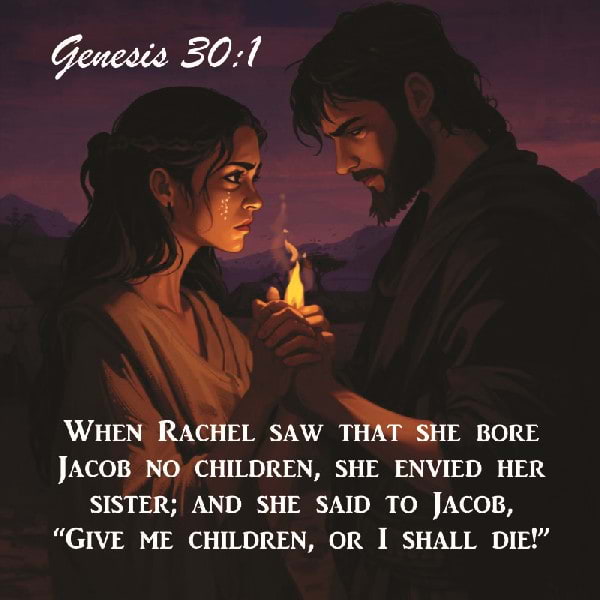
For Leah, praising God came easily with her four children; however, seeing her sister's blessing only stirred up jealousy in Rachel.
When Rachel saw that she was bearing no children for Jacob, she became jealous of her sister and said to Jacob: "Give me children, or I shall die!" Then Jacob's anger was kindled against Rachel, and he said, “Am I in the place of God, who has withheld from you the fruit of the womb?” (vs. 1-2).
On this occasion, neither Rachel nor Jacob responded in a way that could be considered godly. Rachel, desperately jealous of Leah’s fertility, demanded children from Jacob. Instead of acknowledging her barrenness as the work of God, she tried to shift the blame onto Jacob. It was all his fault, she insisted.
Jacob did not react well to this kind of demand. Of course, the logic of what he said was sound. It was God who had kept Rachel from having children; Jacob could not override God’s will. However, Jacob’s attitude is questionable. His impulsive response seems far removed from true righteous indignation. I believe it was more an expression of outrage: "Do not blame me for your barrenness, Rachel; blame God." Her demand struck a raw nerve regarding Jacob’s virility and male ego, and he responded with equal ferocity. The fact that he used spiritual language and invoked God to rebuke her does not mean his spirit was right in his actions. We often use pious words to wound people deeply.
Like Rachel, Rebekah was also barren, but Isaac’s response was very different from Jacob’s. He prayed on Rebekah’s behalf, and in response to his prayer, God granted his wife children (Genesis 25:21).
In her desperation, Rachel proposes having a child through her servant Bilhah. Thus, from the union of Jacob and Bilhah, Dan is born (v. 6). Rachel thanked God for the son, but at no point do we see her consulting God’s will before coming up with this "brilliant" idea. That is just how it is... many people do things based on their own ideas and then say, "God gave this to me."
And Bilhah bore another son to Jacob: Naphtali. Her primary interest and concern is... that, at the birth of this second son, she had prevailed over Leah (v. 8).
Genesis 30:9-21

Rachel, though undoubtedly wrong to suggest that Jacob sleep with Bilhah, can at least be understood as reacting to her own barrenness; Leah, however, already had four sons. There was no need to give her servant Zilpah to Jacob as a wife, except for the fact that this is exactly what Rachel had done. Leah and Rachel were in direct competition. If Rachel could use her servant in this contest, so could Leah.
And she named him Gad. And Zilpah, Leah’s servant, bore a second son to Jacob. And Leah said, “Happy am I! For the women will call me happy”; so she called his name Asher. (vv. 9–13).
Leah’s words betray her here. God is not mentioned even once. In the heated intensity of this battle between two wives, little attention is paid to the ethics of their actions, only to the expected results. She who once viewed her children as a gift from a merciful and loving God now sees them merely as a matter of luck "How lucky I am," "How fortunate I am," and "How happy I am." Religious devotion had been cast aside. To any observer, Leah was leading Rachel 4 to 2, yet that was not enough. Now, she added two more points to the score. Yet, in the process of gaining ground on her sister, she abandoned the piety she had previously shown. Her focus shifted from God’s assessment of her actions to the praise she would receive from other women (v. 13).
We might be tempted to read this account of the struggles between Leah and Rachel and think of it as something from "long ago" and "far away" and, therefore, of little relevance to us. Nothing could be further from the truth. There are differences between the culture of that time and our own, but, as a friend of mine observed, the only difference between Jacob’s practice in his day and ours is that he lived with his four wives simultaneously, whereas we live with ours consecutively. We do with divorce what Jacob did with polygamy.
These stories are recorded in the Bible to serve as examples for us, so that we may learn not to live according to our worldly and selfish desires which result in trouble, conflict, and heartache, but to always seek God’s guidance.
Genesis 30:22-24

After exhausting all her schemes and stratagems and failing to bear children, God grants Rachel the desire of her heart.
Then God remembered Rachel, and God hearkened to her and opened her womb. She conceived and bore a son, and said, “God has taken away my reproach”; and she called his name Joseph, saying, “May the Lord add to me another son!” (vv. 22-24).
Prayer does not immediately occur to Rachel as the solution to the stigma of barrenness; rather, it appears to be her last resort. I never cease to be amazed at how we still regard prayer as a "last resort." I often hear people say, "Oh, I have done everything I could; now all that is left is to pray." And I think to myself, "Why did not you pray first before anything else?"
Only after all those futile efforts had been thwarted and proven fruitless did God open Rachel’s womb and this may well have been an answer to her prayers. Rachel would eventually have another son, but he would come at the cost of her own life (35:16ff.).
It is worth noting that, in those days, a woman’s worth and sense of fulfillment were measured by her ability to bear children. Today, however, children are often viewed as a burden that hinders professional and personal fulfillment. Consequently, contraceptives are seen as the key to women's freedom, and abortion as a necessity for their happiness.
The meaning of life should not be equated with either of these things. We must seek our worth, significance, and approval in God, not in any man, including a husband. Worshiping God is the highest and noblest purpose for humanity; neither children nor careers can replace it. The Biblical perspective appears to be that mothers who raise their children to be faithful worshippers of God have fulfilled their calling in life (cf. 1 Timothy 2:15).
Genesis 30:25-36
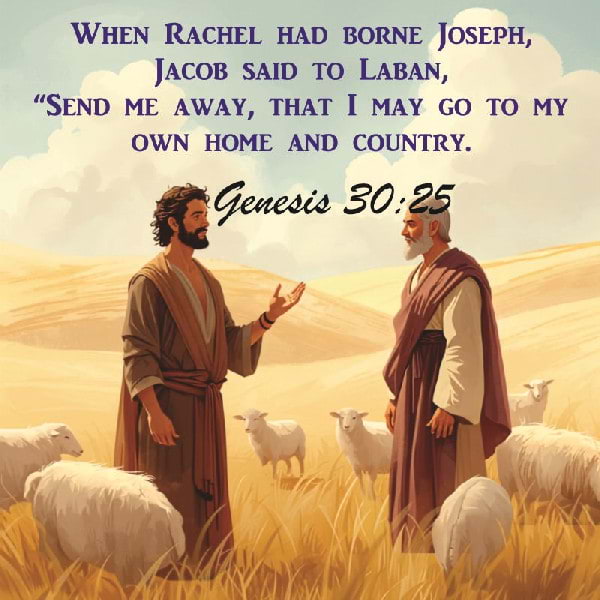
Rachel gave birth to Joseph (v. 25) near the end of Jacob’s second seven-year period of service to Laban. Having fulfilled his obligation, Jacob began to long for home, so he approached Laban to discuss returning to Canaan. Laban was the type of man who was fully devoted to the Lord, provided it meant prosperity. But he also had his other gods, just to make sure all his bases were covered. He was like people today who happily add Jesus to their list of gods, as long as He brings them success and happiness. So Laban said to Jacob, Stay a while longer, Jacob! I have noticed that the Lord has blessed me because of you. Tell me what you want to be paid (vv. 27-28).
Jacob had been dealing with this fellow for 14 years, so he was no fool. First, he made his case by listing everything he had done for Laban; but the time had come for Jacob to provide for his own family (vv. 29-30). So Laban said, "Very well, what is the proposal?" Jacob made an offer that seemed too good to be true. He said, "I will keep tending your flock for a while. What I want in return are all the speckled, spotted, and black sheep, and all the speckled and spotted goats." Apparently, these animals were rarer. Laban knew a good deal when he saw one, so he quickly agreed, thinking he had nothing to lose. But to ensure he would not lose out, he went to the flock, separated all those animals, and put them in the care of his sons, three days' journey away from Jacob and the rest of Laban’s flock (vs 35-36).
Laban was already altering the agreement, because Jacob had expected all those sheep to be his starting that very day (v. 32). But Laban essentially said: "Very well; later, after I have taken them all away, you may keep whatever is left." (Some interpret this to mean that the flock entrusted to Laban's sons actually belonged to Jacob but had been removed by Laban so that Jacob could not use it for breeding). Later, Laban would change the terms of the agreement whenever he had the chance ("ten times" 31:7–8 an expression meaning "many times").
So Jacob set to work.
Genesis 30:37-38
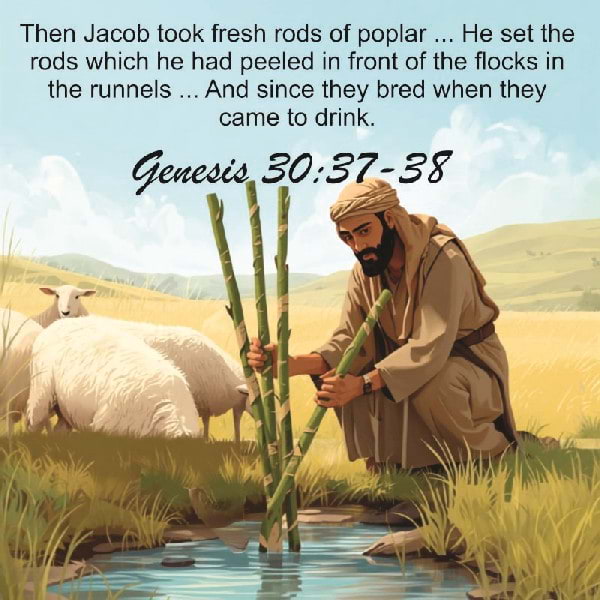
Jacob was not the type to dwell on a setback. So, he set to work, implementing the latest animal-breeding method. He took some fresh branches and peeled parts of them, leaving them striped and exposing the white wood underneath. Then, he placed them in front of the watering troughs where the sheep and goats mated. The theory was that a visual impression on the mother at the moment of conception would affect the appearance of the offspring.
(31:10, 12) The Lord draws Jacob’s attention to this, as if to say: "It is not your crazy scheme that is working. I am the one causing these male goats to mate, for I have seen all that Laban is doing to you". God ordained that the specific type of sheep and goats Laban had agreed to give Jacob would multiply according to natural genetic laws. Jacob’s peeled branches had nothing to do with it. Once again, it is Jacob who attempts to act on his own and yet again does not seek the Lord.
Neither hard work nor integrity, important as they are, was enough. Jacob was a hard worker, and hard work often brings financial success. The Bible commends hard work. Yet, even when we work hard, we must acknowledge that any success we enjoy comes from the Lord, not from our own labor. Let us be honest: some people work hard all their lives and never get rich. And while integrity is vital to our testimony as God’s people, it often hinders success rather than promoting it. The dishonest person often prospers, while the person of integrity misses out on opportunities for easy money. Therefore, the conclusion remains the same: prosperity comes solely from the Lord.
This applies to us as well. It is the principle of stewardship that we own nothing, but are merely managers. God owns everything, and as the Owner, He directs how it is to be used. If we are truly generous, we give God ten percent (the tithe for the church) and our offering (for missions, etc.), while squandering the rest on ourselves. But that is not God’s perspective on prosperity; it is meant to be used for God’s purposes.
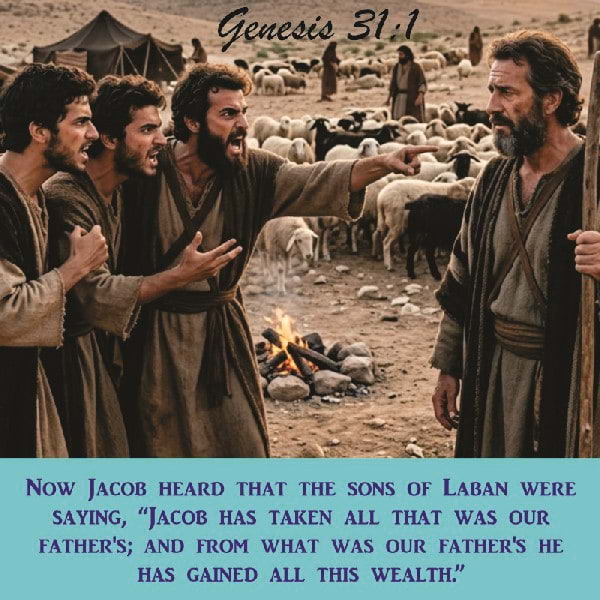
Jacob’s success with the flocks gave Laban’s sons an opportunity to make malicious remarks about their brother-in-law’s honesty. They refused to acknowledge his skill as a herdsman or God’s providence in Jacob’s life. The issue was not that Jacob had stolen anything; the problem was that Laban’s sons were filled with envy. Envy distorts the truth. Jacob had stolen nothing from Laban, yet envy drives people to lie. Consequently, Laban’s sons claimed: "Jacob has taken everything our father owned."
Laban’s attitude toward him was no longer what it had been; the envy of Laban’s sons had poisoned his heart against Jacob. Previously, Laban had been satisfied with his agreement with Jacob (Genesis 30:34).
Laban believed his sons, disregarded his own dishonesty, and turned against Jacob. Naturally, Jacob feared for his life and sought guidance from God. The Lord gave him permission to return and reaffirmed the promise: "I will be with you."
Distrusting the people in the main camp, Jacob asked Rachel and Leah to meet him out in the fields for a family discussion.
Jacob explained the situation to his wives and gave God full credit for the prosperity he had achieved, as well as for the guidance to flee to Canaan.
Remarkably, Rachel and Leah were united on this matter. They agreed that their father had been unfair. They recalled with clear resentment how Laban had humiliated them by selling them off like property and using money that rightfully belonged to them and their children. They willingly agreed to leave.
Envy is harmful not only in itself but also because of the company it keeps. Strife, division, and unspiritual living often accompany envy (1 Corinthians 3:3). The pursuit of self-interest, confusion, and evil things accompany it (James 3:16). On the other hand, love does not envy (1 Corinthians 13:4), and God wants to deliver His people from envy (Titus 3:3).
Genesis 31:22-24
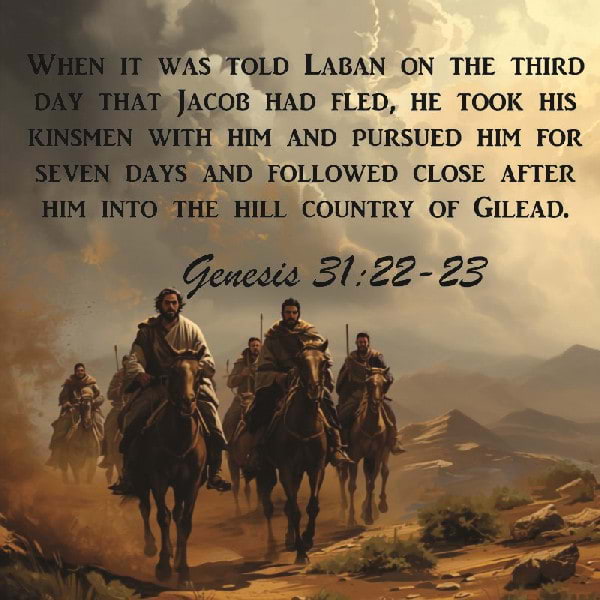
WE NEED GOD'S GRACIOUS PROTECTION BECAUSE THE WORLD IS A CUNNING ENEMY.
Laban represents the world, and he is a cunning fellow. He is the type of guy who gives you a friendly pat on the back while simultaneously stealing your wallet. He uses spiritual language as if he believed in the Lord, yet he is obviously a polytheist who invokes whichever god suits him at the moment. He is a pious hypocrite who wants you to believe he is the most loving father in the world, when in reality, all he cares about is his own pocket.
Jacob had to choose to flee because he realized that saying goodbye to Laban would not be easy. Laban likely planned to use force against Jacob, but God intervened, telling Laban in a dream not to harm him. "Take heed that you say not a word to Jacob, either good or bad" (31:24, 29) is a Hebrew expression meaning: "Do not use flattery or threats to try to persuade Jacob to return." Had the Lord not stopped Laban, Jacob would likely have returned home empty-handed at best.
Laban accuses Jacob of stealing his idols; confident that no one had done so, Jacob allows Laban to search. When Laban finds nothing, it is Jacob's turn to unleash all the anger he had suppressed for years. Finally, Laban kisses his children (meaning "grandchildren") and daughters, blesses them, and returns home. The last image we have of him is the intriguing spectacle of a man kissing his children and daughters after having wronged them for all those long years.
What a picture of cunning! But that is the world, is not it? The god of this world is a master of deception and betrayal. Those who serve the god of this world are like Laban: selfish, willing to do anything to get what they want, and sounding both threatening and pious at the same time. The world accuses church members of hypocrisy, yet it is no better and is often far worse. Since the world is such a cunning enemy, we could not survive without God's gracious protection.
Since Laban became hostile to Jacob, he became more sensitive to God's dealings and got help and guidance. Now a visitation from angels God awoke him again and, to some extent, prepared him for what was to come. Mahanaim means: two camps or two groups. It concerns the camp of Jacob and the invisible and surrounding camp of the angels of God who protected Jacob and his family. Here we see that:
- Angels of God meet us on the dusty road of ordinary life. You know, those critical moments in life when we say: “only God for me”... yeah... He's watching... He finds us.
- The angels of God meet us punctually in time of need. You know, in situations where I have heard people say: “I thought, I am going to die, there is no other way and help arrived at the right time!”.
- The angels of God appear in the form we need: in the case of Jacob, the army of God.
Genesis 32:1-2
Jacob was going through a difficult time; for quite a while, he had wanted to return to his homeland, but his father-in-law was holding him back. Eventually, the situation shifted, and he began to face hostility and slander from his brothers-in-law, Laban’s sons.
At this point, Jacob was done negotiating; taking advantage of Laban’s absence, he fled with his entire family. Laban pursued him, but God warned him not to harm Jacob. Thwarted by God, Laban sought an agreement. Jacob seized the opportunity to tell Laban everything he had bottled up for years. After all that tension, the two made a non-aggression pact, and Laban finally departed.
As he continued his journey, Jacob had a marvelous vision of God’s angels. He named the place Mahanaim because it was clear there were two camps: one belonging to Jacob and his family, and the other to the angels of God.
It is the same for us: GOD’S ANGELS MEET US ON THE DUSTY ROAD OF ORDINARY LIFE. Sometimes we go through moments of distress; even though God’s Word promises we will never be alone, that is often how we feel.
But make no mistake, do not let fear take over your thoughts, for GOD’S ANGELS MEET US RIGHT WHEN WE ARE IN DISTRESS. Jacob did not ask for the angels' presence; they found him. Hey, God has not forgotten you, you know? God sent a multitude of angels for Jacob who had two enemies and as His servants, He is watching over us, too. You may not see them, but they are all around you.
Jacob was not feeling brave, for he still had to face his brother Esau whom he had deceived years earlier. He had no idea how Esau would react; the last time they met, Esau had wanted to kill him! How would it go this time? God’s angels appear in the form we need. In Jacob’s case, it was an army of angels. But for us, they sometimes come as a person who helps us through a difficult time, someone who reaches out a hand, someone who guides us and shows us the way forward. Someone who warns us of danger. Someone who shelters and hides us, saving us from death.
It is God’s faithful, covenant love that never abandons us, believe it! You are not alone.
Genesis 32:22-30

As Biblical scholars have observed over the centuries, much of this episode remains shrouded in mystery.
We might surmise that Jacob wanted some time alone in the camp to pray and ask God for help, given that he was about to meet Esau and feared his brother's reaction, fearing even that he might be killed. Was it when Jacob sought to rejoin his group that this angel, or man—appeared and blocked his path? We cannot know for sure. We only know that a struggle ensued between Jacob and the angel, lasting until daybreak. During the fight, Jacob’s hip was dislocated, yet he persisted in the combat, refusing to let go until he received a blessing. Jacob was in desperate need of help, but before obtaining it, he had to confess the sin symbolized by his name: "Heel-Grasper" or "Deceiver."
More than a mere angel, this figure was the Angel of the Lord, the pre-incarnate Son of God appearing in human form. This is evident from Jacob’s own words: "For I have seen God face to face, and yet my life is preserved" (v. 30).
We ought to marvel at Moses’ account stating that the angel did not prevail against Jacob, a man nearly a hundred years old. How could it be that God did not prevail over Jacob?
In response to the struggle, God changed his name to Israel "he who struggles or prevails with God". This name change, like those of Abraham and Sarah, signified a shift in status and a transformation of his inner self.
In Genesis 32:22–30, we see how Jacob becomes Israel.
Jacob did not have to face Esau alone; first, he had to confront God. God confronted him amidst the turmoil of his guilt to lead him to a full acknowledgment of his own sinfulness and the need for radical change. The lesson Jacob learned here is vital for every Christian. It is a transformative truth, for it explains why God's blessings can only be obtained through honest means. It revealed to Jacob the reason why all his previous "victories" were, in fact, disasters, resulting in discord, hatred, and hostility.
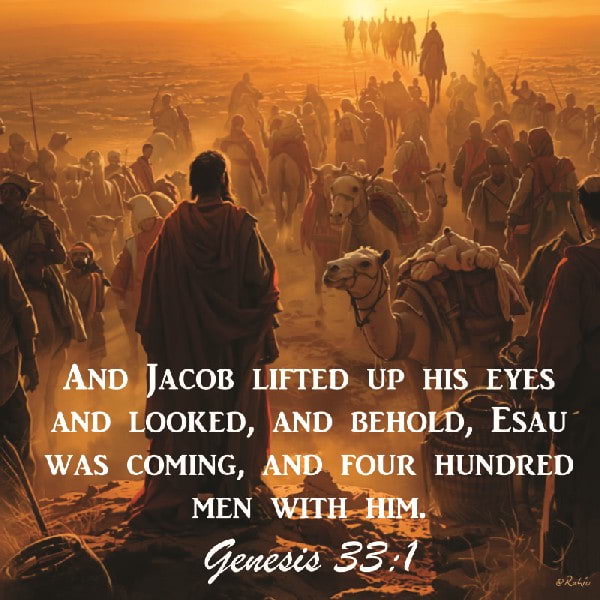
In this chapter, we witness the long-awaited reunion between Esau and Jacob after many years.
The previous chapter recounted Jacob’s wrestling match with the angel and the changing of his name to Israel; one might have thought that, following such an encounter, Jacob would never be the same that he would be completely transformed. Yet, upon reaching Chapter 33, we realize that Jacob had not changed all that much. His preparations for meeting Esau, placing the maidservants and their children in the lead, followed by his less-favored wife and her children, and finally Rachel, his beloved and favorite wife, at the rear, reveal this. Furthermore, his words to Esau, addressing him as "my lord," whereas Esau was more genuine in calling him "my brother" show that Jacob remained a manipulator and an impostor.
The same often happens in our lives as Christians; along our journey, we undergo trials and experience dramatic blessings that could change us, yet those around us soon realize we remain the same as ever.
At best, it was a superficial reconciliation, for Jacob never verbally confessed the wrongs he had committed against Esau, nor did he ask for forgiveness.
It is like a husband who hurts his wife. To make amends, he brings home flowers and a gift. But if the gift is the extent of his response, true reconciliation has not taken place. The husband needs to acknowledge specifically how he hurt his wife and ask for forgiveness.
Jacob’s sinful nature also manifests in his response to Esau’s offer to travel together (vv. 12–16). It would not have been right for Jacob to go with Esau, given that God had clearly commanded him to go to Canaan, not Seir. Thus, while Jacob was right to refuse, he was wrong in the manner in which he did so. He makes up an excuse, claiming that his children and flocks were too weak to keep pace with Esau. He had pushed them hard to escape from Laban, but now he uses their frailty as a pretext to avoid accompanying Esau. He lies, telling Esau that he will follow him to Seir (v. 14).
We have all found ourselves in similar situations, where we were asked to participate in an activity that would compromise our faith. Yet, the right course of action is to be direct and kind.
Genesis 33:16-17
In Genesis 31:3, God told Jacob: "Return to the land of your fathers and to your kindred, and I will be with you". Instead, Jacob settled in Succoth and later bought land in Shechem.
The text does not give us a specific reason for Jacob's incomplete obedience, but it may suggest one. It is possible that he remained afraid of Esau. Despite Esau's warm welcome, Jacob likely did not trust him. Those who are deceitful, like Jacob, often assume others will be as well.
Observing Christians (myself included) tells me that Jacob was doing what we all do. He was trying to follow the Lord, yet at the same time, he was not fully obeying Him. By naming the altar "God, the God of Israel," he acknowledged his gratitude to God for bringing him safely back to the Promised Land. However, by failing to go to Bethel, he was yielding to his carnal fear of Esau. He was the new man, Israel, yet still the old man, Jacob. We do the same thing. We begin with faith in the Lord, but then we live according to the flesh.
Be mindful of your own inclination toward the flesh. We all have our weaknesses. Jacob’s inclination was to scheme. Abraham and Isaac were prone to lying under pressure. Moses tended to act decisively but in his own strength, as seen when he killed the Egyptian and, later, when he struck the rock. David had a weakness for women. We, too, have our own inclinations. It is easy to act automatically, without thinking. It is important to be careful and attentive to your own tendencies, especially in this area. Stay in the Word, it reveals the thoughts and intentions of your heart (Hebrews 4:12), so that you can remain on guard.

You might ask yourself: "Why is such a sordid chapter as this in the Bible?" Since "All scripture is inspired by God and profitable for teaching, for reproof, for correction, and for training in righteousness" (2 Timothy 3:16), this text holds lessons for us. I believe Moses included this chapter, with all its repulsive details, to warn God's people about the danger of assimilating into the world. It is also a consequence of the disobedience of not going to Bethel.
If Satan succeeds in leading God's people to act as badly as, or worse than, those who do not know Christ, the world rejects the gospel. It is even more tragic when Christians use their faith to take advantage of others, as Jacob's sons did in this instance. When believers are fatally drawn to the world, it proves fatal for the world, which loses the gospel.
Jacob thought he was in great danger when facing Esau; in reality, he was quite safe at that moment, surrounded by a regiment of angels. Here, Jacob thought he was completely safe among friendly people, yet he was in grave danger. Had he accepted the Shechemites' offer, God's people would have been absorbed into Canaanite culture and ceased to exist. We pray for the church in countries where there is persecution and rightly so. But the greatest danger to God's people is not persecution; it is assimilation. Persecution has the power to weed out the lukewarm. We, who tend to blend in with our hedonistic culture, face greater spiritual danger than those who are persecuted.
Across the globe, Satan tempts Christians primarily through television/internet. On average, each person watches more than three hours of TV a day. American teenagers see about 14,000 sexual references on television annually. Children's programs aired during the day on weekends feature, on average, 25 acts of violence per hour.
If you, as a professing Christian, regularly watch this type of programming, you are not a God-fearing person, and you will not raise children God-fearing chidren! You are being assimilated into our godless culture, whether you realize it or not.
Genesis 34:4

Shechem may have been good for Jacob’s finances, but it was a disaster for his family. His disobedience in failing to go to Bethel resulted in a harvest of shameful events in Shechem. And it all unfolded during the course of everyday family life. Dinah, Jacob’s daughter by Leah, was about 14 or 15 years old. Like any teenager, she wanted friends, so she began frequenting Shechem. While there, she caught the eye of the prince, the man who gave the city its name, and he fell in love with her.
What 14- or 15-year-old girl would not be flattered by that? Dinah was likely somewhat naive, so she allowed herself to get drawn into a situation with Shechem where the two were left alone. Passion overcame him, and he raped her.
In verse 15, Jacob’s sons strike a deal involving the circumcision of Shechem and all the men of the city; the ensuing events were horrific and could have been avoided had Dinah never gone to that city or, before that, had Jacob settled in Bethel as God had commanded.
As God’s people, we are engaged in a life-or-death struggle against our enemy, the devil. When you think of spiritual warfare, you might picture missionaries confronting sorcerers or evil governments persecuting Christians. But have you considered the day-to-day life of the family? You should! The family is under attack by the enemy, and the battlefield consists of everyday events, such as a teenager going to a (non-believing) friend’s house.
Jacob’s father had sternly warned him not to take a Canaanite bride (28:1), yet he does not seem concerned that Dinah is on the verge of marrying this Canaanite man!
Parents are accountable to God for where their children go, what they do, and whom they spend their time with. The wrong friendships can lead young Christians into terrible situations where they lack the wisdom or willpower to resist evil.
We are all influenced by our relationships. It is normal and appropriate for teenagers to form friendships with others their own age. But if they get involved with bad company, the consequences can be devastating.
According to the Scriptures, God remained silent for nearly ten years after commanding Jacob to leave Paddan-aram and return to Bethel (31:3). The question that arises is: "Why did God take so long to instruct Jacob to proceed with the task of returning to Bethel, as He had already clearly commanded him?" The answer is quite simple: until then, Jacob was not listening.
Despite his dramatic encounter with the Angel of the Lord in chapter 32, Jacob quickly lost any sense of urgency regarding the fulfillment of God's command. Undoubtedly, Jacob intended to go to Bethel eventually, but there was no rush in his mind.
The tragic and painful events of chapter 34 greatly sharpened Jacob's ability to hear and obey God. His daughter had been violated, his sons had killed the men of Shechem, and it seemed that neither he nor his family could safely remain in that region any longer. It was only when Jacob sensed great danger and when staying in Shechem seemed impossible that he became willing to listen to God's voice reminding him of his duty to return to Bethel.
There is certainly a principle here for all Christians regarding the will of God and the will of man. The Christian possesses free will in the sense of being able to choose whether or not to obey what God has commanded. We may resist God's commandments, but we cannot thwart His ultimate purposes. God allowed Jacob to go his own way and reap the consequences of his disobedience.
Yet, in the end, we will do what God has planned. God does not shout, throw tantrums, or fly into a rage over His children's disobedience, as many of us do as parents. He is, of course, deeply saddened by disobedience, yet He will allow us to go our own way and pay the painful price of sin. And then, when we have had our fill of sin and have nowhere else to turn, we will surely listen and obey. God’s will can be resisted for a time and at a high cost, but in the end, God will create an atmosphere in which we will listen and obey.
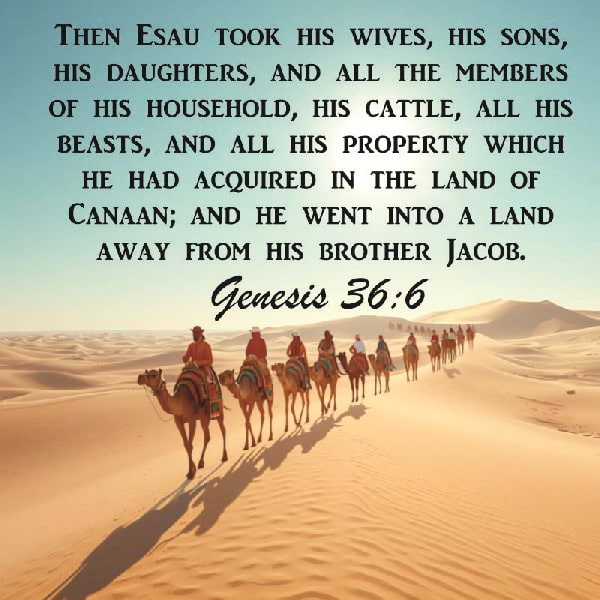
Even when reading the Bible, Genesis 36 is a chapter one does not often reflect upon deeply. To be honest, it is one of those chapters that makes us question why it is even in the Bible.
Esau, the man whose generations are listed here, was highly successful by worldly standards. He founded a dynasty and a nation; he was the father of rulers and kings. He enjoyed financial prosperity, had beautiful women in his harem, and wielded political power. He was a famous man in his own time and for centuries afterward. He was also a decent fellow, the kind of person who would make a great neighbor or friend. Yet Esau lived for this world, and in doing so, he failed miserably where it mattered most: with God. Was he a successful man who went to hell?
Thus, the chapter viewed in context, portrays two paths set before us all: the path to earthly success, fame, and power, which can yield quick and visible results; and the path of obedience to God’s will, which is far slower and offers less visible rewards. The worldly path focuses on visible things that, from God’s perspective, are destined to perish; God’s path focuses on things that are unseen yet eternal, things that cannot be taken from us (see 2 Corinthians 4:18). Therefore, the chapter teaches us this:
If we succeed by worldly standards but fail God, we fail where it truly matters.
Esau represents the natural man: strong, capable, and independent, able to handle life’s challenges using his own resources. Why rely on God for anything when you can handle it yourself? Abraham, Isaac, and Jacob along with their barren wives, represent God’s way of working. He humbles our pride by confronting us with problems we are unable to solve problems such as barren wives, in the face of the promise to make us into a great nation. Then, when we cry out to Him, He demonstrates His power to save.
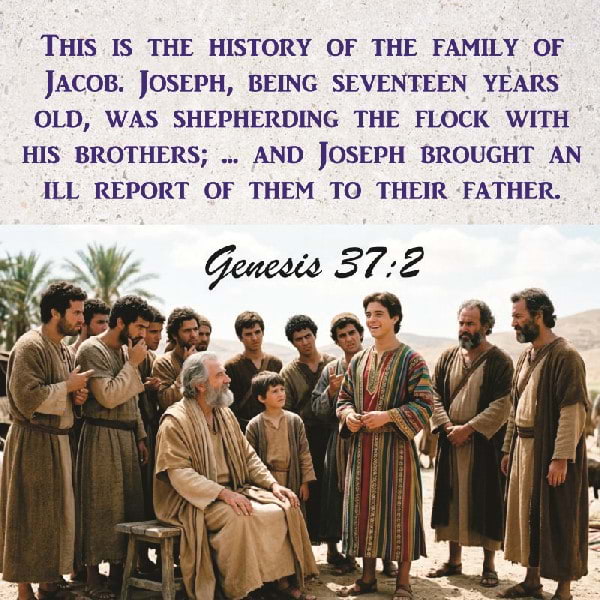
One major disservice we do to this text is failing to grasp the root cause of the animosity Joseph’s brothers felt toward him. We often tend to picture Joseph as a boy of eight to ten who snitched on his older brothers. That hardly constitutes a capital offense, nor does it align with the details of the account. Joseph was not seven, but seventeen (37:2). While that is young in some respects, in the Ancient Near East, girls of that age were often already married (e.g., Dinah, 34:1ff.), and it was not uncommon for young men to become kings at that age (cf. 2 Kings 11:21).
I maintain that Joseph was rejected by his brothers because of the authority he exercised over them, despite being the younger brother. Seventeen was not necessarily a young age for such authority, yet he was younger than his older brothers, and this was, in fact, difficult for them to accept. Several compelling pieces of evidence converge to support this claim:
1) ...literally, he tended or acted as a shepherd to his brothers while with the flock. Strange as the expression may seem, this is undoubtedly the precise translation and meaning of the words, implying that Joseph was charged with supervising his brothers, particularly the sons of Bilhah and Zilpah.
2) Following Reuben’s transgression, Joseph received the rights of the firstborn: 1 Chronicles 5:1–2.
3) Joseph’s robe symbolized the authority granted to him over his brothers.
4) The strongest antagonism toward Joseph came from the sons of Bilhah and Zilpah (v 2), whereas the two brothers who attempted to rescue him (Reuben and Judah) were sons of Leah (37:21, 26).
5) Joseph’s reporting to his father would have been a logical and necessary part of his role and authority as supervisor.
6) The intensity of the reaction of Joseph’s brothers to his dreams suggests there must have been some basis for their fears that Joseph would attain such power and prominence.
All of this led Joseph’s brothers to seek to defend their own positions.
Genesis 37:3
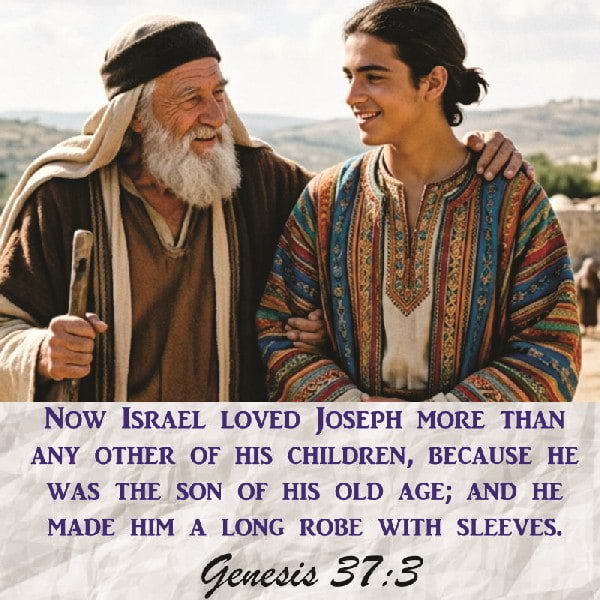
Isaac had the weakness of preferring one son over the other. Now Jacob himself was doing the same thing, perhaps because Joseph reminded him of Rachel. The result was a rift between Joseph and his half-brothers. Some of the resentment was justified, as Joseph was prone to tattling, especially regarding the less, favored sons of Bilhah and Zilpah. Furthermore, Jacob gifted Joseph a special garment that set him apart from the others. His half-brothers recognized the garment as a mark of favoritism and resented him for it. His brothers hated that robe! The first thing they did when Joseph came to check on them was strip him of it.
Jacob seemed blind to the hatred his sons were harboring against Joseph. We can be like that too; we get busy with work all day, and the kids are at school. When we get home, the children are doing homework, and we just want to eat and rest while watching TV; we end up out of touch with our children's world, and they grow up under other kinds of influences.
Perhaps your parents did (or are doing) hurtful things to you. You might feel angry and bitter toward them, or even toward God, because of the wrongs they committed. You might blame them for failing to protect you from things that harmed your life, for showing favoritism to your siblings, or for being passive parents. Or, you can trust that God, in His sovereignty, placed you in your family. Even if you do not understand everything, you can thank Him, knowing He will turn all those bad things into something good. You can ask Him to take away your bitterness and transform you into an instrument of His love.
Joseph had two dreams in which the central theme was his eventual elevation above his brothers. He shared these dreams with his family. Some might say he was wrong to do so; let us just say he was naive. He was a seventeen year-old young man who likely lacked wisdom and maturity.
Often, a person like Joseph, who is highly competent (as his later story demonstrates), threatens others without even realizing it.
Genesis 37:5
Perhaps out of naivety, Joseph liked to tell his half-brothers about the unusual dreams he had. And this only fueled their anger toward him. It does not appear that Joseph shared these dreams to provoke a reaction from his brothers; he seems innocent of any ill intent. Even when he went to check on them in the fields, one gets the impression he expected no trouble. He thought they would be happy to see him. He was even wearing that hated coat. Had he possessed a shred of common sense, he would have left the coat at home.
Yet God is sovereign, even when teenagers are naive. I assume God gave Joseph those dreams, given that they were prophetically true. Why did not God wait until later, when Joseph would have had the wisdom to keep quiet? I do not know. But I do know that Joseph's naivety did not thwart God's sovereign plan. Although we should strive to live wisely, when we fail to do so, we can trust that God will intervene and use even the foolish things we do in our youth, provided we submit ourselves to Him.
Genesis 37:19-22
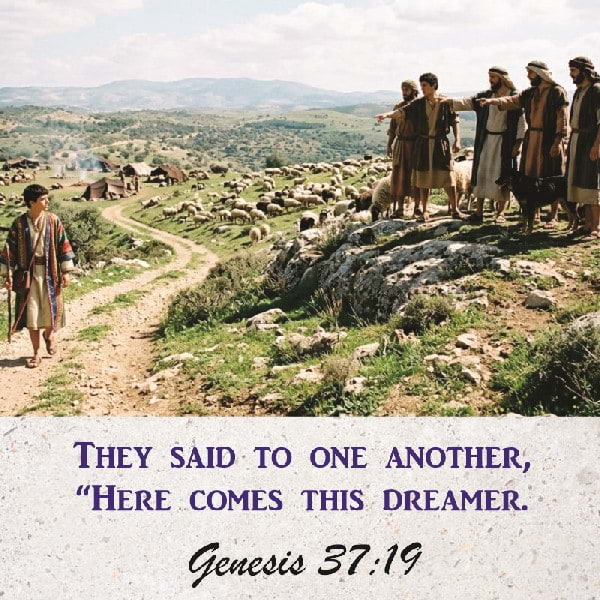
So, when the brothers saw Joseph approaching in the distance (they could spot that cursed tunic!), they conspired to kill him and throw him into a pit, claiming a wild beast had devoured him. At that moment, Reuben, the eldest, intervened and persuaded his brothers not to shed blood, but simply to cast Joseph into the pit. He planned to free him later and return him to their father (v. 22) perhaps as a way to regain his father's trust (after having slept with his concubine). Once Joseph was in the pit, Reuben stepped away - perhaps to check on the flocks — while the other brothers callously sat down to eat lunch.
As they ate their sandwiches and debated whether to let him die in the pit or kill him themselves, a caravan of merchants passed by. Judah had a brilliant idea: "There is no profit for us if we let Joseph die in this pit. Let us sell him to these merchants. That way, we won't bear the guilt of killing our own brother, and we wil each make a few shekels." The idea seemed great to everyone.
Is not it amazing how we can ease our consciences regarding a terrible sin by rationalizing that, at least, it was not as bad as it could have been? Compared to murdering their brother, selling him into slavery did not seem so bad. You can almost hear them saying, "It will be better for Joseph and better for us this way." Twenty years later, the brothers would still vividly remember poor Joseph's pleas for them not to do such a terrible thing (Genesis 42:21), yet here they were, rationalizing their sin by saying, "After all, he is our brother." Comparative morality is no morality at all!
Meanwhile, Reuben returned to the pit, found it empty, and panicked. Distraught, he tore his clothes. He voiced his distress to the others, but they ignored him. To cover up their deed, they killed a young goat and stained the tunic that belonged to Joseph with its blood.
These brothers were heartless not only toward Joseph but also toward their father. The old man was devastated when he saw Joseph’s blood-stained tunic and assumed he had been killed by a wild beast. Can you picture them all gathered around the weeping man, patting him on the back and saying, "Calm down, calm down!"
Genesis 37:20b

We can also see a sign of God's providence in the brothers' ironic arrogance: "and we shall see what will become of his dreams!" (v. 20). And what happened was that his dreams were fulfilled precisely! God was in control of the entire process, despite the brothers' initial sin, for which they were responsible. God, in His sovereignty, placed Joseph in Potiphar's household and orchestrated the events that followed there, despite the sin Potiphar's wife committed against Joseph. God was sovereign at the moment the cupbearer remembered Joseph before Pharaoh.
Joseph could easily have thought, "If I had not met that man in the fields, I would not have found my brothers, and none of this would have happened!" But his walk through the fields and his encounter with that man were not mere chance. Although God is not mentioned in this chapter, He is obviously at work. Often, when God is most silent, He is most present. Years later, Joseph was able to tell his brothers: "As for you, you meant evil against me; but God meant it for good, to bring it about that many people should be kept alive" (Genesis 50:20). We may grasp the purpose of God's plans after a few years, or perhaps only in eternity. But, like Joseph, we need to trust God even when we do not understand. In short, we can trust God regardless of what happens to us, because His sovereign and loving hand is upon us, even in the small "events" of life.

Chapter 38 pauses the story of Joseph. In this interlude, we are introduced to the story of Judah. Upon reading Chapter 38, we ask ourselves once again: why is this story presented here? You know, when something bad happens in our family, we tend to hide the fact or bury that dark past; yet here, God exposes the errors of His children because there is something we need to learn.
Two themes permeate this chapter: the first is the speed with which God’s people can become morally corrupt. Judah marries a Canaanite woman and fully integrates himself into that corrupt culture. The second theme is the holiness and grace of God. These two qualities exist in perfect tension: God’s grace never nullifies His holiness, nor does His holiness nullify His grace. God’s holiness is evident when He puts two of Judah’s sons to death because of their sins. Yet, God’s grace triumphs over the grave sin of Judah and Tamar, such that their son, Perez, becomes part of the genealogy of Jesus Christ (Matthew 1:3–16). Thus, we learn that:
1- God’s people are prone to corruption.
Judah, son of Jacob, grandson of Isaac (who was still alive during part of this period), and great-grandson of Abraham, a member of the primary family with whom God was dealing on earth lived exactly like the Canaanites. You may have been born into a God-fearing family. Perhaps your grandparents were God-fearing people. Yet Judah’s life demonstrates how easily one can become as corrupt as our morally depraved culture.
2- Corruption begins when you distance yourself from God’s people.
We read (38:1) that "Judah left his brothers and went to visit a certain Adullamite named Hirah." This did not happen by chance; it involved a choice on Judah’s part. We do not know the reason for his choice. Perhaps he saw how Hirah and the people of Adullam lived and thought: "I do not want to live a monotonous life like my grandfather Isaac or my father Jacob. I want some adventure, some excitement, some pleasure in life. I am going to move near Hirah." Although his brothers were not a godly group at the time, Judah’s move represented a distancing from God’s covenant people.
Genesis 38:6-13

Judah and his wife had three sons: Er, Onan, and Shelah. They grew up (marriage at age fifteen was not uncommon in that culture), and Judah chose a Canaanite wife named Tamar for his eldest son, Er. Thus, contrary to the strong warning of his great-grandfather Abraham, Judah had chosen a Canaanite wife for himself and now did the same for his son. It is not surprising, then, to read that Er was so wicked that the Lord took his life. His specific sin is not mentioned, but he must have been an ungodly man.
Then Judah told his second son to go to Tamar and fulfill his duty as a brother-in-law. This is known as levirate marriage (from the Latin *levir*, meaning "husband's brother"), a common custom in the ancient Near East that was later codified in the Mosaic Law (Deuteronomy 25:5–10). If a man died childless, his brother was to marry the widow, and the firstborn son would be considered the heir of the deceased. Onan apparently married Tamar but did not want to provide an heir for his brother, so he interrupted the sexual act (which, incidentally, is not a reliable method of contraception). Because he refused to father an heir for his brother, God struck Onan dead. He was not struck down for practicing birth control, but for his selfishness in wanting his brother's inheritance for himself.
Judah did not know why his sons were dying. All he knew was that they had married Tamar and then died. Consequently, he was unwilling to allow his third son to marry her. He told her to return to her father's house and wait until Shelah was old enough to marry, but he had no intention of actually proceeding with the marriage (v. 11). In Judah's mind, Tamar was cursed.
For centuries, Satan has used marriage to ungodly people to corrupt those from godly homes, and this tactic still works masterfully. Judah was, at best, a nominal believer, but by marrying this Canaanite woman, he ensured his children would be completely pagan. She did not teach them to fear the Lord. Therefore, if you are single, it is crucial to wait on the Lord.
Genesis 38:14-19

Several years passed (v. 12). Shelah was now old enough to marry, but Tamar began to realize that Judah would not keep his word. Having already been widowed twice, her chances of finding a husband and bearing children were slim. Childlessness was a disgrace, and as a childless widow, Tamar would have no means of support once her parents died. So, she devised a plan to deceive Judah and conceive a child by him, thereby becoming the mother of his heir.
Judah’s wife had died, he had mourned her, and now it was time to shear his sheep. It was a festive season, "when sexual temptation was heightened by Canaanite worship, which encouraged ritual fornication as fertility magic" (Derek Kidner, *Genesis* [IVP], p. 188). So Tamar took off her widow’s garments, dressed as a cult prostitute, complete with a veil, and sat in a conspicuous spot where she knew Judah would pass by.
And her plan worked. She obtained his seal and cord, items akin to a credit card. A man would wear his special cylinder seal on a cord around his neck; when a deal was struck, he would roll it into hot wax to sign the contract. She also took Judah’s specially carved staff.
When Judah learned that Tamar was pregnant, he hypocritically condemned her to death. What is most striking about this story is the extent to which Judah had fully conformed to the corruption of Canaanite culture. We are often shocked to hear of Christians, especially Christian leaders, falling into serious sin. Yet this story serves as a warning that we are all prone to moral corruption. If you think, "Why, I would never fall into that kind of sin," then you do not know your own heart. "Therefore let any one who thinks that he stands take heed lest he fall" (1 Corinthians 10:12). We must all fight daily against the desires of the flesh. We live in a culture as corrupt as that of Canaan. And our enemy, the devil, is far more concerned with causing Christians to fall into sin than with those who make no such claim.

The world defines success primarily in financial terms, adding, perhaps, notions of power, fame, and the elusive quality of "happiness".
Therefore, we need to bring to light the Biblical answer to the question: What is true success?
Genesis 39 is a story of rise and fall, of going from poverty to wealth. At the beginning of the chapter, Joseph is in the worst possible situation: a slave sold into a foreign culture. Yet God causes him to prosper, and he rises to power in Potiphar’s household, eventually becoming the head of security for Pharaoh. Life was as good as a slave could hope for at that time. But then, Potiphar’s wife attempted to seduce Joseph. When he refused her advances, she falsely accused him. He ended up in the dungeon, seemingly in a worse position than at the start of the chapter.
There are several parallels between Joseph’s rise to the highest position in Potiphar’s household (39:1–6) and his experience in prison (39:21–23):
Verse 2: "The Lord was with Joseph"
Verse 21: "The Lord was with Joseph"
Verse 4: "So Joseph found favor in Potiphar’s eyes"
Verse 21: "the Lord... granted him favor in the eyes of the chief jailer"
Verse 4: "[Potiphar] appointed him overseer of his household and entrusted all his possessions to him"
Verse 22: "And the chief jailer entrusted to Joseph all the prisoners who were in the jail; so that he was responsible for everything that was done there."
Verse 6: "with [Joseph] there, he did not concern himself with anything other than the food he ate"
Verse 23: "The warden did not supervise anything under Joseph's responsibility"
Verse 3: "[Potiphar] saw that the Lord was with him and how the Lord made everything he did prosper"
Verse 23: "The warden also put Joseph in charge, because he saw that "the Lord was with him; and whatever he did, the Lord made it prosper."
Clearly, Joseph was truly successful—both in Potiphar's house and in prison —because God's hand was upon him. The Biblical definition of true success is:
Is true success having God's blessing on your life?
Genesis 39:12
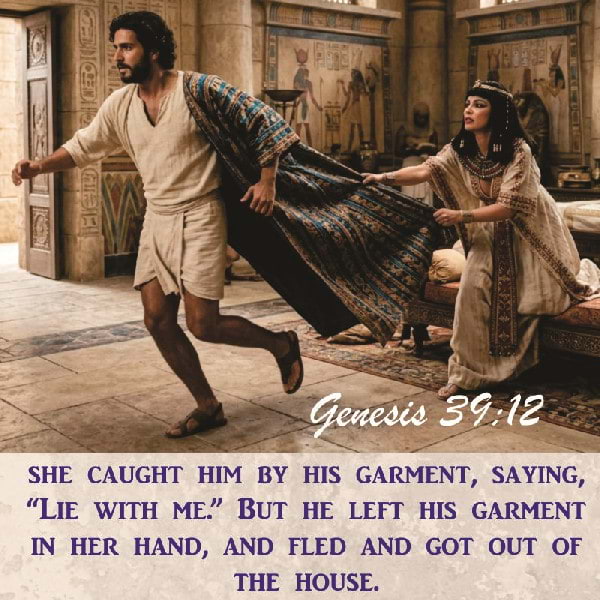
WHEN OUR HOPES ARE DASHED
I believe that when Joseph interpreted the dreams of the cupbearer and the baker that night, he went to sleep already imagining what it would be like to see his father again, to embrace him, weep with him, and tell him everything that had happened; he was filled with hope and expectation.
But the whole day passed, another night fell, and there was no news from the jailer regarding his release. He unrolled his bedding, thinking, "Perhaps today was just too busy. Tomorrow the cupbearer will mention my situation to Pharaoh." Yet the next day came and went without any word about Joseph's release. Perhaps Joseph asked the jailer, "Have you heard anything about my situation yet?" "No, nothing yet. Not a word." A week passed, then a month. Joseph’s high hopes gradually faded and finally vanished when he realized: "The cupbearer has forgotten me." Joseph went from great hope to a complete absence of hope, save for God. This story teaches us how...
- GOD uses disappointments to lead His servants to the place where their only hope is in Him.
- Trusting solely in God is the key to overcoming disappointment and despair.
- If your hope is in God, you will not focus on self-pity, but on serving Him by serving others.
- If your hope is in God, you will maintain a positive attitude rather than a cynical one.
God is always sovereign, even when it seems He has forgotten you. Clearly, God was sovereign over all these events, even the petty squabbles of a pagan king. He placed those two men in the same prison as Joseph. He gave them their dreams. And although the timing seemed wrong, as if He had "wasted" two years of Joseph's life, God gave Pharaoh his dream at precisely the right moment.
God’s promises are fulfilled in His time, not ours. If Joseph had been released at that moment, he never would have been appointed second-in-command, right after Pharaoh. God’s way and timing were clearly the best, even though Joseph had to accept this by faith until years later, when he could look back and see how God had worked everything together for good.
Genesis 39:21

Joseph was faithful to his vision. His life proves that a vision drives people away from sin (Pr 29:18). Because he believed in what God had shown him, he remained firmly faithful and loyal in all his relationships, especially with God.
People who are faithful to God's project will enjoy the willingness of God and neighbor and will be successful in their endeavors. They will receive the reward despite any difficulties they have encountered along the way.
- CLAIM THE GOD'S VISION TO YOU Genesis 37:5-10.
- EXPECT GOD'S FAVOR IN THE NEXT SIGHT. HE GUARANTEES FAVOR AND SUCCESS TO THE FAITHFUL! (Genesis 39:4)
- STAY FAITHFUL TO GOD IN EVERYTHING YOU DO. DO NOT MAKE CONCESSIONS, especially when his vision is slow to be fulfilled (Genesis 39:9).
- BELIEVE GOD IS ENOUGH! He has given you the gifts you need to accomplish your purpose through you (Gen 41:14, 57).
Trust in the sovereign providence of God! He makes all things obey for your benefit when you STAY FAITHFUL to your calling and purpose (Gen. 45:7).
God can speak to us today through dreams, just as He did in Joseph's time. But we need to be balanced in our approach because many of our dreams are not from God. I know people who have dreams every week, and they are silly dreams and people go to websites on the internet looking for what it means and to be a good thing they are anxious waiting to happen. If it is something bad, they are afraid! So it really does not work with a dream of God. We need to be balanced in our approach because many of our dreams are not spiritual. If God is trying to show you something or speak to you through a dream, I believe He will confirm it in your heart if you ask Him for wisdom, use discernment, and stay in tune with His Word and God also explains the meaning to you. Because that is His Purpose.
Genesis 41:9-12
The Lord says: "Those who honor Me, I will honor" (1 Sam. 2:30). Joseph had honored the Lord both in Potiphar's house and in prison. Now, the Lord greatly honored Joseph. And Joseph, in turn, continued to make it a point to honor the Lord in four ways that we should imitate:
1- Honor God by remembering that He is the source of all success
These human factors make Joseph's first words to Pharaoh even more impressive. When Pharaoh says, "I have heard that you know how to interpret dreams," it would have been easy for Joseph to reply, "Oh, it is nothing special. Just a little pastime I developed over the years". But instead, Joseph boldly tells this pagan king: "It is not in me; God will give Pharaoh a favorable answer" (v 16). Joseph was clear about the source of his success. He did not allow the splendor of Pharaoh and his palace to make him forget: "Without God, I am nothing. He is the source of all my ability to interpret dreams".
2- Honor God by testifying to how He empowers you in everything you do. There is a danger that, as a Christian in a pagan culture, people might consider you a good person and attribute your goodness to yourself rather than to God.
3- Honor God by testifying to His sovereignty over all things
Three times (vs 25, 28, 32), Joseph tells Pharaoh that God has determined what will happen and that it will come to pass because God has decreed it.
4- Honor God in your family life
Pharaoh elevated Joseph to the most important position in the kingdom so he could oversee preparations for the famine, and gave him an Egyptian name (the meaning of which is uncertain) and an Egyptian wife. In this process, it would have been easy for Joseph to forget God's promises to his ancestors and... fully integrate into the comfortable Egyptian lifestyle he now enjoyed. When his two sons were born, Joseph gave them names that bore witness to God's faithfulness. Manasseh means "forgetfulness", symbolizing that God had made him forget the pain of his youth. Ephraim means "doubly fruitful", testifying that God had made Joseph fruitful in the land of his affliction.
Genesis 41:33-36
Pharaoh's dream was, in fact, a revelation from God. He received it but could not understand it. He was like someone who reads the Bible but needs the help of a man or woman of God to understand it.
The dream came to Pharaoh twice because the matter had already been decided by God; Joseph saw God's confirmation in the repetition of the dream.
Pharaoh should now look for a discerning and wise man: Up to this point, Joseph had imparted knowledge to Pharaoh, telling him what would happen as revealed in the dreams which were a message from God. Now, Joseph began to apply wisdom to that knowledge.
1- There is an important difference between knowledge and wisdom. Knowledge tells us what is happening; wisdom tells us what to do about it. Knowledge is the diagnosis; wisdom is directed toward the cure. Knowledge is good and necessary, but it is not enough.
2- The world possesses far more knowledge than wisdom. Scientists, poets, politicians, and everyone else today can often see what the problems are. True wisdom sees that Jesus Christ is the answer.
Pharaoh must also appoint overseers to collect one-fifth of Egypt's harvest during the seven years of plenty: In his God-given wisdom, Joseph saw that this looming crisis required proper administration. One-fifth represents a 20% tax. Some ancient sources suggest that Pharaoh normally took 10% of Egypt's grain as tax. If this is true, then Joseph proposed doubling the taxes for the next seven years.
So Pharaoh asked them, "Can we find anyone like this man, in whom is the divine spirit?" This man, in whom is the divine spirit: Pharaoh had access to many priests, magicians, and holy men. What he lacked (until Joseph) was a man with the divine spirit. This is what made Joseph stand out from the rest. Joseph did not need to preach a sermon or lead a prayer for Pharaoh to see the divine spirit upon him. He could see it in his character, his message, his knowledge, his wisdom, and his humility.
Genesis 41:42-45
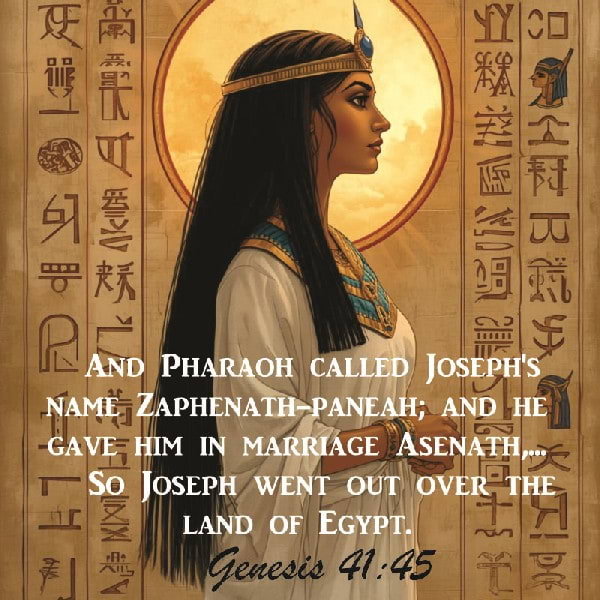
When God moves the pieces to change our lives, it happens in the blink of an eye, in an instant. One day Joseph was a slave in prison; the next, he was elevated to prime minister of the leading country of that time. Is not that incredible?
To symbolize Joseph's new office, Pharaoh gave him the ring he wore (v. 42) which bore the seal of authority and clothed him in fine linen garments, and placed a gold chain around his neck. He gave him a chariot (v. 43) in which he rode publicly, accompanied by a proclamation that the people should honor him. Next, Pharaoh changed his name to Zaphenath-Paneah, which means "Abundance of Life" or "The God Speaks and Lives." Just as Hagar, in the desert, named the place of her encounter with an angel "Beer-Lahai-Roi", "I have seen the God who lives and sees me", Pharaoh acknowledged the presence of the LIVING and active God. When God works in my life and yours, even the most skeptical person glorifies this God of power.
Finally, Joseph married a young woman from a high-ranking family in the priestly city of On (v. 45). The Greeks called this city Heliopolis; it remains a suburb of modern-day Cairo. The young woman's name was Asenath, meaning "one belonging to the goddess Neith". Joseph was thrust into close contact with Egyptian paganism, yet he was not overcome by it. When a Christian is faithful to God, it does not matter where they are. Consider this: all the decisions were made by Pharaoh, they were not choices Joseph himself had made. Perhaps he simply wanted the freedom to return home, even after suffering in Egypt for thirteen years. Yet, the one who walks in close relationship with God knows that our lives are in His hands, and everything that happens to us, even the bad parts, serves as a lesson in God’s teaching. So, in good times, stay with God; in difficult times, stay with God. God is good all the time.
To resume: Joseph, whom Jacob believed to be dead, had been promoted to the second-highest position in Egypt after years in prison. He was responsible for the plan to store grain during the years of plenty and distribute it during the years of famine. Famine had spread across Canaan, so Jacob sent his other ten sons (excluding Benjamin) to Egypt to buy grain. They appeared before Joseph and did not recognize him in his Egyptian guise after twenty-two years, though he recognized them. He treated them harshly, accused them of being spies, and detained Simeon until the others could return with their youngest brother, Benjamin, to prove their honesty. Throughout this, Joseph was testing his brothers to gauge the state of their hearts and lead them to repentance.
On the journey home, one of the brothers opened his sack to feed his donkey and discovered that the money used to pay for the grain had been returned. The brothers feared being accused of theft when they returned to free Simeon and buy more grain. Yet, for the first time, they also recognized God's hand in their lives and exclaimed, "What is this that God has done to us?"
They returned home and told Jacob everything. As they finished recounting the story and emptying their sacks, they discovered to their horror that not just one, but everyone's money had been returned. It was at this moment that Jacob lamented his own version of Murphy's Law: "All this is against me". It was as if he had cried out "Worst-Case Scenario", saying: "Yes, Joseph is dead, Simeon is dead, and Benjamin is going to die too!"
At that moment, Reuben intervened and made an extreme proposal: he would take responsibility for Benjamin; If he does not bring him back, Jacob might kill two of Reuben’s sons. It is an absurd proposal, but Reuben had long been in his father’s bad graces and was trying to change that.
When we face a situation where everything is going wrong, we should ask ourselves: "Is God in this?" (Hebrews 11:6) You need to make the deliberate choice to trust in the invisible God.
Genesis 42:36
What should you do when it seems like everything is against you? The answer is: You should do the opposite of what Jacob did. When things seem to be against you, do not play the victim as Jacob did in verse 43:6: "Why did you treat me so ill as to tell the man that you had another brother?" He blamed his sons for answering Joseph’s questions, almost as if he expected them to have guessed what would happen.
TRUST THAT GOD IS ON YOUR SIDE. As we have seen throughout this story, God’s hand was always at work behind the scenes. It was God who sent Joseph to Egypt. It was God who placed him in Potiphar’s house and later in prison. It was God who sent the baker and the cupbearer to prison with Joseph and gave them the dreams that he interpreted. It was God who gave Pharaoh the dreams and gave Joseph the interpretation, enabling him to rise to the position of second-in-command in Egypt. It was God who was behind all the situations Jacob faced. Even without understanding why God was doing all of that, Jacob needed to trust in the sovereign and loving hand of the God who had promised to bless him.
(1) Are you ruled by irrational fears? Jacob was ruled by the fear of losing Benjamin.
(2) Do you have a negative and pessimistic attitude? As we have seen, Jacob was pessimistic about his past (42:36) and his future (42:38).
(3) Are you self-centered? The Hebrew text of 42:36 reveals Jacob’s focus on himself: "You have deprived me... all these things are against me."
(4) Are you blaming others for your problems? Jacob blames his sons for depriving him of Joseph and Simeon, and then of Benjamin (42:36).
(5) Are you yielding reluctantly because you have to? Jacob finally says, "If it must be so, then..." (43:11). He is reluctantly yielding to what needs to be done, but his heart is not in it.
Paul expressed the kind of active faith in God that we ought to have when he wrote regarding trials: "We know that God works in all things for the good of those who love him, of those who have been called according to his purpose... If God is for us, who can be against us?"
TRUST! GOD IS WORKING ON YOUR BEHALF.
THE POWER OF RECONCILIATION
Here, the test Joseph devised for his brothers to see if their behavior had changed, comes to an end. To resume, he observed that:
1- They brought Benjamin back, just as they had promised.
2- They returned the money found inside their sacks, proving they were not greedy like they had been when they sold Joseph for twenty pieces of silver; they were acting as honest men.
3- They pleaded for Benjamin’s freedom. Joseph wanted to see their attitude toward their brother whether they would abandon him as they had abandoned him.
Judah poured out his soul before the official in a plea worthy of a literary masterpiece. For Joseph, the change he saw in Judah came as a surprise. It was Judah who had instigated the sale of Joseph, yet now he was willing to become a slave in Benjamin’s place.
Overcome with emotion, Joseph ordered everyone to leave the room and, to everyone's astonishment, began to weep aloud. His heart, once full of doubt, was now satisfied; his brothers were no longer the callous men who had sold him into slavery.
Then, casting aside his royal dignity, he embraced his brother Benjamin, and together they wept. He did the same with each of his brothers (v. 15), and only then did they speak with him.
The path to full reconciliation was arduous for both Joseph and his brothers. The brothers had to face their guilt, confess their sins (42:21–22), and acknowledge that God was chastening them (42:28). They had to plead for mercy (44:27–32) and demonstrate that they had changed (44:33–34). For Joseph, too, the process of validation was painful. The results of forgiveness and reconciliation were already visible. An abundance of food was available at no cost. Jacob’s life was spared thanks to Benjamin’s return and the news that Joseph was alive. Family unity was restored, and a sense of liberation from guilt and fear was evident.
Joseph shows us the key to reconciliation with those who have deeply hurt us, whether they are family members or friends.
THE NEW HOME IN EGYPT
Despite the news that Joseph was in Egypt, it was not easy for Jacob to leave Canaan, for it was the Promised Land. Jacob lived in Hebron (37:14). Upon learning that Joseph was alive and a high-ranking official in Egypt, Jacob set out for there.
While traveling toward Beersheba, Jacob offered sacrifices and worshipped the Lord. Although there is no clear record of him praying for guidance and protection, it is possible he used that moment to seek God's direction and approval. God’s answer came at nightfall, and the word was positive: DO NOT FEAR GOING DOWN TO EGYPT (v. 3). The message also contained promises. Jacob’s family would become a great nation. God would bring them back and always be with them; and Joseph would lay his hand upon Jacob’s eyes meaning he would be present at the time of Jacob’s death.
Jacob rose from that place with all his doubts resolved. Everything and everyone connected to Jacob journeyed to Egypt and soon reached the border.
They settled in the land of Goshen. God’s purpose was to preserve the patriarch’s family as a unit, separating it from the spiritual decay, immorality, and idolatry of the Canaanites and Egyptians. The Egyptians were different, so intermarriage and idolatry would not hold the same strong allure as they did in Canaan.
Like Jacob, whenever changes arise in our lives, we need to seek God’s guidance. What you need, above all, is to be sensitive to the living God and to listen to Him. By "listening to God," I do not mean hearing an audible voice. God does that so rarely that you should not expect it. But if you walk close to the Lord, seek godly counsel, and apply the wisdom of God’s Word in prayer and reliance on His Spirit, He will often give you a strong intuition as to whether an action comes from Him or not. Fasting can be useful when considering an important decision. Therefore, you should seek not only God’s will but God Himself. Keep your emotions in check and seek the Lord Himself.
PROSPERITY IN GOSHEN
"Thus Israel dwelt in the land of Egypt, in the land of Goshen; and they gained possessions in it, and were fruitful and multiplied exceedingly."
The opening verse sets a scene of blessing and prosperity. The people of Israel, the family of Jacob did not merely survive; they flourished in Goshen. They "acquired property," "were fruitful," and "multiplied exceedingly." This is a clear demonstration of God's faithfulness in fulfilling His promises. The covenant made with Abraham—that his descendants would be as numerous as the stars in the sky (Genesis 15:5) was visibly coming to pass, even on foreign soil.
It is important to note that God's blessing is not restricted to a specific geographical location. He can sustain and cause His people to prosper in any circumstance, whether in the Promised Land or in the "Egypt" of our own lives. Goshen was a providential refuge, an oasis prepared by God. Yet, the text subtly reminds us that they were "in the land of Egypt." It was a place of blessing, but it was not their ultimate home.
In verse 29, Jacob asks Joseph: "DO NOT BURY ME IN EGYPT." Why this request?
1- It was an act of faith: Jacob believed unshakeably in God's promise that the land of Canaan would belong to his descendants.
2- It was a declaration of identity: Jacob did not view himself as an Egyptian, but as an heir to the promise.
3- It was a silent prophecy: By insisting on being taken back to Canaan, Jacob was prophesying the future Exodus. He was teaching his children and grandchildren that they, too, should one day leave Egypt and return to their inheritance.
SPIRITUAL LESSONS:
Living as pilgrims and strangers
Jacob teaches us that it is possible to be blessed in the "Egypt" of this world without allowing our hearts to become attached to it. We are called to live as "pilgrims and strangers" (1 Peter 2:11).
The story of Jacob’s final wish is much more than a sentimental account of an elderly father. It is a powerful illustration of faith that perseveres to the end. Jacob, the man who wrestled with God and with men and prevailed, ends his journey not with a display of strength, but with an act of total dependence on and worship of God.
It is so good to pause for a moment, look back, and see the ways God has guided you. I just want to encourage you to do that today. Just take a minute or two to pause and thank God for the specific ways He has guided your life... and view your life story as His story, the story of Him as your Shepherd.
Now, he looks to the future and blesses Joseph’s sons. He prays essentially the same thing for them: that the God who shepherded him would shepherd them as well. What a wonderful way to pray for the next generation! As you read verse 16, think of your children and reflect: "O God, please shepherd them. May You guide, direct, and protect them; provide for them; and show them Your promises again and again, so that they see You, know You, and love You as their Shepherd." Praying like this for the next generation, praying this way for people so we might lead them to Jesus, simply praying that God would shepherd them in this way.
Genesis 48:15-16 teaches us to trust God as our Shepherd.
In Jacob’s blessing, he testified of "the Angel who has redeemed me from all evil". This is the first time the word "redeem" in the sense of a kinsman-redeemer appears in Scripture. It is based on the obligation of a family member to buy back a relative's mortgaged property or to redeem the relative himself from slavery (Leviticus 25:25–55).
Jacob realized that his dishonesty with Esau and his struggles with Laban were evils that had threatened to ensnare him. But God helped him set things right with Laban and reconcile with his brother Esau. God also delivered him from the wayward paths of his older sons and restored Joseph to him. God’s actions filled his heart with hope and joy. For Jacob, these events were redemptive, for he owed everything to what God had done on his behalf. The One who had acted in the past would bless his grandchildren as well.
Jacob’s blessings were prophecies regarding his sons' lives. We might ask, then, what the purpose of these prophecies was, given that Jacob’s sons did not live long enough to see it all come to pass? They all died in Egypt. So why did Jacob address these words to them? The text offers some clues: Verse 28 states that these were blessings suited to each individual. Furthermore, verse 1 indicates that these blessings were predictions of what would happen to each son in the future, implying events that would unfold beyond their own lifetimes.
We have already seen how the prophecies concerning Reuben, Simeon, and Levi were linked to sins they had failed to overcome. The name Judah means "praise," and Jacob predicts that his brothers will praise him. Zebulun means "dwelling", and he would dwell near the sea. Issachar means "wages"; the prophecy concerning him relates to his labor. Dan means "judge"; he would judge his people. Gad sounds like a Hebrew word for "troop" or "raiders"; four of the six Hebrew words in verse 19 are plays on his name.
Remember, for the Hebrews, names held great significance. They were often given as prophecies or expressions of hope for a child's future. Here, alongside his observations about each son, Jacob is granted prophetic insight by the Holy Spirit regarding the direction in which each son's character would lead his respective tribe. Thus, Jacob’s sons should have learned that character shapes destiny, not only for ourselves but also for our descendants.
It is worth noting that Judah, despite the mistakes he had made, received a greater blessing than Joseph. This illustrated that God’s choice is made according to His grace, not based on human merit. But God’s choice is made independently of human merit, so that no one may boast before God. One final reason why Moses shared these prophecies with his readers was to instill in them the hope of God’s salvation through the Messiah. One would arise from the tribe of Judah, and the people would obey Him. Even though great men might come from certain tribes and accomplish great deeds, true deliverance would come only from the Lord.